Search This Blog

Friday, March 21, 2014

Spring Cleaning the Forest

Our home-owner's insurance policy was recently canceled because "you no longer meet our underwriting requirements, due to being located in a wildfire area".  Well duh.  I thought they understood that when they first issued the policy.

Because the insurer cancelled my home-owner's policy, I also cancelled the RV, Motorbikes, and cars.  They don't get to pick and choose what property of mine they get to insure.  They also saved me some money, because I found cheaper rates with a different insurance company (Geico).

Anyway... this is the second time that we have owned property.  The first property we owned was 2-1/2 acres in the Mojave Desert.  That property didn't require any maintenance.  Even tumbleweeds would blow right across the land because it was not fenced on the downwind side. 

Now that we are living in the forest, things require a lot more upkeep.  The insurance cancellation brought the realization that we have been here for two years now, and I haven't yet created a satisfactory fire-safe zone around the house and shop.  We have been busy getting the interior of the house set up, and ignored the grounds.

There is a lot of hard work involved with creating a fire-safe zone.  The  recommended minimum distance between a structure and any tree is 25 feet, with the forest thinned (and undergrowth removed) to a distance of 50 feet, with all tree branches removed to a level of 6 feet.

Personally I think 50 feet is a good radius for no trees.  I don't want the possibility a burning tree just 25 feet from my house.  Actually I don't want any tree close enough to fall onto the house.  Although two sides of our house have excellent clearance, I still have quite a bit of removal and thinning to do on the remaining sides.

This is an excellent time of year to clean up, because the forest is very wet, so it's safe to burn.  It's quite difficult to get a pile of twigs, branches and logs to catch fire.  Both times I burned, it took a full gallon of gasoline (and some diesel) to get the pile to stay lit.  This means that the forest won't catch fire whenever a spark flies off the fire.  The only bad thing is that downed trees located in the shade are often still frozen to the ground :)

This past week I got started on the process of making the house fire-safe by removing several years worth of fallen dead trees.  I have owned a 18" McCullouch MacCat chainsaw for the past 20 years, and it has served pretty well for odd pruning jobs and taking down small trees.  The first time I used it to gather soft wood for the fireplace, it proved not to be up to the task.  It doesn't have the power or the cutting ability to quickly get through a bigger log.  This past week I damaged the blade by forcing the saw into a log, and I realized that with this level of work, I needed a bigger, professional saw.

So... This year I got an early birthday present:  A Stihl MS 362.  This sucker comes with a 25" bar, but it is powerful enough to run a 36" bar.  It is amazing how quickly and easily it cuts compared to the MacCat.  This thing goes through logs like they aren't there.  Instead of spending minutes getting a log cut, it's over with in seconds.  It definitely makes the job easier. 

I also bought a skip-tooth chain to try out aggressive cuts, but haven't tried it out yet.  A skip-tooth chain makes kickback more severe, so I want to get used to the saw before putting on that chain.  Kickback is where the blade pops up after grabbing and releasing in a cut, or getting caught in wiry ground branches, especially at lower engine speeds. 

With the new saw, I can round up a lot of trash wood and a few chunks of firewood in short order.  Note:  This is not a lifted SoCal poser truck with chrome and aluminum hardware underneath.  I also don't cry like a girl when it gets a dent or scratch. 

Lodgepole pine - crabgrass tree of the forest.  Not even worth cutting up for firewood.


Saturday, March 01, 2014

Compressor Destruction :(

I have always been amazed by how quickly and destructively large powerful machines can fail.  I happened upon some pictures recently of an Industrial Combustion Turbine failure, brought on by icing.  The other type of combustion turbine is aero, like you might find on an aircraft.  Industrial (or "Frame") turbines are quite heavy and cannot be flown.

A gas turbine consists of three sections:  Compressor, Combustor, and Turbine.  At the inlet of the compressor, air pressure is reduced because the compressor is sucking air in.  This inlet pressure drop also causes a slight temperature drop, which is how this turbine's problem began.

Take a look at this video of an aircraft testing an aero turbofan engine.  You can see water vapor entering the engine.   This water vapor appears because the drop in pressure (a.k.a. suction) at the compressor inlet is also causing air temperature to drop.  The temperature is falling below the dewpoint - that is, moisure present in the air is condensing suddenly due to the drop in temperature.  Those swirls are condensing water vapor entering the engine.


Certain weather conditions, however, will cause moisture in the air to change from harmless vapor to ice.  Relative humidity must be high, ambient temperature has to be near the dew point, and temperature has to be near or below freezing.  Remember that air temperature drops as it enters the compressor, so the temperature doesn't have to be 32 degrees.  Inlet icing can occur with ambient temperatures as high as 38 degrees.

Icing is only an issue for the first row of compressor blades, because they are the coldest ones.  Water vapor can form, and freeze to the blades, if they are cold enough.   Icing is not a problem further inside the compressor, because as the air pressure increases, the air temperature also increases.   In fact, at the discharge of the compressor of a stationary gas turbine, the air temperature is about 700 degrees F. 

If necessary, a portion of this 700 degree air can be "bled off", and brought forward to the inlet.  This raises the inlet temperature just enough to prevent ice from forming. This is called the Inlet Bleed Heat system.  You take a small hit on engine output, but it definitley beats scrapping the engine.

Gas Turbine compressors are designed using complex fluid dynamics calculations to maximize airflow.  Maximizing airflow requires minimizing vortex formation, and minimizing interstage air leakage along the shaft and casing.  Thus everything inside is machined with very fine clearances for high efficiency.  For these reasons the blades are machined with pretty tight tolerances, and normally the airflow in the machine is in line with what the software calculated.

Inlet icing throws all that fluid modeling out the window, because if the blades are covered in ice, airflow will be erratic.   

This machine may have experienced ice buildup on the stationary compressor blades in the first row. The ice caused the air to flow unevenly onto the the rotating blades.  Each time a rotating blade passed a stationary blade with ice on it, turbulent/uneven airflow would cause a rocking motion as the rotating blade was buffeted by varying amounts of air.  This would actually be a very high speed vibration, since the rotor spins at 60 times per second.  The vibration created metal fatigue at the base of the blade (like bending a coat hangar over and over until it snaps in two) and eventually the blade came loose from the rotor. 

With the rotor spinning at 60 revolutions per second, the blade had plenty of centrifugal (centripetal) stress to shear it off, once the base had gathered enough cyclical fatigue to create a crack.

What followed after the compressor blade released compounded the failure.  It was pulled through the machine by the air stream and impacted most (perhaps all) of the other blades.  What a mess.  Moral of the story:  Don't allow the inlet to ice up.

Below: A new, clean compressor.  Inlet to the left side, discharge is near the circular flange to the right.


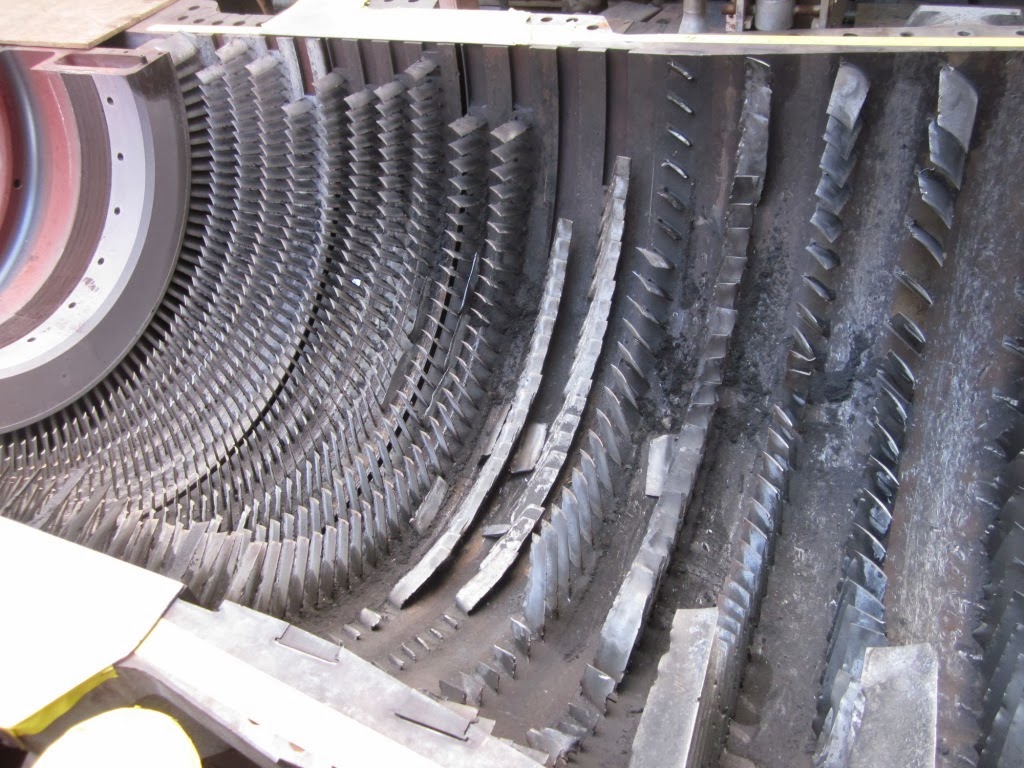
Below:  A severely damaged compressor.  It appears that all of this damage was caused by a single blade passing through the compressor.  (Inlet is to the left side, so the loose blade came from that row).  None of the blades on this rotor escaped harm.  It is not clear if the combustor section or turbine section were also damaged.

 
With the rotor removed, you can see that most of the stationary blades are also damaged.  The case will undoubtedly need some repairs as well.  Sad sad stuff here.

Sunday, February 23, 2014

Slick android launcher

One of the cool things about android devices is how you can change the interface.  I recently came across a cool new app called the "Next 3D Launcher", which I have installed and am still learning.

In this video the phone starts out with a typical android interface, then moves to the Next Launcher, where every swipe moves the screen in 3D.  Slick!


Friday, February 21, 2014

Rooting the Android Phone

I like to dabble with technology.  I've built the last several computers that I have owned, and managed to troubleshoot them and make repairs when things conked out.

I used Blackberry phones for several years, but recently decided that it was time to own a phone with a bigger display and more options.  A year or so ago, I bought a Droid Razr Maxx HD.  I chose that particular phone because it has a massive 3300 milliamp hour battery.  I wasn't keen on having to recharge a phone more often than once per day.  I have now had the phone for about a year, and found it to be pretty useful and also very robust.


I spend a lot of time reading techie websites like Ars Technica, and learned a little about "rooting" Android phones.  I never gave rooting my phone much thought (it seemed risky), but for one reason or another I recently decided to try it.  The idea I might turn my phone into an expensive paperweight didn't seem too awful now that it's a year old.  Turning the phone into a brick was definitely a possibility, because I am not any kind of hacker.

This past week I set out to root my phone, but it wasn't nearly as easy as I had been led to believe.  I had done a lot of reading about it, and watched several videos of people rooting their phones.  It all seemed very simple:  Download the exploit script, set up your phone to accept it, then run the script.  Rooting android phones requires using an exploit to trick the phone into thinking a developer is debugging it, then installing a different file for the phone to read when you re-start it.

There were three tools I tried to use, and they all failed.  All the videos I watched and all the information I read was valid for an older version of Android.  My wireless carrier recently updated the version of the Android Operating System that my phone uses.  This update locked the phone bootloader, which prevented the exploit from loading the file that would grant root access.

Finally after a lot of additional searching, I located an exploit that claimed to work on the Samsung Galaxy 3, and "should work" on all other droid devices.  I took a gamble and used that exploit, called "Saferoot", and three days of failure and stumbling around the internet finally paid off!  I managed to root the phone and get "Superuser access".

"Yeah whatever", you are probably thinking. 

Well there are some *very* cool things you can do when you have root access. 

Without rooting your phone, when you install an app, you either have to accept all the permissions that it requires, or do without the app.  Why would a simple flashlight app need access to my contacts list?

With root access, you can install Titanium Backup, which allows you to make a backup image of your phone, freeze apps, and most importantly, deny them permissions that you don't want them to have.

You can install Cyanogenmod, an open-source operating system that contains no bloatware apps and due to the transparency of open-source software, is free of spyware.


You can install AdFree, which mostly eliminates ads from showing up on your phone, by blocking data requests to known advertising hosts.  Interestingly Google removed this app from the Google Play Store a year ago.  It was probably getting between advertisers and a big pile of cash, and they weren't happy about that.  To install this app, you have to sideload it by downloading the .apk file onto your PC, and then installing it into your phone, then activating it from a file manager. 

You can install Permissions Denied, which, Like Titanium Backup, allows you (the owner of the phone) to restrict permissions that apps request.
 

The TOR browser app for android (known as Orbot) can also take advantage of root access, although it also works without it.  This allows a user to use the web anonymously.

Needless to say, rooting your phone is very much frowned upon by the government and also by your wireless carrier, which are both excellent reasons to do it!  Also, bear in mind that it is your phone, not theirs.  As with anything that belongs to you, you should feel free to do with it as you please.

On a less tech note, I have found a use for used toilet paper tubes, which helps make life a little less cluttered.  Lots of loose and frequently tangled-up USB and earbud cables now have a home.

Thursday, February 06, 2014

K-141, Project 949A. Kursk [АПЛ "Курск"] Oscar II Class

The loss of the Kursk is recent enough that it probably doesn't need to be retold here, but I will do so anyway, in remembrance of the men lost.

Kursk was an Oscar II class submarine, and the last submarine built in the Soviet era.  Construction began in 1990, and by the time she was completed and launched in 1994, the cold war had ended.

The Oscar II class were the largest attack submarines ever built, running about 500ft long, and 60 feet wide.  When viewed in cross-section, the inner hull of the Oscar II class was circular, while the outer hull was oval-shaped.  This oval-shaped outer hull gave the Oscar II ships the appearance of being fat.  Between the inner and outer hulls were missile tubes containing 24 anti-ship missiles, as well as air banks.

Below:  Oscar II submarines in port.  They look a little chubby compared to other subs.


Kursk in port.

Below:  The reason Oscar Class submarines look "fat".   Lots of anti-surface ship firepower.


 Profile of an Oscar II Class submarine


After the collapse of the Soviet Union, the sailors of the Northern Fleet were intermittently paid, and little money was available for repair and maintenance of the fleet.  Kursk only made a single patrol between her launching in 1994 and her loss in 2000.  With the lack of sea-time, it is probable that her crew was not well-trained, and certainly not proficient.  It's not clear whether a well-trained and proficient crew would have altered the outcome, however.

On August 12, 2000, Kursk was participating in the largest Russian Naval exercise in 9 years, following the collapse of the Soviet Union.  Three other submarines, the Russian flagship battlecruiser "Petr Velikiy" (Peter the Great) were participating, along with a flotilla of smaller vessels.

Kursk was preparing to fire a dummy torpedo at the battlecruiser Petr Velikiy, when an explosion occured.  The accepted theory is that the highly concentrated HTP (High-Test Peroxide) hydrogen peroxide which fueled the torpedo leaked out and reacted, causing the torpedo engine to detonate, starting a fire.

A similar explosion caused by an HTP-fuelled torpedo was responsible for the loss of HMS Sidon in 1955, after which the British Navy abandoned torpedoes propelled by peroxide.

This first explosion was recorded on the SOSUS network, and was estimated to have an explosive force of 220-550lb TNT.  A second, larger explosion measuring 6000-14000 lbs of TNT occured 135 seconds after the first explosion.  Kursk came to rest in just 350 feet of water.

Rescue offers were made immediately by US, British, and Norwegian teams, but these offers were rebuffed by the Russian Navy.  It was believed at the time that there were no survivors from the initial explosion.

I will turn the saddest part of this sinking over to Wikipedia:

Captain Lieutenant Dmitriy Kolesnikov, one of the survivors of the first explosion, survived in the ninth compartment in the turbine room at the stern of the boat after explosions destroyed compartments 1-5. Recovery workers found notes on his body. They showed 23 sailors (out of 118 aboard) had managed to enter compartment nine after the ship sank.

There has been much debate over how long the sailors might have survived. Some point out that many potassium superoxide chemical cartridges, used to absorb carbon dioxide and chemically release oxygen to enable survival, were found used when the craft was recovered, suggesting some of the crew survived for a significant time.

Kolesnikov's last note has a time of 15:15, indicating that he and the others in the aft compartment lived at least four hours after the explosion.   32 hours after the first explosion no sound was heard (i.e. hull tapping) to signal the Russian Submarine Rescue Vehicle Priz, when it attempted to mate with the aft escape trunk. 

The oxygen generator cartridges appear to have been the cause of death; a sailor appears to have accidentally brought a cartridge in contact with the sea water, causing a chemical reaction and a flash fire. The official investigation into the disaster showed some men appeared to have survived the fire by plunging under the water.  Fire marks on the walls indicate the water was at waist level in the lower area at this time.  However, the fire rapidly used up the remaining oxygen in the air, causing death by asphyxiation.

In July 2002, the investigation committee concluded that a technical malfunction on a single Type 65-76 "Kit" (Whale) torpedo caused the first explosion, triggering a fire in the torpedo room which, two minutes later, caused 5-7 additional torpedo warheads to detonate.

The second explosion destroyed a large section of the submarine (at least 4 of the 9 compartments) killing up to 95 of the 118 crew members and causing the submarine to sink. Around 23 crew members survived the sinking and took refuge in the ninth compartment where they died due to carbon monoxide poisoning following a fire in that compartment (between 6 and 32 hours after the sinking).

Kursk was raised from the ocean floor in a difficult and expensive recovery project.  Her bow was an unrecoverable mess and was cut off, using carbide coated cables.  She was re-floated and returned to Russia, where her two reactors were decomissioned, and her side missiles were removed.  Those of her 118 crew that were recovered were buried with honors.

Wednesday, February 05, 2014

K-278 Komsomelets (Project 685 Плавник), Mike Class

K-278 was a unique and magnificent submarine.  Only one of this class of ship was built.  Because she was so unusual, construction took an unusually long 5 years.  Her construction began in April 1978, she was launched in May 1983, and commissioned on the last day of 1984.  The Soviet Navy rarely named their submarines, but this ship was special, and received the name of "Komsomelets" - which means "a member of the Young Communist League".

Sunday, February 02, 2014

K-219 (Project 667A)

K-219 was a Soviet ballistic missile submarine.  She was a Yankee I class ship, which carried sixteen liquid-fueled nuclear missiles for use against land targets in the US.  The ship was propelled by two PWR reactors, and had two propellor shafts.

On a side note, the Soviet Navy gets credit for envisioning and building the first submarine to carry an ICBM, the Zulu Class submarine.  The Zulu was a conventional diesel-electric submarine that was modified with an extended sail to carry a single nuclear-tipped long-range missile.  It was also the first submarine to test launch a ballistic missile.

Saturday, February 01, 2014

K-431 (Project 675)

K-431 was an Echo II class submarine.  Construction was started in January 1964, and she was commissioned in September of 1965, in a very rapid construction process.  The Echo II class was a twin reactor ship which carried cruise missiles for attacking surface ships.  Not very pretty.


Thursday, January 30, 2014

K-8, Project 627 (проект 627)

November-Class submarine.  Source: Wikipedia

K-8 was a November-Class Soviet submarine.  The November class was the first class of Soviet nuclear attack submarines.  This class of submarines suffered from reliability problems related to the ships' steam generators.  The steam generators in these early nuclear ships frequently developed leaks. 

Leakage from a steam generator tube allows very radioactive primary coolant to exit the reactor coolant loop and enter the non-radioactive steam cycle loop.  This radioactivity, depending on the size and duration of the leak, can be hazardous to the crew.   With the November Class' dual reactor design, it would seem feasible to shut a damaged reactor down, reduce the primary system pressure, and limp home.

K-8 developed steam generator leaks on three separate occasions.  On one occasion however, the steam generator leak was so severe that one reactor experienced a Loss of Coolant Accident.  The crew struggled to make repairs and to refill the primary coolant loop in order to prevent a core meltdown due to decay heat.  Several of the crew received significant doses of radiation as well as radiation burns.

The end for K-8 came in a more mundane way however.  In April of 1970, while operating at a depth of 400ft, a short circuit caused a fire, which spread to two compartments via the ventilation system.  Both reactors were shutdown, and the captain ordered the ship abandoned.  Things must have been hellish inside. 

Fortunately, K-8 was part of a Soviet fleet exercise when the fire occurred, so help was nearby.  A surface vessel was dispatched to tow her back to port for repairs.

Disabled submarines are difficult to keep afloat (even next to a pier), and the reason is this:  Most of the ship is already submerged.  This is partly due to the thickness of the pressure hull, but also the ship is designed to be pretty close to neutral bouyancy.  When the main ballast tanks are full of air, a submarine will have positive bouyancy, but not a whole lot of it.

Submarines are not surface ships, so they are designed with round-bottom hulls.  This makes them wallow badly on the surface in heavy seas.  When a submarine pitches and rolls in the waves, air escapes from the main ballast tanks, which are vented at the bottom.  With each wave, a little main ballast tank air spills out, and a little bouyancy is lost. 

This air can be replaced by a couple of means.  The first is a massive low-pressure roots blower that takes air in from a large snorkel mast, and forces water out of the main ballast tanks.  This method only works if electrical power is available.  With both reactors out of service, it is unlikely that the storage battery of K-8 could have supplied the LP blower with electrical power for very long.

The other method for replacing air in the main ballast tanks involves briefly "puffing" them with very high pressure air from the ship's air banks.  I don't know the capacity of the high pressure air banks on this class of ship, but I do know the supply of air was not infinite.  In any case, without having electricity to run a high-pressure air compressor, these would eventually run out of pressure be unable to displace water out of the ballast tanks.

The abandon-ship order of the captain of K-8 was countermanded when the towing vessel arrived. 52 crewmembers, including the captain, re-boarded the ship for the tow back to port.   73 crewmembers were taken aboard the towing vessel.

The ships encountered rough weather.  After 80 hours of heroic but futile damage control, the K-8 flooded.  Sadly, even though ships were nearby, she took 52 men with her, who are now on eternal patrol with her.  

Wednesday, January 29, 2014

K-27, Project 645 (645 Кит-ЖМТ)

The Soviet and US Navies operated a large number of submarines, each generation improving in quality.  A silent covert game of cloak and dagger took place beneath the waves that most people were completely unaware of. 

The Soviets at one time had the largest fleet of submarines in the world.  In many respects, advanced Soviet submarines were superior to their US cold war counterparts.  Several Soviet submarine designs could dive to a greater depth than a standard US MK 48 torpedo!  

US submarines (from the arrival of Thresher) had held the advantage of stealth, and superior sonar equipment.  Soviet submarines, in contrast, held the advantage of survivability (due to double-hull construction and huge amounts of reserve bouyancy), weapon-carrying capacity, greater depth and top speed.

The US experimented with a variety of reactor/propulsion designs, but only one used a liquid-metal cooled reactor:

USS Seawolf (SSN-575) was the second US submarine (after USS Nautilus), and the only US submarine to have a liquid metal cooled reactor.  The reactor was cooled using liquid sodium, which of course would be problematic for the crew if  it ever leaked.  Seawolf also had steam superheaters, for added efficiency.  These were also problematic, and thus were seldom in service.  Because liquid metal is much more efficient than water at removing core heat, the propulsion plant was only 40% the size of Nautilus'.  Seawolf was eventually converted to a more typical S2W pressurized water reactor (PWR) with a saturated steam plant.  PWR and saturated steam plants in US submarine design continues to this day.

The Soviets' emphasis on submarine speed, depth and power of course led to more propulsion designs that used liquid metal cooled reactors.  Soviet reactors of this type used a Lead-Bismuth coolant that was far less hazardous than liquid sodium, at least from a fire hazard standpoint.  From a power-weight (and size) standpoint, the liquid metal cooled reactor is far superior to a light water cooled reactor.  From a safety standpoint, not so great.

Recall that liquid metal cooled reactors are Fast neutron reactors, or sometimes intermediate speed reactors.  All liquid metal cooled reactors have a positive void coefficient of reactivity.  That means that if the coolant inadvertantly boils in the core, reactor power will increase.  Which will boil more metal, and increase power even more.   This happens rapidly, and core damage (meltdown!) is fairly common with this type of reactor.

So with that background, lets talk about the Soviet submarine K-27, or Projekt 645. 

The Soviet's first class of nuclear attack submarines was called the November class.  They used dual 70 Megawatt PWR reactors for propulsion.  13 of these were built before technology allowed creation of superior designs.  Even so, they were superior to the USS Nautilus, in speed, depth, and stealth.  One could also argue that Nautilus was really an experiment to prove that nuclear propulsion could work on a submarine, rather than a true nuclear attack submarine, however, and not be wrong.

Profile of a November-Class Submarine:


Back to K-27.  This was a unique single-ship design by the Soviets, just as Seawolf was for the US Navy.  K-27 was a November-Class submarine with a unique power plant.  Rather than two 70 Megawatt PWRs, the Soviets used two VT-1 liquid metal cooled reactors, with an output of 73 MW. The advantage of smaller footprint and weight of the metal-cooled reactors allowed more weapons to be carried.

She was laid down on June 1958 and launched in April 1962.  She was commissioned October 1963 after full-scale builders sea trials and official tests.  She performed well (although with heavy maintenance for the new metal-cooled reactors) until a reactor accident in the port (left) reactor happened in May 1968.

The ship was making a full speed submerged run, when a reactor automatic control rod withdrew itself.  Boiling occured, and reactor power plummeted from 83% to 7% in about 90 seconds, as the core melted.  Unfortunately for the crew, poor decisions made after the initial accident would cost many of them their lives. 

The main purpose of cladding U-235 in a reactor with Zircaloy or Stainless steel is to keep the highly radioactive freshly split atoms from getting into the coolant and spreading.  When the fuel assemblies melt down, these radioactive atoms mix in the coolant, and get outside the heavily shielded reactor vessel. 

Unknown to the crew, the captain had the radiation alarms disabled.  Radioactive gases were released from the fuel, which the crew were exposed to.  Another captain might have surfaced the ship and ventilated it with the massive air blowers all submarines are equipped with.  The ship limped home on the starboard reactor and was laid up for several years.  Five sailors who worked in the propulsion plant died within a week of the accident, while 30 more died between 1968 and 2003.  Quite a high death rate for a crew of young, healthy men.

K-27 was brought into shipyard, and the starboard reactor coolant was kept liquid by steam piped in at the shipyard while the radioactivity in the port side reactor died down.  In 1973 the decision was made that repairing or replacing the reactor in the aging ship was not worthwhile, and the ship was decomissioned in February 1979.

Her disposal was... interesting.  Rather than remove the melted down mess that remained of the port side reactor, the Soviets decided to fill her reactor compartment with a solidifying agent.  Next they towed her, not out to sea, but very close to land.  In 1982 they sunk her in just 100 ft of water, just offshore of Novaya Zemlya. Google Earth Coordinates Here

She didn't want to sink, however, so they ended up having to ram her.

K-27 refusing to be scuttled: 

There is now a great deal of urgency in re-floating K-27 and removing her radioactive coolant system and fuel.  This is an environmental hazard that will eventually become a serious problem, and quite close to shore.  Where it was disposed of is the Island of Novaya Zemlya, a harsh glacier-scoured island that has been a nuclear testing and dumping ground for generations. 


Interestingly there is equipment available to de-fuel this unique ship that was used on many other liquid-metal cooled ships at the end of the cold war.  However, this now-unused de-fueling equipment will not remain in optimum condition forever, so the race is on.  Hopefully someone is interested in recovering this ship before it becomes a big environmental mess.