"Death smiles at us all; all we can do is smile back." - Marcus Aurelius

An advertisement-free blog about motorcycling, Northern life, home improvement, power plants, submarines, nuclear stuff, and a few other off-beat subjects. Comments are welcome. (Image is the Selway Crags in Northern Idaho)
Showing posts with label Steam Generator. Show all posts
Showing posts with label Steam Generator. Show all posts
Saturday, September 18, 2021


Thursday, January 30, 2014
K-8, Project 627 (проект 627)
November-Class submarine. Source: Wikipedia

K-8 was a November-Class Soviet submarine. The November class was the first class of Soviet nuclear attack submarines. This class of submarines suffered from reliability problems related to the ships' steam generators. The steam generators in these early nuclear ships frequently developed leaks.
Leakage from a steam generator tube allows very radioactive primary coolant to exit the reactor coolant loop and enter the non-radioactive steam cycle loop. This radioactivity, depending on the size and duration of the leak, can be hazardous to the crew. With the November Class' dual reactor design, it would seem feasible to shut a damaged reactor down, reduce the primary system pressure, and limp home.
K-8 developed steam generator leaks on three separate occasions. On one occasion however, the steam generator leak was so severe that one reactor experienced a Loss of Coolant Accident. The crew struggled to make repairs and to refill the primary coolant loop in order to prevent a core meltdown due to decay heat. Several of the crew received significant doses of radiation as well as radiation burns.
The end for K-8 came in a more mundane way however. In April of 1970, while operating at a depth of 400ft, a short circuit caused a fire, which spread to two compartments via the ventilation system. Both reactors were shutdown, and the captain ordered the ship abandoned. Things must have been hellish inside.
Fortunately, K-8 was part of a Soviet fleet exercise when the fire occurred, so help was nearby. A surface vessel was dispatched to tow her back to port for repairs.
Disabled submarines are difficult to keep afloat (even next to a pier), and the reason is this: Most of the ship is already submerged. This is partly due to the thickness of the pressure hull, but also the ship is designed to be pretty close to neutral bouyancy. When the main ballast tanks are full of air, a submarine will have positive bouyancy, but not a whole lot of it.
Submarines are not surface ships, so they are designed with round-bottom hulls. This makes them wallow badly on the surface in heavy seas. When a submarine pitches and rolls in the waves, air escapes from the main ballast tanks, which are vented at the bottom. With each wave, a little main ballast tank air spills out, and a little bouyancy is lost.
This air can be replaced by a couple of means. The first is a massive low-pressure roots blower that takes air in from a large snorkel mast, and forces water out of the main ballast tanks. This method only works if electrical power is available. With both reactors out of service, it is unlikely that the storage battery of K-8 could have supplied the LP blower with electrical power for very long.
The other method for replacing air in the main ballast tanks involves briefly "puffing" them with very high pressure air from the ship's air banks. I don't know the capacity of the high pressure air banks on this class of ship, but I do know the supply of air was not infinite. In any case, without having electricity to run a high-pressure air compressor, these would eventually run out of pressure be unable to displace water out of the ballast tanks.
The abandon-ship order of the captain of K-8 was countermanded when the towing vessel arrived. 52 crewmembers, including the captain, re-boarded the ship for the tow back to port. 73 crewmembers were taken aboard the towing vessel.
The ships encountered rough weather. After 80 hours of heroic but futile damage control, the K-8 flooded. Sadly, even though ships were nearby, she took 52 men with her, who are now on eternal patrol with her.
K-8 was a November-Class Soviet submarine. The November class was the first class of Soviet nuclear attack submarines. This class of submarines suffered from reliability problems related to the ships' steam generators. The steam generators in these early nuclear ships frequently developed leaks.
Leakage from a steam generator tube allows very radioactive primary coolant to exit the reactor coolant loop and enter the non-radioactive steam cycle loop. This radioactivity, depending on the size and duration of the leak, can be hazardous to the crew. With the November Class' dual reactor design, it would seem feasible to shut a damaged reactor down, reduce the primary system pressure, and limp home.
K-8 developed steam generator leaks on three separate occasions. On one occasion however, the steam generator leak was so severe that one reactor experienced a Loss of Coolant Accident. The crew struggled to make repairs and to refill the primary coolant loop in order to prevent a core meltdown due to decay heat. Several of the crew received significant doses of radiation as well as radiation burns.
The end for K-8 came in a more mundane way however. In April of 1970, while operating at a depth of 400ft, a short circuit caused a fire, which spread to two compartments via the ventilation system. Both reactors were shutdown, and the captain ordered the ship abandoned. Things must have been hellish inside.
Fortunately, K-8 was part of a Soviet fleet exercise when the fire occurred, so help was nearby. A surface vessel was dispatched to tow her back to port for repairs.
Disabled submarines are difficult to keep afloat (even next to a pier), and the reason is this: Most of the ship is already submerged. This is partly due to the thickness of the pressure hull, but also the ship is designed to be pretty close to neutral bouyancy. When the main ballast tanks are full of air, a submarine will have positive bouyancy, but not a whole lot of it.
Submarines are not surface ships, so they are designed with round-bottom hulls. This makes them wallow badly on the surface in heavy seas. When a submarine pitches and rolls in the waves, air escapes from the main ballast tanks, which are vented at the bottom. With each wave, a little main ballast tank air spills out, and a little bouyancy is lost.
This air can be replaced by a couple of means. The first is a massive low-pressure roots blower that takes air in from a large snorkel mast, and forces water out of the main ballast tanks. This method only works if electrical power is available. With both reactors out of service, it is unlikely that the storage battery of K-8 could have supplied the LP blower with electrical power for very long.
The other method for replacing air in the main ballast tanks involves briefly "puffing" them with very high pressure air from the ship's air banks. I don't know the capacity of the high pressure air banks on this class of ship, but I do know the supply of air was not infinite. In any case, without having electricity to run a high-pressure air compressor, these would eventually run out of pressure be unable to displace water out of the ballast tanks.
The abandon-ship order of the captain of K-8 was countermanded when the towing vessel arrived. 52 crewmembers, including the captain, re-boarded the ship for the tow back to port. 73 crewmembers were taken aboard the towing vessel.
The ships encountered rough weather. After 80 hours of heroic but futile damage control, the K-8 flooded. Sadly, even though ships were nearby, she took 52 men with her, who are now on eternal patrol with her.
Sunday, October 20, 2013
The reactor with a hole in its head...
In 2002 the US came very close to having a massive loss of coolant accident that probably would have led to major core melting (melt-down), and a release of offsite contamination. Everyone knows about the meltdown at Three Mile Island, but not many people know about this...
Background:
In a Pressurized Water Reactor (PWR), the control rods are completely removed from the core after the reactor is up to full power, and dilute Boric Acid (a strong neutron poison) is carefully added to control reactivity.
The purpose of this process is to achieve a flatter neutron flux profile throughout the core.
A flat neutron flux is desirable for a couple of reasons: It helps to even out fuel burnup and it helps to reduce hot and cold coolant channels. When control rods are partially inserted into an operating reactor core, neutron flux is depressed near them, since they absorb neutrons. Therefore fewer fissions occur near the control rods. This localized reduction of fission causes uneven fuel burn and creates cold zones due to reduced fission near the rods. For a given power output, other sections of the reactor core away from the control rods must now run hotter to compensate.
Below, a side-view of a reactor core. The solid line indicates neutron population in this reactor at steady-state power, with a control rod partially inserted to control reactor power. Because there are very few neutrons in the area adjacent to the control rod, for a given power level, other areas of the core have to produce more fissions. The spots on the solid line marked "A" are those places where we might see excessive fissions, overheating, and possible fuel element failures.
The dashed line indicates neutron population with the control rod removed (which is possible if you add Boric Acid as a virtual liquid control rod). As you can see, neutron population is more consistent throughout the reactor, and therefore there won't be any excessive localized fission and heating, as you see at the points marked "A"
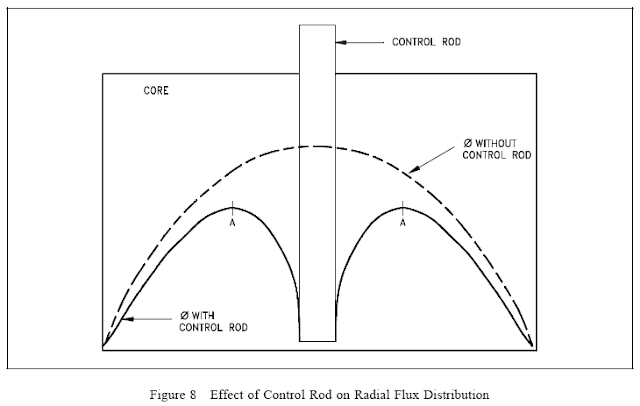
With borated primary coolant, neutrons are depressed equally throughout the core, and so power generation is more evenly distributed, and the reactor can be run closer to its thermal limit, because there is no need to account for hot and cold zones due to tilting of the neutron flux.
However you would hope that there is a better way to keep a flat neutron flux profile throughout a reactor core than using very hot diluted boric acid in the primary coolant loop.
As mentioned above, the primary coolant in these PWR reactors contains Boric Acid, which is a mild acid. For this reason, the piping, pumps, valves, etc are all made of high chrome steel (stainless steel).
The reactor vessel and closure head, however, are not. Due to their size, it is impractical to make the entire thing from stainless steel. Instead, the reactor vessel and head are made from carbon steel, and their interior is clad with a sheet of 3/8" thick stainless steel. In this way, the carbon steel, which is not resistant to acids, is protected from contact with the Boric Acid in the primary coolant.
The Event:
In 2002, Davis-Besse nuclear power plant in Ohio discovered they had a very minor primary coolant leak. The coolant was leaking out along a penetration in the reactor vessel head, where a Control Rod Drive Mechanism (CRDM) was mounted. The CRDM is what pulls the control rods out of the core and allows the reactor to start and shut down. The coolant leak was so minor that it hadn't been noticed - in a million gallon system, a minor leak can go undetected almost forever. Any water leaking from the primary coolant would also be quite hot and would flash to steam immediately, so no water puddling would occur.
Davis-Besse had a tiny coolant leak, however. One which they were unaware of. In 2002 the plant shut down for a refueling outage, and performed an inspection underneath the insulation on the reactor vessel head. This was done after other plants of the same design had uncovered minor leakage. They found a little problem...
At the time it was discovered, the acid had eaten away a hole the size of a football completely through the reactor vessel head in the area of the leaking CRDM penetration. The only thing that was holding the 2500 psig primary coolant in place was 3/8" of stainless steel cladding, which was bulging outwards from the pressure.
Below is a picture of a Babcock & Wilcox design PWR primary coolant loop, with the reactor vessel head highlighted.

Below is a cut-away of a B&W reactor vessel head, with a zoom-in on the point of the leak.

Below are images of the hole in the reactor vessel head.

The photo below gives you an idea how thick engineers designed the reactor vessel head to keep 2500 psig of primary coolant in place. It's astonishing (and wonderful) that thin piece of 3/8" of stainless steel was able to keep the coolant from blasting out.

This would not have been merely a primary coolant leak. This would have been a major accident. Here are some of the potential consequences of such a massive leak, had the cladding ruptured:
Background:
In a Pressurized Water Reactor (PWR), the control rods are completely removed from the core after the reactor is up to full power, and dilute Boric Acid (a strong neutron poison) is carefully added to control reactivity.
The purpose of this process is to achieve a flatter neutron flux profile throughout the core.
A flat neutron flux is desirable for a couple of reasons: It helps to even out fuel burnup and it helps to reduce hot and cold coolant channels. When control rods are partially inserted into an operating reactor core, neutron flux is depressed near them, since they absorb neutrons. Therefore fewer fissions occur near the control rods. This localized reduction of fission causes uneven fuel burn and creates cold zones due to reduced fission near the rods. For a given power output, other sections of the reactor core away from the control rods must now run hotter to compensate.
Below, a side-view of a reactor core. The solid line indicates neutron population in this reactor at steady-state power, with a control rod partially inserted to control reactor power. Because there are very few neutrons in the area adjacent to the control rod, for a given power level, other areas of the core have to produce more fissions. The spots on the solid line marked "A" are those places where we might see excessive fissions, overheating, and possible fuel element failures.
The dashed line indicates neutron population with the control rod removed (which is possible if you add Boric Acid as a virtual liquid control rod). As you can see, neutron population is more consistent throughout the reactor, and therefore there won't be any excessive localized fission and heating, as you see at the points marked "A"

With borated primary coolant, neutrons are depressed equally throughout the core, and so power generation is more evenly distributed, and the reactor can be run closer to its thermal limit, because there is no need to account for hot and cold zones due to tilting of the neutron flux.
However you would hope that there is a better way to keep a flat neutron flux profile throughout a reactor core than using very hot diluted boric acid in the primary coolant loop.
As mentioned above, the primary coolant in these PWR reactors contains Boric Acid, which is a mild acid. For this reason, the piping, pumps, valves, etc are all made of high chrome steel (stainless steel).
The reactor vessel and closure head, however, are not. Due to their size, it is impractical to make the entire thing from stainless steel. Instead, the reactor vessel and head are made from carbon steel, and their interior is clad with a sheet of 3/8" thick stainless steel. In this way, the carbon steel, which is not resistant to acids, is protected from contact with the Boric Acid in the primary coolant.
The Event:
In 2002, Davis-Besse nuclear power plant in Ohio discovered they had a very minor primary coolant leak. The coolant was leaking out along a penetration in the reactor vessel head, where a Control Rod Drive Mechanism (CRDM) was mounted. The CRDM is what pulls the control rods out of the core and allows the reactor to start and shut down. The coolant leak was so minor that it hadn't been noticed - in a million gallon system, a minor leak can go undetected almost forever. Any water leaking from the primary coolant would also be quite hot and would flash to steam immediately, so no water puddling would occur.
Davis-Besse had a tiny coolant leak, however. One which they were unaware of. In 2002 the plant shut down for a refueling outage, and performed an inspection underneath the insulation on the reactor vessel head. This was done after other plants of the same design had uncovered minor leakage. They found a little problem...
At the time it was discovered, the acid had eaten away a hole the size of a football completely through the reactor vessel head in the area of the leaking CRDM penetration. The only thing that was holding the 2500 psig primary coolant in place was 3/8" of stainless steel cladding, which was bulging outwards from the pressure.
Below is a picture of a Babcock & Wilcox design PWR primary coolant loop, with the reactor vessel head highlighted.


Below are images of the hole in the reactor vessel head.

The photo below gives you an idea how thick engineers designed the reactor vessel head to keep 2500 psig of primary coolant in place. It's astonishing (and wonderful) that thin piece of 3/8" of stainless steel was able to keep the coolant from blasting out.

This would not have been merely a primary coolant leak. This would have been a major accident. Here are some of the potential consequences of such a massive leak, had the cladding ruptured:
- A massive steam/water jet would have blasted out of this hole, certainly damaging this control rod, but possibly adjacent ones also. Could the ability of the reactor to shut down been compromised?
- The steam/water blast probably would have ripped tons of insulation loose. This would have fouled the intake of the emergency water re-injection system, which takes suction from the floor of the containment building.
- Major coolant leak accidents are typically modeled for weaker points in the primary coolant system - pumps, steam generators, drain lines, etc. These are equipped with remote-operated valves to isolate these leaks from the reactor core. This leak was was directly above the reactor core, and not isolable from it. Continuous water injection directly into the core would be required for several months to prevent decay heat from melting it.
- It is very likely that with the reactor fill system compromised due to ingesting insulation, and an unisolable leak right above the fuel, that core damage would have occurred.
Sunday, September 22, 2013
Nuclear Reactors - How they work (part 2)
Previously (part 1) we had a Pressurized Water Reactor (PWR) which was critical and adding heat to the coolant/moderator. After the reactor reaches the point where it is generating heat, and the moderator becomes less effective, it becomes neccessary to withdraw the control rods again to increase power output.
Since this is a PWR, we are not supposed to have large-scale boiling in the core. Steam doesn't transfer heat as readily as water does, and in a PWR, in-core boiling is a bad, bad thing. For this reason the pressure in the primary coolant loop must be kept well above the boiling point of water for the temperature found in the core. How do we do that? We have a pressurizer!
The pressurizer does three things: First, it acts as a surge volume for the primary coolant system by maintaining a compressible steam-filled void space. Secondly, it keeps the system pressure high enough that boiling cannot occur in the core. This is accomplished by keeping the pressurizer vessel half full of water, and adding enough electrical heaters that the temperature in the pressurizer is kept higher than that of the core. All boiling will occur in the pressurizer, not in the core.
Lastly, the pressurizer controls the primary coolant system pressure. As more electric heaters are energized in the pressurizer vessel, saturation conditions increase, causing pressure to rise. To reduce primary pressure, a shower spray head at the top of the vessel can spray slightly cooler water into the steam, condensing a portion of the steam and reducing pressure. It's quite a simple and elegant process.
Below is a simplified diagram of the primary and secondary systems of a PWR. The radioactive primary coolant (Red) is contained in a closed loop. The reactor core is the heat source, the control rod drive mechanism positions the control rods to increase/decrease reactor power, the primary pump circulates the primary coolant, and pressurizer serves as a static surge volume.
The steam generator segregates the radioactive primary coolant from the steam/water system, but allows heat to be transferred out of the primary coolant loop and generate steam for the turbine.

Pressure in the primary system is increased by energizing submerged electrical heaters in the pressurizer, and reduced by spraying a small slip-stream of primary coolant from the reactor coolant pump through a spray head at the top of the pressurizer. This cools and condenses some of the steam in the pressurizer, reducing system pressure.
Temperature is gradually increased by withdrawing the control rods. Remember in the previous post that the neutron population would increase with no control rod movement if the reactor were slightly supercritical? That is no longer the case when power level is high enough for the reactor to generate heat. After the core begins heating and the "negative temperature coefficient of reactivity" kicks in, withdrawing the control rods increases power, followed by a smaller drop in power as the primary coolant heats up. So control rods are withdrawn in a series bumps, and the coolant temperature is slowly increased.
The primary coolant pump circulates primary coolant (very pure water) between the reactor core and the steam generator. The reactor core adds heat created by fission. The steam generator removes heat by boiling secondary water in a heat exchanger. Thus, primary coolant is radioactive, but does not boil. Secondary water is non-radioactive, and does boil.
In a PWR, excess fuel is loaded, more than what is required to bring the reactor up to power. This is done so that the reactor can continue to run as the U-235 is expended, and fission products build up. Many of the atoms that are created by fission are strong neutron absorbers (poisons), and eventually result in the inability of the reactor to maintain full power. This is in spite of excess U-235 added at during refueling. Only about 3% of the U-235 is used up before the accumulation of poison halts reactor operation. This is why fuel recycling is so desirable from an industry standpoint.
Commercial PWRs are unique in that they add boric acid to the primary coolant. Boron is a neutron absorber. With the addition of boron to the coolant, the control rods may be entirely withdrawn from the core, using only boron to control neutron population. This is desirable because in the vicinity of control rods, neutron population, and fissions will be depressed. This forces other regions of the core to run hotter for a given power level. With control rods out of the core, neutron distribution is more consistent and hot spots due to uneven neutron flux are less likely to develop.
At a certain point, on the secondary side of the steam generator, steam is at an adequate pressure to begin warming up the steam turbine. This also has an interesting impact on reactor power. As we create steam on the secondary side of the steam generator, we are also removing heat from the primary coolant. This slightly cooler primary coolant returns to the reactor. Since it is now more dense, it is a better moderator, and more neutrons stay in the core to cause fissions. Reactor power now increases along with steam demand. This is a very desirable feedback loop, because now there is little need to adjust the control rods. We allow the steam turbine load to determine what power level the reactor will operate at.
The remainder of the steam plant operates in a very similar manner to a fossil-fueled plant. One difference: Since it is not possible to superheat the steam with this process, steam dryers are added between different stages on the steam turbine, to prevent mist from damaging the lower pressure sections.
Since this is a PWR, we are not supposed to have large-scale boiling in the core. Steam doesn't transfer heat as readily as water does, and in a PWR, in-core boiling is a bad, bad thing. For this reason the pressure in the primary coolant loop must be kept well above the boiling point of water for the temperature found in the core. How do we do that? We have a pressurizer!
The pressurizer does three things: First, it acts as a surge volume for the primary coolant system by maintaining a compressible steam-filled void space. Secondly, it keeps the system pressure high enough that boiling cannot occur in the core. This is accomplished by keeping the pressurizer vessel half full of water, and adding enough electrical heaters that the temperature in the pressurizer is kept higher than that of the core. All boiling will occur in the pressurizer, not in the core.
Lastly, the pressurizer controls the primary coolant system pressure. As more electric heaters are energized in the pressurizer vessel, saturation conditions increase, causing pressure to rise. To reduce primary pressure, a shower spray head at the top of the vessel can spray slightly cooler water into the steam, condensing a portion of the steam and reducing pressure. It's quite a simple and elegant process.
Below is a simplified diagram of the primary and secondary systems of a PWR. The radioactive primary coolant (Red) is contained in a closed loop. The reactor core is the heat source, the control rod drive mechanism positions the control rods to increase/decrease reactor power, the primary pump circulates the primary coolant, and pressurizer serves as a static surge volume.
The steam generator segregates the radioactive primary coolant from the steam/water system, but allows heat to be transferred out of the primary coolant loop and generate steam for the turbine.

Pressure in the primary system is increased by energizing submerged electrical heaters in the pressurizer, and reduced by spraying a small slip-stream of primary coolant from the reactor coolant pump through a spray head at the top of the pressurizer. This cools and condenses some of the steam in the pressurizer, reducing system pressure.
Temperature is gradually increased by withdrawing the control rods. Remember in the previous post that the neutron population would increase with no control rod movement if the reactor were slightly supercritical? That is no longer the case when power level is high enough for the reactor to generate heat. After the core begins heating and the "negative temperature coefficient of reactivity" kicks in, withdrawing the control rods increases power, followed by a smaller drop in power as the primary coolant heats up. So control rods are withdrawn in a series bumps, and the coolant temperature is slowly increased.
The primary coolant pump circulates primary coolant (very pure water) between the reactor core and the steam generator. The reactor core adds heat created by fission. The steam generator removes heat by boiling secondary water in a heat exchanger. Thus, primary coolant is radioactive, but does not boil. Secondary water is non-radioactive, and does boil.
In a PWR, excess fuel is loaded, more than what is required to bring the reactor up to power. This is done so that the reactor can continue to run as the U-235 is expended, and fission products build up. Many of the atoms that are created by fission are strong neutron absorbers (poisons), and eventually result in the inability of the reactor to maintain full power. This is in spite of excess U-235 added at during refueling. Only about 3% of the U-235 is used up before the accumulation of poison halts reactor operation. This is why fuel recycling is so desirable from an industry standpoint.
Commercial PWRs are unique in that they add boric acid to the primary coolant. Boron is a neutron absorber. With the addition of boron to the coolant, the control rods may be entirely withdrawn from the core, using only boron to control neutron population. This is desirable because in the vicinity of control rods, neutron population, and fissions will be depressed. This forces other regions of the core to run hotter for a given power level. With control rods out of the core, neutron distribution is more consistent and hot spots due to uneven neutron flux are less likely to develop.
At a certain point, on the secondary side of the steam generator, steam is at an adequate pressure to begin warming up the steam turbine. This also has an interesting impact on reactor power. As we create steam on the secondary side of the steam generator, we are also removing heat from the primary coolant. This slightly cooler primary coolant returns to the reactor. Since it is now more dense, it is a better moderator, and more neutrons stay in the core to cause fissions. Reactor power now increases along with steam demand. This is a very desirable feedback loop, because now there is little need to adjust the control rods. We allow the steam turbine load to determine what power level the reactor will operate at.
The remainder of the steam plant operates in a very similar manner to a fossil-fueled plant. One difference: Since it is not possible to superheat the steam with this process, steam dryers are added between different stages on the steam turbine, to prevent mist from damaging the lower pressure sections.
Subscribe to:
Posts (Atom)