Search This Blog

Showing posts with label Cold War. Show all posts

Saturday, October 15, 2022

A New Radiation Detector

"Most of what passes for legitimate entertainment is inferior or foolish and only caters to or exploits people's weaknesses.

Avoid being one of the mob who indulges in such pastimes.  Your life is too short and you have important things to do.  Be discriminating about what images and ideas you permit into your mind.

If you yourself don't don't choose what thoughts and images you expose yourself to, someone else will, and their motives may not be the highest.

It is the easiest thing in the world to slide imperceptibly into vulgarity.

But there is no need for that to happen if you determine not to waste your time and attention on mindless pap." - Marcus Aurelius

Monday, February 21, 2022

Ukraine Conflict: Qui Bono? (To whose benefit?)


“Why, of course, the people don’t want war, why would some poor slob on a farm want to risk his life in a war when the best that he can get out of it is to come back to his farm in one piece?  Naturally, the common people don’t want war; neither in Russia nor in England nor in America, nor for that matter in Germany. That is understood. But, after all, it is the leaders of the country who determine the policy and it is always a simple matter to drag the people along, whether it is a democracy or a fascist dictatorship or a Parliament or a Communist dictatorship.”

“The people can always be brought to the bidding of the leaders. That is easy. All you have to do is tell them they are being attacked and denounce the pacifists for lack of patriotism and exposing the country to danger. It works the same way in any country.”- Herman Goering

Sunday, May 21, 2017

Nearby Radiological Emergency

This past week there was a radiological emergency at the Hanford Reservation.  The event caused a site-wide alert to shelter-in-place.  Very exciting.

Thursday, October 16, 2014

An interesting US submarine design

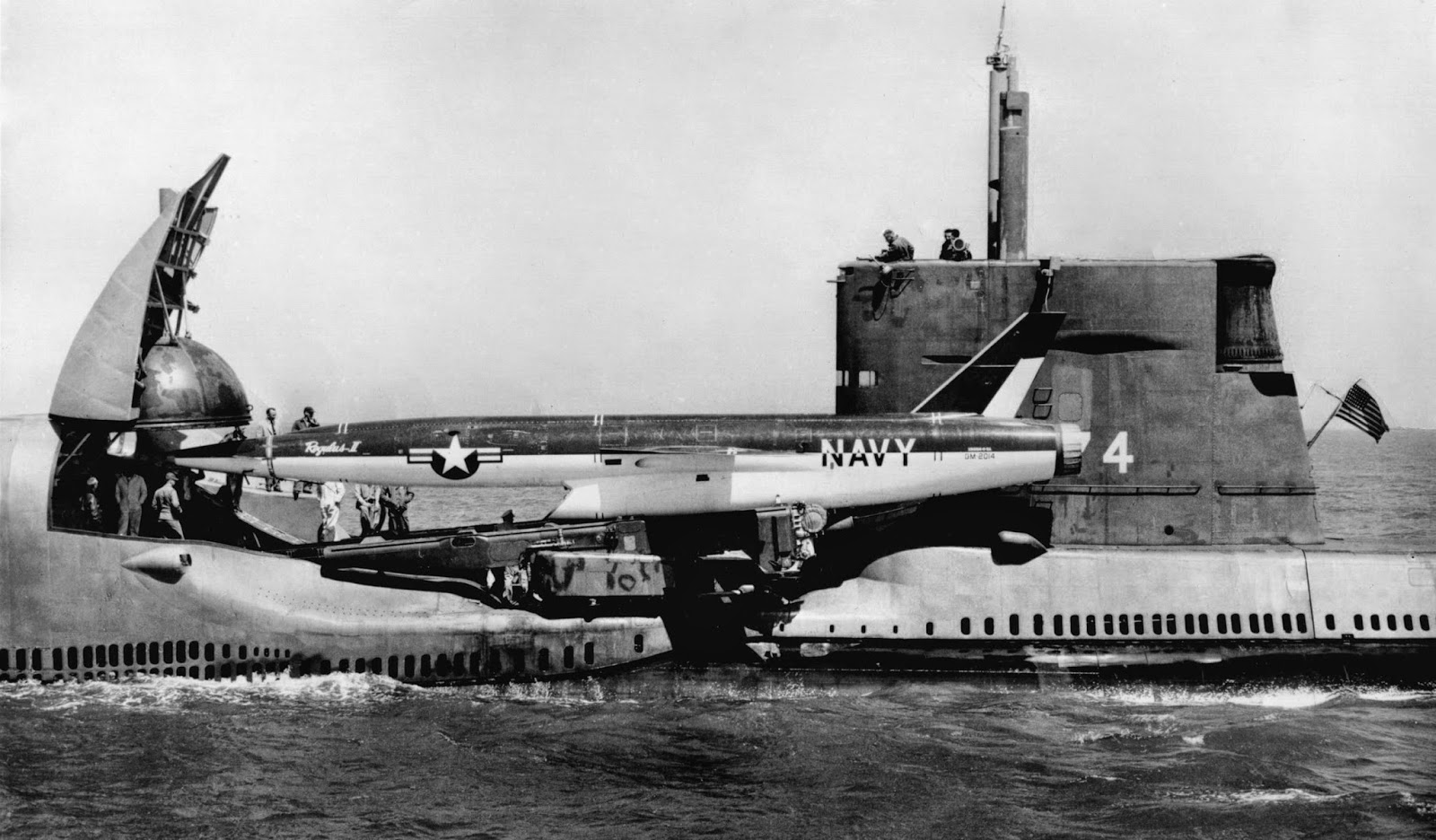
The previous post about the nearby, but not very effective or long-lasting Titan 1 missile launch complex reminded me of another early nuclear deterrent weapon system that didn't last too long. That weapon system was the combination of the Regulus missile with a submarine.  This was a weird combination of weapons that apparently made sense at the time...

The USS Grayback and USS Growler were commissioned as standard diesel-electric attack submarines in 1957, but were modified in 1958 with a watertight missile hangars on the front deck. This allowed the ships to carry either (4) Regulus 1 missiles, or (2) Regulus 2 missiles.  The result was not pretty.

USS Growler (SSG-577) surfaced and billowing diesel exhaust.

What was the purpose of these submarines and their aircraft hangars?  Once again, nuclear deterrence.  These ships were to stay submerged with their nuclear-tipped cruise missiles, and be prepared to fire them at the Soviet Union.  However if the command to attack were ever given, a ridiculous series of events would have to take place to launch a missile.

To perform a launch, these submarines would have to surface, open the watertight hangar door, and then slide the missile out backwards.  After that, the crew would unfold the wings and lock them in place, rotate the missile sideways so the exhaust wouldn't melt the ship, calibrate the missile's guidance system, (fuel the missile?), and launch it.

The missile also required radio control to reach its target, and two additional control stations were required along the missile's course.  It surely would have made for interesting times if the enemy were able to take control of the missile in flight!

Below, USS Grayback (SSG-574) rolls out a Regulus II missile in preparation for launch.

The missile used a solid fuel rocket booster to get it moving, and a GE J79 turbojet to fly at Mach 2 for about 1000 nautical miles, delivering a 2 Megaton W-27 thermonuclear warhead.

A nuclear-powered version of this submarine design was also built: The USS Halibut.  It had a slightly cleaner look, apparently having been designed around the missile bay, rather than having it tacked on after construction.

Below, USS Halibut (SSGN-587) launches a Regulus II cruise missile with attached rocket boosters.

These were not the first guided missile submarines however.  A previous generation of subs had carried Regulus I missiles, which had about half the range (500 nautical miles) of a Regulus II

Below, the USS Tunney launches a Regulus I cruise missile.

In the early cold war years, this arrangement was part of the strategic nuclear deterrent,  However the development of the vertically-launched Polaris Missile and the 16 tube George Washington class ballistic missile submarine rendered this entire design obsolete.

Within 10 years of the launch of the first ship, the last of them had been removed from service as missile carriers.  The Halibut was re-purposed as a special operations ship, and was decommissioned in 1976.

Sunday, February 02, 2014

K-219 (Project 667A)

K-219 was a Soviet ballistic missile submarine.  She was a Yankee I class ship, which carried sixteen liquid-fueled nuclear missiles for use against land targets in the US.  The ship was propelled by two PWR reactors, and had two propellor shafts.

On a side note, the Soviet Navy gets credit for envisioning and building the first submarine to carry an ICBM, the Zulu Class submarine.  The Zulu was a conventional diesel-electric submarine that was modified with an extended sail to carry a single nuclear-tipped long-range missile.  It was also the first submarine to test launch a ballistic missile.

Saturday, February 01, 2014

K-431 (Project 675)

K-431 was an Echo II class submarine.  Construction was started in January 1964, and she was commissioned in September of 1965, in a very rapid construction process.  The Echo II class was a twin reactor ship which carried cruise missiles for attacking surface ships.  Not very pretty.


Thursday, January 30, 2014

K-8, Project 627 (проект 627)

November-Class submarine.  Source: Wikipedia

K-8 was a November-Class Soviet submarine.  The November class was the first class of Soviet nuclear attack submarines.  This class of submarines suffered from reliability problems related to the ships' steam generators.  The steam generators in these early nuclear ships frequently developed leaks. 

Leakage from a steam generator tube allows very radioactive primary coolant to exit the reactor coolant loop and enter the non-radioactive steam cycle loop.  This radioactivity, depending on the size and duration of the leak, can be hazardous to the crew.   With the November Class' dual reactor design, it would seem feasible to shut a damaged reactor down, reduce the primary system pressure, and limp home.

K-8 developed steam generator leaks on three separate occasions.  On one occasion however, the steam generator leak was so severe that one reactor experienced a Loss of Coolant Accident.  The crew struggled to make repairs and to refill the primary coolant loop in order to prevent a core meltdown due to decay heat.  Several of the crew received significant doses of radiation as well as radiation burns.

The end for K-8 came in a more mundane way however.  In April of 1970, while operating at a depth of 400ft, a short circuit caused a fire, which spread to two compartments via the ventilation system.  Both reactors were shutdown, and the captain ordered the ship abandoned.  Things must have been hellish inside. 

Fortunately, K-8 was part of a Soviet fleet exercise when the fire occurred, so help was nearby.  A surface vessel was dispatched to tow her back to port for repairs.

Disabled submarines are difficult to keep afloat (even next to a pier), and the reason is this:  Most of the ship is already submerged.  This is partly due to the thickness of the pressure hull, but also the ship is designed to be pretty close to neutral bouyancy.  When the main ballast tanks are full of air, a submarine will have positive bouyancy, but not a whole lot of it.

Submarines are not surface ships, so they are designed with round-bottom hulls.  This makes them wallow badly on the surface in heavy seas.  When a submarine pitches and rolls in the waves, air escapes from the main ballast tanks, which are vented at the bottom.  With each wave, a little main ballast tank air spills out, and a little bouyancy is lost. 

This air can be replaced by a couple of means.  The first is a massive low-pressure roots blower that takes air in from a large snorkel mast, and forces water out of the main ballast tanks.  This method only works if electrical power is available.  With both reactors out of service, it is unlikely that the storage battery of K-8 could have supplied the LP blower with electrical power for very long.

The other method for replacing air in the main ballast tanks involves briefly "puffing" them with very high pressure air from the ship's air banks.  I don't know the capacity of the high pressure air banks on this class of ship, but I do know the supply of air was not infinite.  In any case, without having electricity to run a high-pressure air compressor, these would eventually run out of pressure be unable to displace water out of the ballast tanks.

The abandon-ship order of the captain of K-8 was countermanded when the towing vessel arrived. 52 crewmembers, including the captain, re-boarded the ship for the tow back to port.   73 crewmembers were taken aboard the towing vessel.

The ships encountered rough weather.  After 80 hours of heroic but futile damage control, the K-8 flooded.  Sadly, even though ships were nearby, she took 52 men with her, who are now on eternal patrol with her.  

Wednesday, January 29, 2014

K-27, Project 645 (645 Кит-ЖМТ)

The Soviet and US Navies operated a large number of submarines, each generation improving in quality.  A silent covert game of cloak and dagger took place beneath the waves that most people were completely unaware of. 

The Soviets at one time had the largest fleet of submarines in the world.  In many respects, advanced Soviet submarines were superior to their US cold war counterparts.  Several Soviet submarine designs could dive to a greater depth than a standard US MK 48 torpedo!  

US submarines (from the arrival of Thresher) had held the advantage of stealth, and superior sonar equipment.  Soviet submarines, in contrast, held the advantage of survivability (due to double-hull construction and huge amounts of reserve bouyancy), weapon-carrying capacity, greater depth and top speed.

The US experimented with a variety of reactor/propulsion designs, but only one used a liquid-metal cooled reactor:

USS Seawolf (SSN-575) was the second US submarine (after USS Nautilus), and the only US submarine to have a liquid metal cooled reactor.  The reactor was cooled using liquid sodium, which of course would be problematic for the crew if  it ever leaked.  Seawolf also had steam superheaters, for added efficiency.  These were also problematic, and thus were seldom in service.  Because liquid metal is much more efficient than water at removing core heat, the propulsion plant was only 40% the size of Nautilus'.  Seawolf was eventually converted to a more typical S2W pressurized water reactor (PWR) with a saturated steam plant.  PWR and saturated steam plants in US submarine design continues to this day.

The Soviets' emphasis on submarine speed, depth and power of course led to more propulsion designs that used liquid metal cooled reactors.  Soviet reactors of this type used a Lead-Bismuth coolant that was far less hazardous than liquid sodium, at least from a fire hazard standpoint.  From a power-weight (and size) standpoint, the liquid metal cooled reactor is far superior to a light water cooled reactor.  From a safety standpoint, not so great.

Recall that liquid metal cooled reactors are Fast neutron reactors, or sometimes intermediate speed reactors.  All liquid metal cooled reactors have a positive void coefficient of reactivity.  That means that if the coolant inadvertantly boils in the core, reactor power will increase.  Which will boil more metal, and increase power even more.   This happens rapidly, and core damage (meltdown!) is fairly common with this type of reactor.

So with that background, lets talk about the Soviet submarine K-27, or Projekt 645. 

The Soviet's first class of nuclear attack submarines was called the November class.  They used dual 70 Megawatt PWR reactors for propulsion.  13 of these were built before technology allowed creation of superior designs.  Even so, they were superior to the USS Nautilus, in speed, depth, and stealth.  One could also argue that Nautilus was really an experiment to prove that nuclear propulsion could work on a submarine, rather than a true nuclear attack submarine, however, and not be wrong.

Profile of a November-Class Submarine:


Back to K-27.  This was a unique single-ship design by the Soviets, just as Seawolf was for the US Navy.  K-27 was a November-Class submarine with a unique power plant.  Rather than two 70 Megawatt PWRs, the Soviets used two VT-1 liquid metal cooled reactors, with an output of 73 MW. The advantage of smaller footprint and weight of the metal-cooled reactors allowed more weapons to be carried.

She was laid down on June 1958 and launched in April 1962.  She was commissioned October 1963 after full-scale builders sea trials and official tests.  She performed well (although with heavy maintenance for the new metal-cooled reactors) until a reactor accident in the port (left) reactor happened in May 1968.

The ship was making a full speed submerged run, when a reactor automatic control rod withdrew itself.  Boiling occured, and reactor power plummeted from 83% to 7% in about 90 seconds, as the core melted.  Unfortunately for the crew, poor decisions made after the initial accident would cost many of them their lives. 

The main purpose of cladding U-235 in a reactor with Zircaloy or Stainless steel is to keep the highly radioactive freshly split atoms from getting into the coolant and spreading.  When the fuel assemblies melt down, these radioactive atoms mix in the coolant, and get outside the heavily shielded reactor vessel. 

Unknown to the crew, the captain had the radiation alarms disabled.  Radioactive gases were released from the fuel, which the crew were exposed to.  Another captain might have surfaced the ship and ventilated it with the massive air blowers all submarines are equipped with.  The ship limped home on the starboard reactor and was laid up for several years.  Five sailors who worked in the propulsion plant died within a week of the accident, while 30 more died between 1968 and 2003.  Quite a high death rate for a crew of young, healthy men.

K-27 was brought into shipyard, and the starboard reactor coolant was kept liquid by steam piped in at the shipyard while the radioactivity in the port side reactor died down.  In 1973 the decision was made that repairing or replacing the reactor in the aging ship was not worthwhile, and the ship was decomissioned in February 1979.

Her disposal was... interesting.  Rather than remove the melted down mess that remained of the port side reactor, the Soviets decided to fill her reactor compartment with a solidifying agent.  Next they towed her, not out to sea, but very close to land.  In 1982 they sunk her in just 100 ft of water, just offshore of Novaya Zemlya. Google Earth Coordinates Here

She didn't want to sink, however, so they ended up having to ram her.

K-27 refusing to be scuttled: 

There is now a great deal of urgency in re-floating K-27 and removing her radioactive coolant system and fuel.  This is an environmental hazard that will eventually become a serious problem, and quite close to shore.  Where it was disposed of is the Island of Novaya Zemlya, a harsh glacier-scoured island that has been a nuclear testing and dumping ground for generations. 


Interestingly there is equipment available to de-fuel this unique ship that was used on many other liquid-metal cooled ships at the end of the cold war.  However, this now-unused de-fueling equipment will not remain in optimum condition forever, so the race is on.  Hopefully someone is interested in recovering this ship before it becomes a big environmental mess.

Tuesday, January 28, 2014

USS Scorpion (SSN-589) - Updated

Scorpion was a Skipjack-Class submarine.  The Skipjack class was the nuclear-powered attack submarine class previous to the Thresher/Permit class.  As such, they were not quite as deep-diving, although they did have a very sleek hull, which allowed for a high submerged speed.  Skipjack-class submarines held (classified) speed records while using somewhat noisy 5-bladed screws, but lost this high speed when the screws were eventually replaced with quieter 7-bladed screws.

Tuesday, January 07, 2014

USS Thresher (SSN-593)

The USS Thresher was the lead ship in a new, advanced class of US Submarines.  Her keel was laid in May of 1958 and she was launched in July 1960.

At the time of Thresher's launch, she was the deepest diving attack submarine in the world.  Until the arrival of Thresher, all submarines had bow-mounted (and most also had stern-mounted) torpedo tubes.  USS Thresher was the first to use angled, midship-mounted torpedo tubes.  This arrangement freed the bow for installation of an extremely high-sensitivity sonar array. 

The bow-mounted sonar consisted of a sphere covered with hydrophones, placed as far away as possible from the propulsion plant.  This new arrangement offered a huge improvement in sonar sensitivity, and Thresher had the ability to detect other submarines at far greater range than they could detect her.  The importance of detecting an enemy ship first cannot be overstated!!! 

In addition to the improvements in the sonar/torpedo tube arrangement, huge improvements had been made to silence the ship.  This was also the quietest nuclear submarine in the world.  For the first time ever, all rotating equipment in the ship was sound-isolated from the ship's hull.  The heavier equipment (propulsion turbines, turbine generators, primary coolant pumps, and reduction gears) were mounted to a subfloor that was suspended and accoustically isolated from the hull.  Smaller machinery and steam piping was mounted using sound-isolating snubbers. 

Thresher was also the first ship to carry the SUBROC missile. The SUBROC was a Stand-off weapon system for attacking enemy ships at greater distances than a torpedo could reach.  The SUBROC was a SUBmarine ROCket that carried a W55 nuclear warhead with a yield of 250 kilotons TNT. It was propelled by a solid fuel rocket motor that would ignite following ejection from a torpedo tube. The SUBROC would then angle up, clear the ocean surface, fly a certain distance, then release the warhead. The warhead would enter the water and detonate at a depth that was programmed prior to launch.


In short, the ship was revolutionary.  She was quiet, fast, deep-diving, had the keenest hearing on the planet, and could shoot a nuclear-tipped rocket out her torpedo tubes.  

Then on April 9, 1963 she sank with all hands.  She took 129 men along with her.  Seven days after being lost, Thresher was stricken from the ship's registry. 

As the lead ship of a new class of submarines, this new class of ship had been called the Thresher (593 class).  After striking Thresher from the registry, the class was renamed after the second ship in the class, the USS Permit class (594 class).


What happened:
Thresher had performed operational testing of all her systems, particularly the weapons and sonar systems for two years. In July 1962 she entered shipyard to inspect equipment conditions, make repairs and correct deficiencies noted during the operational testing.   She un-docked on April 8.

On April 9, Thresher got underway from Portsmouth Naval Shipyard in Maine, for the purpose of conducting a dive to test depth.  Diving to test depth is always done immediately following any major overhaul or repair, so that the sea-worthiness of the ship can be tested.

Thresher rendezvoused with a submarine rescue vessel named Skylark, and then conducted a slow descent in 100ft increments, while circling Skylark in order to maintain communications.  As Thresher neared test depth, Skylark received a message over the underwater telephone stating "...minor difficulties, have positive up-angle, attempting to blow".  Lastly there was a final garbled message that included the number "900".  When Skylark received no further communication, surface observers gradually came to realize that Thresher had sunk.

Thresher had gone down in 8400ft of water, and it was difficult to gather evidence or get photographs to determine what had caused the loss of the ship.  A court of inquiry was convened, and a picture of events began to unfold.


In this class of ship, the major heat loads were cooled by seawater-supplied heat exchangers.  A/C Units, Generators, oil coolers - everything was supplied by high-pressure seawater piping.  At the time, most of the joints in these seawater pipes were silver-soldered, rather than welded.  Many of the silver-soldered joints were faulty, and there was no process in place for quality control.

It is conjectured that one of the larger silver-soldered joints sheared off near test depth, filling the ship from *both* ends of the damaged seawater pipe.  This in itself would not have sunk the ship, but several other things likely compounded the problem.  The seawater would have blasted in and created a mist as it struck other surfaces.  This saltwater mist probably created enough electrical grounds and disturbances to trip (or scram) the reactor. 

A shutdown reactor also should not have caused the ship to be lost.  Enough heat remains in the primary coolant to generate propulsion steam for several minutes.  However, the procedures in place at that time called for the main steam stop valves to be shut whenever the reactor scrammed (to conserve heat in the primary coolant).  This action eliminated the option of driving the ship toward the surface using the propulsion turbines, just as Thresher was taking on additional weight due to flooding.

The captain ordered an emergency main ballast tank blow.  An emergency blow releases extremely high pressure air from large air tanks into the main ballast tanks.  The air displaces water out the bottom of the ballast tanks and makes the ship more bouyant.   The emergency blow also should have saved the ship, but it did not. 

Previous classes of submarines did not dive this deep, and therefore did not require air at such high pressure to blow their main ballast tanks while at maximum depth.  No previous submarine had needed to dehydrate compressed air, and this class of ship did not have compressed air dryers either.

The air in the high pressure air banks was moist air.  It is believed that during the emergency main ballast tank blow, as the air pressure dropped, ice formed in the piping and blocked further air flow, preventing a full blow of the ballast tanks.

The Thresher is believed to have made some progress toward reaching the surface, before flooding overcame the bouyancy created by the partial ballast tank blow.

Loss of the Thresher came as a huge shock to the Navy, and to the Submarine Service.  As a result of the investigation, the SUBSAFE program was initiated.  This was a QA/QC program to ensure all parts of the ship subject to seawater pressure were of the highest quality, and pedigreed with a paper trail, from smelting to installation.

Other improvements included remotely-operated hydraulic shutoff valves for all seawater systems that didn't rely on electrical power, air dryers and larger diameter piping for the compressed air systems, and procedural changes that allowed crews to use residual primary coolant heat for emergency steam propulsion.  Not much point protecting the reactor, if the ship will be lost in the process...

Later classes of submarines (engineered from the ground up with SUBSAFE) in would use seawater-freshwater heat exchangers for everything except the main propulsion condensers.  This other cooling system circulated low pressure fresh water to machinery that required cooling, and so minimized the amount of high-pressure seawater piping within the ship.

Those are the engineering improvements that we are able to take away from this tragedy. 

Thresher was lost at sea and never decommissioned.  Both she and her crew, as well as a number of civilian shipyard workers, remain on Eternal Patrol.

Wednesday, December 25, 2013

Another excellent documentary on Cold War Submarines

This is an episode of Nova that interviews a lot of Navy and intelligence insiders, as well as the authors of the book "Blind Man's Bluff".  Nice write up.  Merry Christmas, too ;)


Speaking of Christmas, my two worst were in the Navy. 

The second-worst Christmas was being underway on station, when the ship that was supposed to relieve us arrived several days late.  It's one thing if you know and expect to be at sea during Christmas.  It's another thing entirely to be ordered to stay put at the last minute.  On the bright side, it wasn't much different than any other day at sea, and everyone accepted the bad deal with grace.

My worst-ever Christmas was at Nuclear Power School in Orlando, Florida.  School let out for a week or two, and we were encouraged to go home and enjoy the holidays.  I had no home other than the Navy, so I pretty much had to stay put.  All my classmates and friends went home to spend Christmas with their parents.  I hung out in a dark and empty base, stood lonely watches, and ate bland chow hall food for Christmas dinner.


Tuesday, December 24, 2013

Documentary on Submarines during the Cold War

I found this cool documentary on submarine operations during the Cold War. 

At time 22:40 they have a segment on the NR-1, the worlds smallest nuclear submarine, which I nearly re-enlisted for. 

The segment right after that is about Navy divers doing special operations.  Having been in the submarine service during that era, I can say that the documentary comes close to describing a couple of situations my ship found itself in.  I was NOT involved in any of the specific incidents mentioned in the show.

Cool video below on how subs and the cold war were deeply connected.


The last segment on Sweden is interesting.  It suggests that US submarines may have been creating fake "Soviet periscope sightings" to swing a neutral Sweden toward NATO.  A false-flag operation.

For a really entertaining book on this subject, I recommend this: Blind Man's Bluff:  The Untold Story of American Submarine Espionage.  Disclaimer: I cannot confirm or deny anything... ;)