"It is more civilized to make fun of life than to bewail it." - Lucius Annaeus Seneca

An advertisement-free blog about motorcycling, Northern life, home improvement, power plants, submarines, nuclear stuff, and a few other off-beat subjects. Comments are welcome. (Image is the Selway Crags in Northern Idaho)
Showing posts with label Nuclear Reactor. Show all posts
Showing posts with label Nuclear Reactor. Show all posts
Thursday, September 23, 2021
Molten Salt Reactors


Saturday, September 18, 2021
Friday, May 07, 2021
Curio idea: CP-1
"Do not try to seem wise to others. If you want to live a wise life, live it on your own terms and in your own eyes." - Epictetus
Saturday, January 23, 2021
Drones
"Don't look down on death, but welcome it. It too is one of the things required by nature. Like youth and old age. Like growth and maturity. Like a new set of teeth, a beard, the first gray hair. Like sex and pregnancy and childbirth. Like all the other physical changes at each stage of life, our dissolution is no different. So this is how a thoughtful person should await death: not with indifference, not with impatience, not with disdain, but simply viewing it as one of the things that happen to us.
Now you anticipate the child's emergence from its mother's womb; that's how you should await the hour when your soul will emerge from its compartment. Or perhaps you need some tidy aphorism to tuck away in the back of your mind. Well, consider two things that should reconcile you to death: the nature of the things you'll leave behind you, and the kind of people you'll no longer be mixed up with.
There's no need to feel resentment toward them-in fact, you should look out for their well-being, and be gentle with them-but keep in mind that everything you believe is meaningless to those you leave behind. Because that's all that could restrain us (if anything could)-the only thing that could make us want to stay here: the chance to live with those who share our vision. But now? Look how tiring it is-this cacophony we live in. Enough to make you say to death, "Come quickly. Before I start to forget myself, like them." - Marcus Aurelius

Thursday, February 13, 2020
Career Autobiography - Part 5: Early Submarine Years - Standing Watch
Part 4 is here:
When you first arrive on a submarine, you are pretty much useless - and your shipmates let you know about that right away. When you first come aboard, you will be called a "NUB". This is Navy slang for "Non-Useful Body".
When you first arrive on a submarine, you are pretty much useless - and your shipmates let you know about that right away. When you first come aboard, you will be called a "NUB". This is Navy slang for "Non-Useful Body".
Monday, August 26, 2019
Nuclear Instrumentation and Reactor Safety
Once again, it's been quite a while since I did a nerdy nuke post... Time to remedy that.
Sunday, May 21, 2017
Nearby Radiological Emergency
This past week there was a radiological emergency at the Hanford Reservation. The event caused a site-wide alert to shelter-in-place. Very exciting.


Thursday, October 16, 2014
An interesting US submarine design
The previous post about the nearby, but not very effective or long-lasting Titan 1 missile launch complex reminded me of another early nuclear deterrent weapon system that didn't last too long. That weapon system was the combination of the Regulus missile with a submarine. This was a weird combination of weapons that apparently made sense at the time...
The USS Grayback and USS Growler were commissioned as standard diesel-electric attack submarines in 1957, but were modified in 1958 with a watertight missile hangars on the front deck. This allowed the ships to carry either (4) Regulus 1 missiles, or (2) Regulus 2 missiles. The result was not pretty.
USS Growler (SSG-577) surfaced and billowing diesel exhaust.

What was the purpose of these submarines and their aircraft hangars? Once again, nuclear deterrence. These ships were to stay submerged with their nuclear-tipped cruise missiles, and be prepared to fire them at the Soviet Union. However if the command to attack were ever given, a ridiculous series of events would have to take place to launch a missile.
To perform a launch, these submarines would have to surface, open the watertight hangar door, and then slide the missile out backwards. After that, the crew would unfold the wings and lock them in place, rotate the missile sideways so the exhaust wouldn't melt the ship, calibrate the missile's guidance system, (fuel the missile?), and launch it.
The missile also required radio control to reach its target, and two additional control stations were required along the missile's course. It surely would have made for interesting times if the enemy were able to take control of the missile in flight!
Below, USS Grayback (SSG-574) rolls out a Regulus II missile in preparation for launch.
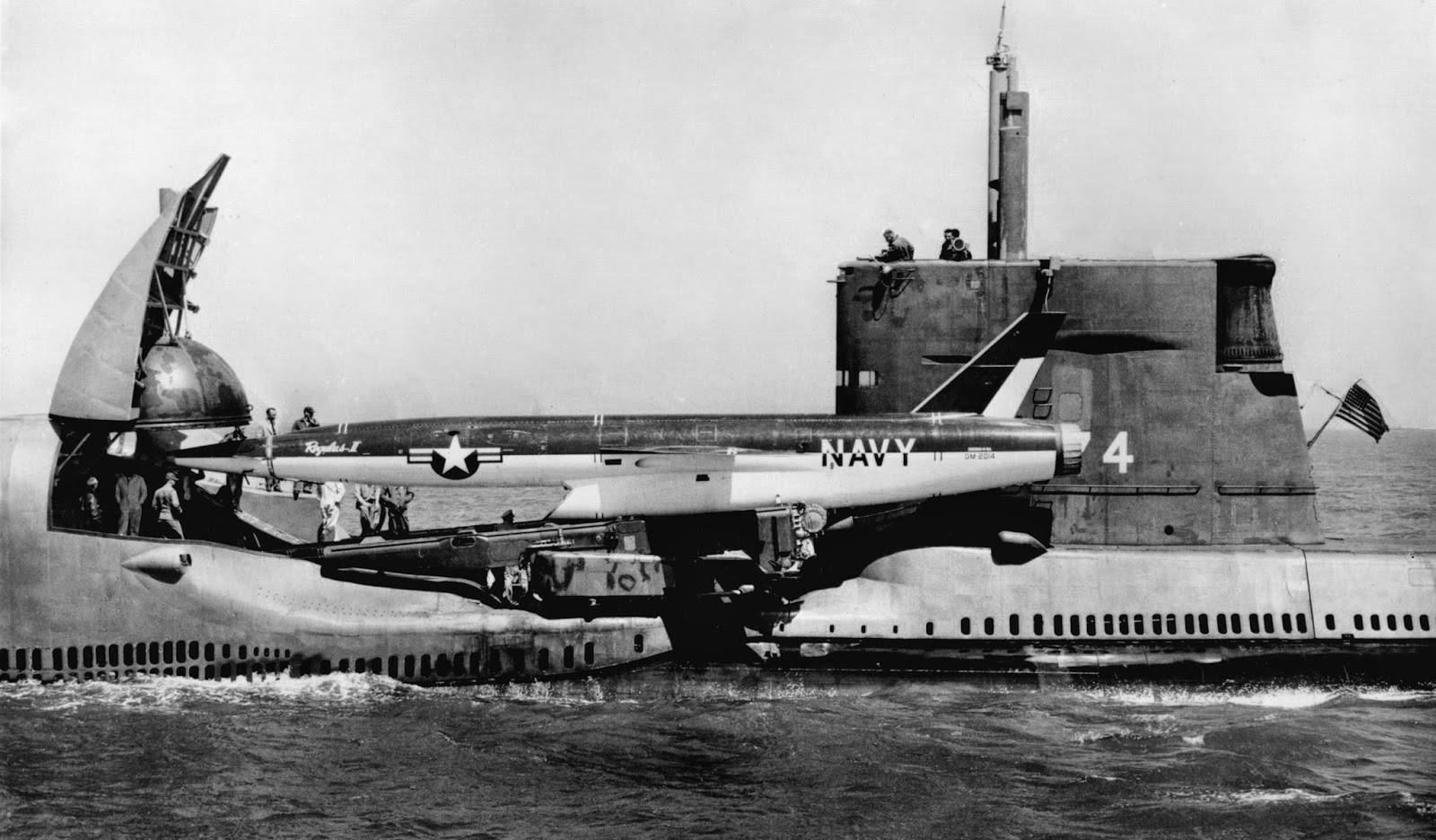
The missile used a solid fuel rocket booster to get it moving, and a GE J79 turbojet to fly at Mach 2 for about 1000 nautical miles, delivering a 2 Megaton W-27 thermonuclear warhead.
A nuclear-powered version of this submarine design was also built: The USS Halibut. It had a slightly cleaner look, apparently having been designed around the missile bay, rather than having it tacked on after construction.
Below, USS Halibut (SSGN-587) launches a Regulus II cruise missile with attached rocket boosters.

These were not the first guided missile submarines however. A previous generation of subs had carried Regulus I missiles, which had about half the range (500 nautical miles) of a Regulus II
Below, the USS Tunney launches a Regulus I cruise missile.

In the early cold war years, this arrangement was part of the strategic nuclear deterrent, However the development of the vertically-launched Polaris Missile and the 16 tube George Washington class ballistic missile submarine rendered this entire design obsolete.
Within 10 years of the launch of the first ship, the last of them had been removed from service as missile carriers. The Halibut was re-purposed as a special operations ship, and was decommissioned in 1976.
The USS Grayback and USS Growler were commissioned as standard diesel-electric attack submarines in 1957, but were modified in 1958 with a watertight missile hangars on the front deck. This allowed the ships to carry either (4) Regulus 1 missiles, or (2) Regulus 2 missiles. The result was not pretty.
USS Growler (SSG-577) surfaced and billowing diesel exhaust.
What was the purpose of these submarines and their aircraft hangars? Once again, nuclear deterrence. These ships were to stay submerged with their nuclear-tipped cruise missiles, and be prepared to fire them at the Soviet Union. However if the command to attack were ever given, a ridiculous series of events would have to take place to launch a missile.
To perform a launch, these submarines would have to surface, open the watertight hangar door, and then slide the missile out backwards. After that, the crew would unfold the wings and lock them in place, rotate the missile sideways so the exhaust wouldn't melt the ship, calibrate the missile's guidance system, (fuel the missile?), and launch it.
The missile also required radio control to reach its target, and two additional control stations were required along the missile's course. It surely would have made for interesting times if the enemy were able to take control of the missile in flight!
Below, USS Grayback (SSG-574) rolls out a Regulus II missile in preparation for launch.
The missile used a solid fuel rocket booster to get it moving, and a GE J79 turbojet to fly at Mach 2 for about 1000 nautical miles, delivering a 2 Megaton W-27 thermonuclear warhead.
A nuclear-powered version of this submarine design was also built: The USS Halibut. It had a slightly cleaner look, apparently having been designed around the missile bay, rather than having it tacked on after construction.
Below, USS Halibut (SSGN-587) launches a Regulus II cruise missile with attached rocket boosters.
These were not the first guided missile submarines however. A previous generation of subs had carried Regulus I missiles, which had about half the range (500 nautical miles) of a Regulus II
Below, the USS Tunney launches a Regulus I cruise missile.
In the early cold war years, this arrangement was part of the strategic nuclear deterrent, However the development of the vertically-launched Polaris Missile and the 16 tube George Washington class ballistic missile submarine rendered this entire design obsolete.
Within 10 years of the launch of the first ship, the last of them had been removed from service as missile carriers. The Halibut was re-purposed as a special operations ship, and was decommissioned in 1976.
Sunday, July 13, 2014
CANDU reactors
I had intended to write up a post about NMRI, or Nuclear Magnetic Resonance Imaging. I may or may not get to that post. To be frank, I don't find flipping atoms back and forth in a big magnet quite as interesting as discovering X-rays or splitting atoms.
So instead of a post on NMRI, I am going to write a post about splitting atoms :)
So instead of a post on NMRI, I am going to write a post about splitting atoms :)
Sunday, May 18, 2014
Nuclear Propulsion - So many options!
Nuclear Propulsion - that is, moving large objects by using the power of the atom - has been around for over half a century. It was 11 A.M. on 17 January 1955, when the USS Nautilus announced she was "Underway on Nuclear Power".
The primary use of nuclear power for propulsion has always been in submarines, where submerged endurance and detection avoidance are both critical.
Prior to nuclear propulsion, submarines were essentially surface ships that could submerge for brief periods of time. These subs used large storage batteries to travel while submerged. The batteries would discharge, and at that time the submarine would either have to surface or use a snorkel, at which point air could be drawn into the ship so that diesel generators could recharge the batteries.
Submarines' reliance on the internal combustion engine was not convenient from a wartime perspective - it severely limited both submerged endurance and detection. For submarines, nuclear propulsion increased the operating envelope a thousand-fold.
The other chief use of nuclear propulsion is in aircraft carriers. The reason nuclear propulsion is chosen for aircraft carriers is that fuel storage that would otherwise be required for propulsion can now be made available for aviation fuel. Using nuclear propulsion on the largest ship in an aircraft carrier group also reduces the number of refueling ships required, thereby extending the range and/or endurance of the group.
A handful of cruisers were fitted with nuclear propulsion plants, but they are no longer being built. It is much less expensive to build and maintain a ship powered by gas turbines than a nuclear-powered ship, and the unique needs of submarines and aircraft carriers do not apply to other ships - thus these other ships are no longer being built with nuclear propulsion plants.
We have discussed the primary coolant/secondary steam system design, which is the typical propulsion plant arrangement in a nuclear-powered maritime vessel.
What a lot of people aren't aware of is just how eager scientists and engineers were to utilize nuclear energy for other types of propulsion, back in the early days of nuclear power. These engineers envisioned, developed, and tested a number of different technologies for harnessing the atom for propulsion. Let's take a look!
Below is a fascinating five-segment video from the Discovery Channel about the US Air Force's attempt to build a nuclear-powered bomber.
The US tested a number nuclear-powered aircraft engines. Below are two of them (courtesy of Wikipedia):
Experimental HTRE reactors for nuclear aircraft, (HTRE 3 left and HTRE 1 right) on display at Idaho National Laboratory near Arco, Idaho
43°30′42.22″N 113°0′18″W / 43.5117278°N 113.00500°W)

These clunky machines are just test beds, and would certainly need to be scaled down for aircraft use!
Nuclear Propulsion in space:
The Air Force wasn't the only entity that wanted to move things around with nuclear power. NASA wanted to make a nuclear rocket motor. Here is a cutaway of a NERVA (Nuclear Engine for Rocket Vehicle Application) motor.

Below, a test platform for a NERVA type rocket motor. Unlike the nuclear aircraft engines, these were very powerful and successful designs that could have been flown, although probably not on manned missions. The one below has not been fired yet, or these people would not be able to approach this closely.

Below is a cool video of a NERVA rocket engine being tested. Liquid hydrogen is being expanded in the motor, which is what provides the thrust. Well above the motor the hot hydrogen ignites, but this is simply an after-effect, not part of the process itself. Power ramps up at about 20 seconds, and a massive release of cryogenic hydrogen is released at 1:25. This might be from an overpressurized storage tank.
And lastly there is this... propulsion based on a series of nuclear bomb blasts, at which point we have entered the realm of science fiction! Exept that these have actually been explored as possibilities :)
The primary use of nuclear power for propulsion has always been in submarines, where submerged endurance and detection avoidance are both critical.
Prior to nuclear propulsion, submarines were essentially surface ships that could submerge for brief periods of time. These subs used large storage batteries to travel while submerged. The batteries would discharge, and at that time the submarine would either have to surface or use a snorkel, at which point air could be drawn into the ship so that diesel generators could recharge the batteries.
Submarines' reliance on the internal combustion engine was not convenient from a wartime perspective - it severely limited both submerged endurance and detection. For submarines, nuclear propulsion increased the operating envelope a thousand-fold.
The other chief use of nuclear propulsion is in aircraft carriers. The reason nuclear propulsion is chosen for aircraft carriers is that fuel storage that would otherwise be required for propulsion can now be made available for aviation fuel. Using nuclear propulsion on the largest ship in an aircraft carrier group also reduces the number of refueling ships required, thereby extending the range and/or endurance of the group.
A handful of cruisers were fitted with nuclear propulsion plants, but they are no longer being built. It is much less expensive to build and maintain a ship powered by gas turbines than a nuclear-powered ship, and the unique needs of submarines and aircraft carriers do not apply to other ships - thus these other ships are no longer being built with nuclear propulsion plants.
We have discussed the primary coolant/secondary steam system design, which is the typical propulsion plant arrangement in a nuclear-powered maritime vessel.
What a lot of people aren't aware of is just how eager scientists and engineers were to utilize nuclear energy for other types of propulsion, back in the early days of nuclear power. These engineers envisioned, developed, and tested a number of different technologies for harnessing the atom for propulsion. Let's take a look!
Below is a fascinating five-segment video from the Discovery Channel about the US Air Force's attempt to build a nuclear-powered bomber.
The US tested a number nuclear-powered aircraft engines. Below are two of them (courtesy of Wikipedia):
Experimental HTRE reactors for nuclear aircraft, (HTRE 3 left and HTRE 1 right) on display at Idaho National Laboratory near Arco, Idaho
43°30′42.22″N 113°0′18″W / 43.5117278°N 113.00500°W)
 WikiMiniAtlas
These clunky machines are just test beds, and would certainly need to be scaled down for aircraft use!
Nuclear Propulsion in space:
The Air Force wasn't the only entity that wanted to move things around with nuclear power. NASA wanted to make a nuclear rocket motor. Here is a cutaway of a NERVA (Nuclear Engine for Rocket Vehicle Application) motor.
Below, a test platform for a NERVA type rocket motor. Unlike the nuclear aircraft engines, these were very powerful and successful designs that could have been flown, although probably not on manned missions. The one below has not been fired yet, or these people would not be able to approach this closely.
Even docking with one of these briefly (Space Station Re-supply, for example) would be hazardous from a radiation standpoint.
According to wikipedia:
Building on the KIWI series, the Phoebus series were much larger reactors. The first 1A test in June 1965 ran for over 10 minutes at 1090 MW, with an exhaust temperature of 2370 K. The B run in February 1967 improved this to 1500 MW for 30 minutes. The final 2A test in June 1968 ran for over 12 minutes at 4,000 MW, the most powerful nuclear reactor ever built.
And lastly there is this... propulsion based on a series of nuclear bomb blasts, at which point we have entered the realm of science fiction! Exept that these have actually been explored as possibilities :)
Saturday, April 05, 2014
Nuclear Research Reactors - TRIGA MK 1 - Neutron Radiography
The TRIGA MK 1 was most often used to do Neutron Activation Analysis when I was at the facility. However there were some other uses to which it could be put. From time to time the MK 1 was used for neutron radiography.
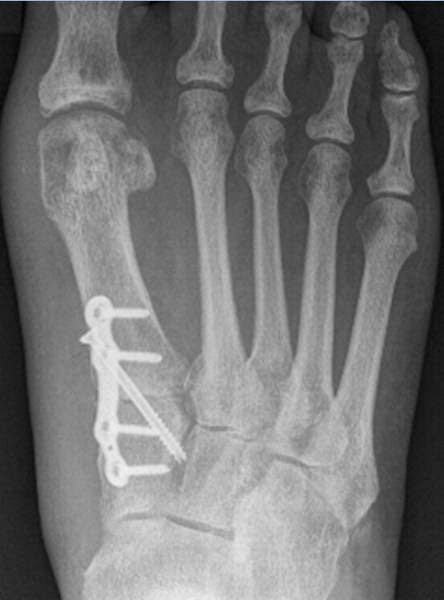
Most people are familiar with X-ray photography, and have seen pictures of broken bones, devices used to knit bones together, and pacemakers. Everyone has seen X-ray pictures. See below for a few examples (Click any image to enlarge).


X-rays are ideal for taking pictures of things that absorb X-rays, such as bone and metal. But if you need to look inside something made of metal... what then? X-rays won't make it through to the other side because they will be absorbed. Suppose we were to use neutrons instead?
Neutrons will go right through some metals and let you look at what is inside, because neutrons are absorbed by a different mechanism than X-rays. For example, if you wanted to image a rubber band inside of a lead brick, X-rays would be useless, but neutrons could do that. Let's look at a couple of examples of neutron radiography.
Below: An X-Ray image of a 35mm SLR camera: Note the lack of detail and large dark areas where metal has blocked the X-rays from reaching the film.

Below: The same camera, this time imaged using Neutron Radiography. Many more of the details of the internals are visible. The darker items in this image will tend to be plastics and other materials that contain hydrogen atoms.


My favorite. A motorcycle engine. You can see the intake valve to the right, exhaust valve to the left, valve seats, valve springs, the sparkplug, the piston rings, the piston and wrist pin, the connecting rod, and the bolts holding the thing together. You can even specks of corrosion or carbon buildup on the piston skirt. The resolution far surpasses most X-ray images.

Most people are familiar with X-ray photography, and have seen pictures of broken bones, devices used to knit bones together, and pacemakers. Everyone has seen X-ray pictures. See below for a few examples (Click any image to enlarge).
Broken Leg

Broken Big toe, with plate and a drywall screw

Pacemaker with stimulating wires

X-rays are ideal for taking pictures of things that absorb X-rays, such as bone and metal. But if you need to look inside something made of metal... what then? X-rays won't make it through to the other side because they will be absorbed. Suppose we were to use neutrons instead?
Neutrons will go right through some metals and let you look at what is inside, because neutrons are absorbed by a different mechanism than X-rays. For example, if you wanted to image a rubber band inside of a lead brick, X-rays would be useless, but neutrons could do that. Let's look at a couple of examples of neutron radiography.
Below: An X-Ray image of a 35mm SLR camera: Note the lack of detail and large dark areas where metal has blocked the X-rays from reaching the film.


Below is a somewhat blurry image of an air compressor. Even with the blur, you can make out the crankshaft, connecting rod, wrist pin, valves, and even the roller bearings. Try doing that with X-rays.


The only problem with neutron radiography is that you can't use it on living tissue. Neutrons are pretty lethal, and they also get absorbed, making things radioactive. Additionally, people, being mostly water, are opaque to neutrons. Nevertheless, neutron radiography is a very useful tool for imaging the inside of metallic objects.
The way neutron radiography was accomplished at the facility is thus: A 12"x12" square aluminum dry tube was placed in the reactor pool, next to the core. The dry tube was 25 feet long so that it could reach the bottom of the pool and sit close to the reactor core.
The dry tube gave neutrons (and unwanted gamma radiation) a path to escape the core without being absorbed in water. The length of the tube served to "collimate" the neutrons - to have them traveling in the same direction as they exited the top. This collimation helps to sharpen the image.
At the top of the tube would be a thin aluminum plate, upon which the item to be imaged rested. Just above the item would be an aluminum cassette containing a large piece of photographic film. I no longer recall if it was special film or just ordinary X-ray film. The reactor power level required for this process wasn't terribly high - perhaps 5 watts for 10 minutes exposure time. However just 5 watts of unshielded radiation straight up from the reactor core is a nasty dose.
While performing neutron radiography, the receptionist was required to leave the building, since she was not a trained Radiation Worker. I wasn't keen on getting dosed with neutron and gamma either, and I was a lot closer to the dry tube than the receptionist desk. Fortunately, this was an infrequent operation, so it probably wasn't necessary to move the reactor control console to a separate room.
Neutron radiography is a very cool imaging technique, with some useful real-world applications.
The Air Force's F-111 Aardvark (as well as other aircraft) had aluminum honeycomb structure inside the wings for stiffness. It was found that corrosion was occurring within the honeycomb. It would have been incredibly tedious and expensive to peel back the skin of every F-111 wing at maintenance intervals to perform a visual inspection. Instead, the Air Force used neutron radiography with a new TRIGA reactor at McClellan Air Force Base in Sacramento.
The more you know!
Thursday, April 03, 2014
Nuclear Research Reactors - The MK 4 Experiments *UPDATED*
I was a reactor operator at General Atomics in the late 1980's. General Atomics then operated two swimming-pool type TRIGA reactors. The first was a MK IV reactor that was the bread and butter of the reactor division of the company. It had two long-running experiments, one of which piggy-backed on the primary one.

The primary experiment that the MK IV was used for was in-core thermionic cell testing. The goal of testing the thermionic cells was to determine the longevity of these unique devices.
What the heck is a thermionic cell? In order to explain, we need to understand how a basic vacuum tube works.
Below is a diagram of a vacuum tube called a diode. It has two elements inside the glass tube (the circle). These elements are called the cathode and the anode. I prefer to call them an emitter and a collector. In this diagram, the bottom emitter is heated by an electrical current, labeled "Filament Supply". So - there is a short electrical loop completely dedicated to heating the spiral-wound filament, which is made of tungsten. Tungsten is chosen because it ejects electrons when heated. This process is called "Thermionic Emission"
Next, voltage is applied at the right side of the diagram, to put a positive charge on the Anode (collector), and a negative charge on the cathode (emitter). This causes electrical current to flow from the emitter at the bottom, to the collector at the top, just like it were a piece of copper wire.
Current will not flow in the other direction if the voltage on the right is reversed though, because the anode is not a heated piece of tungsten, ready to fling electrons out. This is the simplest vacuum tube around. It is called a diode, and it only lets current pass in one direction, from cathode (emitter) to anode (collector).


If you had enough of these devices in a single small reactor core, you could easily get a Megawatt of power. This would be perfect to launch into orbit as a power supply for your space laser, plasma weapon, or coil gun to shoot down incoming nuclear missiles - and in fact the project was funded by the Department of Defense through the Strategic Defense Initiative (aka the "Star Wars" Program).
The MK IV reactor was run round the clock in order to put reactor hours on the thermionic devices, to see how they would hold up, year after year.
We had some other people who wanted to use the MK IV reactor's spare neutrons, and run their "experiment" alongside the thermionic experiment. These guys were jewelers. That's right, they made jewelry. I don't think the jewelers had the income stream to keep the reactor running 24-7, so it was good that they could use the opportunity provided by the government's experiment.
This is where I learned about gemstone color enhancement. Improving the appearance of gemstones goes back to ancient times, when emeralds would be soaked in oil to hide their fractures. Nowadays though, a generic stone like topaz can be made beautiful by irradiation.
The stones were packed into canisters and placed in dry Cadmium-lined tubes (to provide fast neutron flux only). Even with fast neutron flux, due to trace impurities in the stones, they become radioactive during the process. The jewelers would come in once a week and rotate the stones using remote tools, so that the stones would be irradiated from all sides. After the stones were cooked, they would be removed from the reactor, but left on a shelf well below the water level, because they were quite radioactive, fresh out of the core.
 Below is a cut natural topaz. Nice clarity and cut, but I am not a fan of pee-yellow gemstones, and most others aren't either.

Below is a Topaz that has been irradiated with fast neutrons. This color is called "London Blue", or "Swiss Blue", and is actually about the color of Windex glass cleaner.


Below is the "Sky Blue" color you get when you irradiate a topaz with pure gamma rays from a Cobalt-60 source. Pretty. Also no neutrons, no radioactivity. You can wear it the next day.

As always, fascinating stuff!
****UPDATE****
An interested anonymous commenter has graciously done a lot of homework and helped out with content on the Gemstone Color Enhancement process. Thank you for that!
Here is a great link for a layman explaining how the various color shifts are achieved
Here is a cool research paper with experiments showing gemstone color changes with dose
Some early (1981) irradiated topaz stones were released before the radioactivity had died down
A nice long-form explanation of topaz color enhancement
Lastly, the link where all the above links (and many more) Can be found:
All very cool information! Thanks again Anon commenter :)
Below, a TRIGA reactor similar to the one I operated. Yes, it glows just like that!
The primary experiment that the MK IV was used for was in-core thermionic cell testing. The goal of testing the thermionic cells was to determine the longevity of these unique devices.
What the heck is a thermionic cell? In order to explain, we need to understand how a basic vacuum tube works.
Below is a diagram of a vacuum tube called a diode. It has two elements inside the glass tube (the circle). These elements are called the cathode and the anode. I prefer to call them an emitter and a collector. In this diagram, the bottom emitter is heated by an electrical current, labeled "Filament Supply". So - there is a short electrical loop completely dedicated to heating the spiral-wound filament, which is made of tungsten. Tungsten is chosen because it ejects electrons when heated. This process is called "Thermionic Emission"
Next, voltage is applied at the right side of the diagram, to put a positive charge on the Anode (collector), and a negative charge on the cathode (emitter). This causes electrical current to flow from the emitter at the bottom, to the collector at the top, just like it were a piece of copper wire.
Current will not flow in the other direction if the voltage on the right is reversed though, because the anode is not a heated piece of tungsten, ready to fling electrons out. This is the simplest vacuum tube around. It is called a diode, and it only lets current pass in one direction, from cathode (emitter) to anode (collector).
So with this understanding of a basic vacuum tube, let's see if we can figure out a thermionic cell.
Suppose in our drawing above, we crank up the power provided by "Filament Supply", so the tungsten emitter is really blasting electrons out. Next, we put the emitter in the center of the vacuum tube, and the collector encircles it, so that no matter what direction the electrons go, the anode (collector) will capture them. This process is called thermionic conversion. You heat the cathode hot enough and it kicks out electrons, and now you have DC current from cathode (emitter) to anode (collector). On the right side of our drawing above, you could power a light bulb with this current.
The clever part of thermionic conversion is you get DC power without the need for a boiler, steam turbine, generator, condenser, pumps, etc, etc. It's a pretty simple and elegant arrangement.
In a nuclear thermionic cell, the emitter is a small thimble of uranium that is coated with tungsten. Around the emitter is a slightly larger collector. The assembly is placed in a reactor. Fission begins in the uranium, which in turn heats the tungsten coating. The tungsten ejects electrons, and current flows in the thermionic cell. Even a tiny thermionic cell can generate 1KW of low-voltage but high amperage power.
Below: A top-down cutaway of a nuclear thermionic cell. The cathode is made from tungsten-coated enriched uranium and inserted into a reactor.

If you had enough of these devices in a single small reactor core, you could easily get a Megawatt of power. This would be perfect to launch into orbit as a power supply for your space laser, plasma weapon, or coil gun to shoot down incoming nuclear missiles - and in fact the project was funded by the Department of Defense through the Strategic Defense Initiative (aka the "Star Wars" Program).
The MK IV reactor was run round the clock in order to put reactor hours on the thermionic devices, to see how they would hold up, year after year.
We had some other people who wanted to use the MK IV reactor's spare neutrons, and run their "experiment" alongside the thermionic experiment. These guys were jewelers. That's right, they made jewelry. I don't think the jewelers had the income stream to keep the reactor running 24-7, so it was good that they could use the opportunity provided by the government's experiment.
This is where I learned about gemstone color enhancement. Improving the appearance of gemstones goes back to ancient times, when emeralds would be soaked in oil to hide their fractures. Nowadays though, a generic stone like topaz can be made beautiful by irradiation.
The stones were packed into canisters and placed in dry Cadmium-lined tubes (to provide fast neutron flux only). Even with fast neutron flux, due to trace impurities in the stones, they become radioactive during the process. The jewelers would come in once a week and rotate the stones using remote tools, so that the stones would be irradiated from all sides. After the stones were cooked, they would be removed from the reactor, but left on a shelf well below the water level, because they were quite radioactive, fresh out of the core.
It would take quite a while for the radioactivity to die off enough for the stones to be released to the public. The jewelers probably had 5-10 million dollar's worth of inventory stacked out in cheap sheet-metal lockers at a given time, waiting for the activity to fade.
Here is a raw uncut, uncolored topaz, as you would find it in nature. Not impressive.
Below is a Topaz that has been irradiated with fast neutrons. This color is called "London Blue", or "Swiss Blue", and is actually about the color of Windex glass cleaner.
Below is a Topaz that has been irradiated by fast neutrons, and afterwards been irradiated by an electron beam provided by a linear accelerator. I like this color better, and the jewelers started producing these after a while. I helped install a used linear accelerator in the underground bunker.
As always, fascinating stuff!
****UPDATE****
An interested anonymous commenter has graciously done a lot of homework and helped out with content on the Gemstone Color Enhancement process. Thank you for that!
Here is a great link for a layman explaining how the various color shifts are achieved
Here is a cool research paper with experiments showing gemstone color changes with dose
Some early (1981) irradiated topaz stones were released before the radioactivity had died down
A nice long-form explanation of topaz color enhancement
Lastly, the link where all the above links (and many more) Can be found:
All very cool information! Thanks again Anon commenter :)
Thursday, February 06, 2014
K-141, Project 949A. Kursk [АПЛ "Курск"] Oscar II Class
The loss of the Kursk is recent enough that it probably doesn't need to be retold here, but I will do so anyway, in remembrance of the men lost.
Kursk was an Oscar II class submarine, and the last submarine built in the Soviet era. Construction began in 1990, and by the time she was completed and launched in 1994, the cold war had ended.
The Oscar II class were the largest attack submarines ever built, running about 500ft long, and 60 feet wide. When viewed in cross-section, the inner hull of the Oscar II class was circular, while the outer hull was oval-shaped. This oval-shaped outer hull gave the Oscar II ships the appearance of being fat. Between the inner and outer hulls were missile tubes containing 24 anti-ship missiles, as well as air banks.
Below: Oscar II submarines in port. They look a little chubby compared to other subs.

Kursk in port.

Below: The reason Oscar Class submarines look "fat". Lots of anti-surface ship firepower.

Profile of an Oscar II Class submarine

After the collapse of the Soviet Union, the sailors of the Northern Fleet were intermittently paid, and little money was available for repair and maintenance of the fleet. Kursk only made a single patrol between her launching in 1994 and her loss in 2000. With the lack of sea-time, it is probable that her crew was not well-trained, and certainly not proficient. It's not clear whether a well-trained and proficient crew would have altered the outcome, however.
On August 12, 2000, Kursk was participating in the largest Russian Naval exercise in 9 years, following the collapse of the Soviet Union. Three other submarines, the Russian flagship battlecruiser "Petr Velikiy" (Peter the Great) were participating, along with a flotilla of smaller vessels.
Kursk was preparing to fire a dummy torpedo at the battlecruiser Petr Velikiy, when an explosion occured. The accepted theory is that the highly concentrated HTP (High-Test Peroxide) hydrogen peroxide which fueled the torpedo leaked out and reacted, causing the torpedo engine to detonate, starting a fire.
A similar explosion caused by an HTP-fuelled torpedo was responsible for the loss of HMS Sidon in 1955, after which the British Navy abandoned torpedoes propelled by peroxide.
This first explosion was recorded on the SOSUS network, and was estimated to have an explosive force of 220-550lb TNT. A second, larger explosion measuring 6000-14000 lbs of TNT occured 135 seconds after the first explosion. Kursk came to rest in just 350 feet of water.
Rescue offers were made immediately by US, British, and Norwegian teams, but these offers were rebuffed by the Russian Navy. It was believed at the time that there were no survivors from the initial explosion.
I will turn the saddest part of this sinking over to Wikipedia:
Captain Lieutenant Dmitriy Kolesnikov, one of the survivors of the first explosion, survived in the ninth compartment in the turbine room at the stern of the boat after explosions destroyed compartments 1-5. Recovery workers found notes on his body. They showed 23 sailors (out of 118 aboard) had managed to enter compartment nine after the ship sank.
There has been much debate over how long the sailors might have survived. Some point out that many potassium superoxide chemical cartridges, used to absorb carbon dioxide and chemically release oxygen to enable survival, were found used when the craft was recovered, suggesting some of the crew survived for a significant time.
Kolesnikov's last note has a time of 15:15, indicating that he and the others in the aft compartment lived at least four hours after the explosion. 32 hours after the first explosion no sound was heard (i.e. hull tapping) to signal the Russian Submarine Rescue Vehicle Priz, when it attempted to mate with the aft escape trunk.
The oxygen generator cartridges appear to have been the cause of death; a sailor appears to have accidentally brought a cartridge in contact with the sea water, causing a chemical reaction and a flash fire. The official investigation into the disaster showed some men appeared to have survived the fire by plunging under the water. Fire marks on the walls indicate the water was at waist level in the lower area at this time. However, the fire rapidly used up the remaining oxygen in the air, causing death by asphyxiation.
In July 2002, the investigation committee concluded that a technical malfunction on a single Type 65-76 "Kit" (Whale) torpedo caused the first explosion, triggering a fire in the torpedo room which, two minutes later, caused 5-7 additional torpedo warheads to detonate.
The second explosion destroyed a large section of the submarine (at least 4 of the 9 compartments) killing up to 95 of the 118 crew members and causing the submarine to sink. Around 23 crew members survived the sinking and took refuge in the ninth compartment where they died due to carbon monoxide poisoning following a fire in that compartment (between 6 and 32 hours after the sinking).
Kursk was raised from the ocean floor in a difficult and expensive recovery project. Her bow was an unrecoverable mess and was cut off, using carbide coated cables. She was re-floated and returned to Russia, where her two reactors were decomissioned, and her side missiles were removed. Those of her 118 crew that were recovered were buried with honors.
Kursk was an Oscar II class submarine, and the last submarine built in the Soviet era. Construction began in 1990, and by the time she was completed and launched in 1994, the cold war had ended.
The Oscar II class were the largest attack submarines ever built, running about 500ft long, and 60 feet wide. When viewed in cross-section, the inner hull of the Oscar II class was circular, while the outer hull was oval-shaped. This oval-shaped outer hull gave the Oscar II ships the appearance of being fat. Between the inner and outer hulls were missile tubes containing 24 anti-ship missiles, as well as air banks.
Below: Oscar II submarines in port. They look a little chubby compared to other subs.

Kursk in port.
Below: The reason Oscar Class submarines look "fat". Lots of anti-surface ship firepower.
After the collapse of the Soviet Union, the sailors of the Northern Fleet were intermittently paid, and little money was available for repair and maintenance of the fleet. Kursk only made a single patrol between her launching in 1994 and her loss in 2000. With the lack of sea-time, it is probable that her crew was not well-trained, and certainly not proficient. It's not clear whether a well-trained and proficient crew would have altered the outcome, however.
On August 12, 2000, Kursk was participating in the largest Russian Naval exercise in 9 years, following the collapse of the Soviet Union. Three other submarines, the Russian flagship battlecruiser "Petr Velikiy" (Peter the Great) were participating, along with a flotilla of smaller vessels.
Kursk was preparing to fire a dummy torpedo at the battlecruiser Petr Velikiy, when an explosion occured. The accepted theory is that the highly concentrated HTP (High-Test Peroxide) hydrogen peroxide which fueled the torpedo leaked out and reacted, causing the torpedo engine to detonate, starting a fire.
A similar explosion caused by an HTP-fuelled torpedo was responsible for the loss of HMS Sidon in 1955, after which the British Navy abandoned torpedoes propelled by peroxide.
This first explosion was recorded on the SOSUS network, and was estimated to have an explosive force of 220-550lb TNT. A second, larger explosion measuring 6000-14000 lbs of TNT occured 135 seconds after the first explosion. Kursk came to rest in just 350 feet of water.
Rescue offers were made immediately by US, British, and Norwegian teams, but these offers were rebuffed by the Russian Navy. It was believed at the time that there were no survivors from the initial explosion.
I will turn the saddest part of this sinking over to Wikipedia:
Captain Lieutenant Dmitriy Kolesnikov, one of the survivors of the first explosion, survived in the ninth compartment in the turbine room at the stern of the boat after explosions destroyed compartments 1-5. Recovery workers found notes on his body. They showed 23 sailors (out of 118 aboard) had managed to enter compartment nine after the ship sank.
There has been much debate over how long the sailors might have survived. Some point out that many potassium superoxide chemical cartridges, used to absorb carbon dioxide and chemically release oxygen to enable survival, were found used when the craft was recovered, suggesting some of the crew survived for a significant time.
Kolesnikov's last note has a time of 15:15, indicating that he and the others in the aft compartment lived at least four hours after the explosion. 32 hours after the first explosion no sound was heard (i.e. hull tapping) to signal the Russian Submarine Rescue Vehicle Priz, when it attempted to mate with the aft escape trunk.
The oxygen generator cartridges appear to have been the cause of death; a sailor appears to have accidentally brought a cartridge in contact with the sea water, causing a chemical reaction and a flash fire. The official investigation into the disaster showed some men appeared to have survived the fire by plunging under the water. Fire marks on the walls indicate the water was at waist level in the lower area at this time. However, the fire rapidly used up the remaining oxygen in the air, causing death by asphyxiation.
In July 2002, the investigation committee concluded that a technical malfunction on a single Type 65-76 "Kit" (Whale) torpedo caused the first explosion, triggering a fire in the torpedo room which, two minutes later, caused 5-7 additional torpedo warheads to detonate.
The second explosion destroyed a large section of the submarine (at least 4 of the 9 compartments) killing up to 95 of the 118 crew members and causing the submarine to sink. Around 23 crew members survived the sinking and took refuge in the ninth compartment where they died due to carbon monoxide poisoning following a fire in that compartment (between 6 and 32 hours after the sinking).
Kursk was raised from the ocean floor in a difficult and expensive recovery project. Her bow was an unrecoverable mess and was cut off, using carbide coated cables. She was re-floated and returned to Russia, where her two reactors were decomissioned, and her side missiles were removed. Those of her 118 crew that were recovered were buried with honors.
Wednesday, February 05, 2014
K-278 Komsomelets (Project 685 Плавник), Mike Class
K-278 was a unique and magnificent submarine. Only one of this class of ship was built. Because she was so unusual, construction took an unusually long 5 years. Her construction began in April 1978, she was launched in May 1983, and commissioned on the last day of 1984. The Soviet Navy rarely named their submarines, but this ship was special, and received the name of "Komsomelets" - which means "a member of the Young Communist League".
Sunday, February 02, 2014
K-219 (Project 667A)
K-219 was a Soviet ballistic missile submarine. She was a Yankee I class ship, which carried sixteen liquid-fueled nuclear missiles for use against land targets in the US. The ship was propelled by two PWR reactors, and had two propellor shafts.
On a side note, the Soviet Navy gets credit for envisioning and building the first submarine to carry an ICBM, the Zulu Class submarine. The Zulu was a conventional diesel-electric submarine that was modified with an extended sail to carry a single nuclear-tipped long-range missile. It was also the first submarine to test launch a ballistic missile.
On a side note, the Soviet Navy gets credit for envisioning and building the first submarine to carry an ICBM, the Zulu Class submarine. The Zulu was a conventional diesel-electric submarine that was modified with an extended sail to carry a single nuclear-tipped long-range missile. It was also the first submarine to test launch a ballistic missile.
Thursday, January 30, 2014
K-8, Project 627 (проект 627)
November-Class submarine. Source: Wikipedia

K-8 was a November-Class Soviet submarine. The November class was the first class of Soviet nuclear attack submarines. This class of submarines suffered from reliability problems related to the ships' steam generators. The steam generators in these early nuclear ships frequently developed leaks.
Leakage from a steam generator tube allows very radioactive primary coolant to exit the reactor coolant loop and enter the non-radioactive steam cycle loop. This radioactivity, depending on the size and duration of the leak, can be hazardous to the crew. With the November Class' dual reactor design, it would seem feasible to shut a damaged reactor down, reduce the primary system pressure, and limp home.
K-8 developed steam generator leaks on three separate occasions. On one occasion however, the steam generator leak was so severe that one reactor experienced a Loss of Coolant Accident. The crew struggled to make repairs and to refill the primary coolant loop in order to prevent a core meltdown due to decay heat. Several of the crew received significant doses of radiation as well as radiation burns.
The end for K-8 came in a more mundane way however. In April of 1970, while operating at a depth of 400ft, a short circuit caused a fire, which spread to two compartments via the ventilation system. Both reactors were shutdown, and the captain ordered the ship abandoned. Things must have been hellish inside.
Fortunately, K-8 was part of a Soviet fleet exercise when the fire occurred, so help was nearby. A surface vessel was dispatched to tow her back to port for repairs.
Disabled submarines are difficult to keep afloat (even next to a pier), and the reason is this: Most of the ship is already submerged. This is partly due to the thickness of the pressure hull, but also the ship is designed to be pretty close to neutral bouyancy. When the main ballast tanks are full of air, a submarine will have positive bouyancy, but not a whole lot of it.
Submarines are not surface ships, so they are designed with round-bottom hulls. This makes them wallow badly on the surface in heavy seas. When a submarine pitches and rolls in the waves, air escapes from the main ballast tanks, which are vented at the bottom. With each wave, a little main ballast tank air spills out, and a little bouyancy is lost.
This air can be replaced by a couple of means. The first is a massive low-pressure roots blower that takes air in from a large snorkel mast, and forces water out of the main ballast tanks. This method only works if electrical power is available. With both reactors out of service, it is unlikely that the storage battery of K-8 could have supplied the LP blower with electrical power for very long.
The other method for replacing air in the main ballast tanks involves briefly "puffing" them with very high pressure air from the ship's air banks. I don't know the capacity of the high pressure air banks on this class of ship, but I do know the supply of air was not infinite. In any case, without having electricity to run a high-pressure air compressor, these would eventually run out of pressure be unable to displace water out of the ballast tanks.
The abandon-ship order of the captain of K-8 was countermanded when the towing vessel arrived. 52 crewmembers, including the captain, re-boarded the ship for the tow back to port. 73 crewmembers were taken aboard the towing vessel.
The ships encountered rough weather. After 80 hours of heroic but futile damage control, the K-8 flooded. Sadly, even though ships were nearby, she took 52 men with her, who are now on eternal patrol with her.
Wednesday, January 29, 2014
K-27, Project 645 (645 Кит-ЖМТ)
The Soviet and US Navies operated a large number of submarines, each generation improving in quality. A silent covert game of cloak and dagger took place beneath the waves that most people were completely unaware of.
The Soviets at one time had the largest fleet of submarines in the world. In many respects, advanced Soviet submarines were superior to their US cold war counterparts. Several Soviet submarine designs could dive to a greater depth than a standard US MK 48 torpedo!
US submarines (from the arrival of Thresher) had held the advantage of stealth, and superior sonar equipment. Soviet submarines, in contrast, held the advantage of survivability (due to double-hull construction and huge amounts of reserve bouyancy), weapon-carrying capacity, greater depth and top speed.
The US experimented with a variety of reactor/propulsion designs, but only one used a liquid-metal cooled reactor:
USS Seawolf (SSN-575) was the second US submarine (after USS Nautilus), and the only US submarine to have a liquid metal cooled reactor. The reactor was cooled using liquid sodium, which of course would be problematic for the crew if it ever leaked. Seawolf also had steam superheaters, for added efficiency. These were also problematic, and thus were seldom in service. Because liquid metal is much more efficient than water at removing core heat, the propulsion plant was only 40% the size of Nautilus'. Seawolf was eventually converted to a more typical S2W pressurized water reactor (PWR) with a saturated steam plant. PWR and saturated steam plants in US submarine design continues to this day.
The Soviets' emphasis on submarine speed, depth and power of course led to more propulsion designs that used liquid metal cooled reactors. Soviet reactors of this type used a Lead-Bismuth coolant that was far less hazardous than liquid sodium, at least from a fire hazard standpoint. From a power-weight (and size) standpoint, the liquid metal cooled reactor is far superior to a light water cooled reactor. From a safety standpoint, not so great.
Recall that liquid metal cooled reactors are Fast neutron reactors, or sometimes intermediate speed reactors. All liquid metal cooled reactors have a positive void coefficient of reactivity. That means that if the coolant inadvertantly boils in the core, reactor power will increase. Which will boil more metal, and increase power even more. This happens rapidly, and core damage (meltdown!) is fairly common with this type of reactor.
So with that background, lets talk about the Soviet submarine K-27, or Projekt 645.
The Soviet's first class of nuclear attack submarines was called the November class. They used dual 70 Megawatt PWR reactors for propulsion. 13 of these were built before technology allowed creation of superior designs. Even so, they were superior to the USS Nautilus, in speed, depth, and stealth. One could also argue that Nautilus was really an experiment to prove that nuclear propulsion could work on a submarine, rather than a true nuclear attack submarine, however, and not be wrong.
Profile of a November-Class Submarine:

Back to K-27. This was a unique single-ship design by the Soviets, just as Seawolf was for the US Navy. K-27 was a November-Class submarine with a unique power plant. Rather than two 70 Megawatt PWRs, the Soviets used two VT-1 liquid metal cooled reactors, with an output of 73 MW. The advantage of smaller footprint and weight of the metal-cooled reactors allowed more weapons to be carried.
She was laid down on June 1958 and launched in April 1962. She was commissioned October 1963 after full-scale builders sea trials and official tests. She performed well (although with heavy maintenance for the new metal-cooled reactors) until a reactor accident in the port (left) reactor happened in May 1968.
The ship was making a full speed submerged run, when a reactor automatic control rod withdrew itself. Boiling occured, and reactor power plummeted from 83% to 7% in about 90 seconds, as the core melted. Unfortunately for the crew, poor decisions made after the initial accident would cost many of them their lives.
The main purpose of cladding U-235 in a reactor with Zircaloy or Stainless steel is to keep the highly radioactive freshly split atoms from getting into the coolant and spreading. When the fuel assemblies melt down, these radioactive atoms mix in the coolant, and get outside the heavily shielded reactor vessel.
Unknown to the crew, the captain had the radiation alarms disabled. Radioactive gases were released from the fuel, which the crew were exposed to. Another captain might have surfaced the ship and ventilated it with the massive air blowers all submarines are equipped with. The ship limped home on the starboard reactor and was laid up for several years. Five sailors who worked in the propulsion plant died within a week of the accident, while 30 more died between 1968 and 2003. Quite a high death rate for a crew of young, healthy men.
K-27 was brought into shipyard, and the starboard reactor coolant was kept liquid by steam piped in at the shipyard while the radioactivity in the port side reactor died down. In 1973 the decision was made that repairing or replacing the reactor in the aging ship was not worthwhile, and the ship was decomissioned in February 1979.
Her disposal was... interesting. Rather than remove the melted down mess that remained of the port side reactor, the Soviets decided to fill her reactor compartment with a solidifying agent. Next they towed her, not out to sea, but very close to land. In 1982 they sunk her in just 100 ft of water, just offshore of Novaya Zemlya. Google Earth Coordinates Here
She didn't want to sink, however, so they ended up having to ram her.

There is now a great deal of urgency in re-floating K-27 and removing her radioactive coolant system and fuel. This is an environmental hazard that will eventually become a serious problem, and quite close to shore. Where it was disposed of is the Island of Novaya Zemlya, a harsh glacier-scoured island that has been a nuclear testing and dumping ground for generations.

Interestingly there is equipment available to de-fuel this unique ship that was used on many other liquid-metal cooled ships at the end of the cold war. However, this now-unused de-fueling equipment will not remain in optimum condition forever, so the race is on. Hopefully someone is interested in recovering this ship before it becomes a big environmental mess.
The Soviets at one time had the largest fleet of submarines in the world. In many respects, advanced Soviet submarines were superior to their US cold war counterparts. Several Soviet submarine designs could dive to a greater depth than a standard US MK 48 torpedo!
US submarines (from the arrival of Thresher) had held the advantage of stealth, and superior sonar equipment. Soviet submarines, in contrast, held the advantage of survivability (due to double-hull construction and huge amounts of reserve bouyancy), weapon-carrying capacity, greater depth and top speed.
The US experimented with a variety of reactor/propulsion designs, but only one used a liquid-metal cooled reactor:
USS Seawolf (SSN-575) was the second US submarine (after USS Nautilus), and the only US submarine to have a liquid metal cooled reactor. The reactor was cooled using liquid sodium, which of course would be problematic for the crew if it ever leaked. Seawolf also had steam superheaters, for added efficiency. These were also problematic, and thus were seldom in service. Because liquid metal is much more efficient than water at removing core heat, the propulsion plant was only 40% the size of Nautilus'. Seawolf was eventually converted to a more typical S2W pressurized water reactor (PWR) with a saturated steam plant. PWR and saturated steam plants in US submarine design continues to this day.
The Soviets' emphasis on submarine speed, depth and power of course led to more propulsion designs that used liquid metal cooled reactors. Soviet reactors of this type used a Lead-Bismuth coolant that was far less hazardous than liquid sodium, at least from a fire hazard standpoint. From a power-weight (and size) standpoint, the liquid metal cooled reactor is far superior to a light water cooled reactor. From a safety standpoint, not so great.
Recall that liquid metal cooled reactors are Fast neutron reactors, or sometimes intermediate speed reactors. All liquid metal cooled reactors have a positive void coefficient of reactivity. That means that if the coolant inadvertantly boils in the core, reactor power will increase. Which will boil more metal, and increase power even more. This happens rapidly, and core damage (meltdown!) is fairly common with this type of reactor.
So with that background, lets talk about the Soviet submarine K-27, or Projekt 645.
The Soviet's first class of nuclear attack submarines was called the November class. They used dual 70 Megawatt PWR reactors for propulsion. 13 of these were built before technology allowed creation of superior designs. Even so, they were superior to the USS Nautilus, in speed, depth, and stealth. One could also argue that Nautilus was really an experiment to prove that nuclear propulsion could work on a submarine, rather than a true nuclear attack submarine, however, and not be wrong.
Profile of a November-Class Submarine:
Back to K-27. This was a unique single-ship design by the Soviets, just as Seawolf was for the US Navy. K-27 was a November-Class submarine with a unique power plant. Rather than two 70 Megawatt PWRs, the Soviets used two VT-1 liquid metal cooled reactors, with an output of 73 MW. The advantage of smaller footprint and weight of the metal-cooled reactors allowed more weapons to be carried.
She was laid down on June 1958 and launched in April 1962. She was commissioned October 1963 after full-scale builders sea trials and official tests. She performed well (although with heavy maintenance for the new metal-cooled reactors) until a reactor accident in the port (left) reactor happened in May 1968.
The ship was making a full speed submerged run, when a reactor automatic control rod withdrew itself. Boiling occured, and reactor power plummeted from 83% to 7% in about 90 seconds, as the core melted. Unfortunately for the crew, poor decisions made after the initial accident would cost many of them their lives.
The main purpose of cladding U-235 in a reactor with Zircaloy or Stainless steel is to keep the highly radioactive freshly split atoms from getting into the coolant and spreading. When the fuel assemblies melt down, these radioactive atoms mix in the coolant, and get outside the heavily shielded reactor vessel.
Unknown to the crew, the captain had the radiation alarms disabled. Radioactive gases were released from the fuel, which the crew were exposed to. Another captain might have surfaced the ship and ventilated it with the massive air blowers all submarines are equipped with. The ship limped home on the starboard reactor and was laid up for several years. Five sailors who worked in the propulsion plant died within a week of the accident, while 30 more died between 1968 and 2003. Quite a high death rate for a crew of young, healthy men.
K-27 was brought into shipyard, and the starboard reactor coolant was kept liquid by steam piped in at the shipyard while the radioactivity in the port side reactor died down. In 1973 the decision was made that repairing or replacing the reactor in the aging ship was not worthwhile, and the ship was decomissioned in February 1979.
Her disposal was... interesting. Rather than remove the melted down mess that remained of the port side reactor, the Soviets decided to fill her reactor compartment with a solidifying agent. Next they towed her, not out to sea, but very close to land. In 1982 they sunk her in just 100 ft of water, just offshore of Novaya Zemlya. Google Earth Coordinates Here
She didn't want to sink, however, so they ended up having to ram her.
K-27 refusing to be scuttled:
There is now a great deal of urgency in re-floating K-27 and removing her radioactive coolant system and fuel. This is an environmental hazard that will eventually become a serious problem, and quite close to shore. Where it was disposed of is the Island of Novaya Zemlya, a harsh glacier-scoured island that has been a nuclear testing and dumping ground for generations.

Interestingly there is equipment available to de-fuel this unique ship that was used on many other liquid-metal cooled ships at the end of the cold war. However, this now-unused de-fueling equipment will not remain in optimum condition forever, so the race is on. Hopefully someone is interested in recovering this ship before it becomes a big environmental mess.
Tuesday, January 28, 2014
USS Scorpion (SSN-589) - Updated
Scorpion was a Skipjack-Class submarine. The Skipjack class was the nuclear-powered attack submarine class previous to the Thresher/Permit class. As such, they were not quite as deep-diving, although they did have a very sleek hull, which allowed for a high submerged speed. Skipjack-class submarines held (classified) speed records while using somewhat noisy 5-bladed screws, but lost this high speed when the screws were eventually replaced with quieter 7-bladed screws.
Monday, January 06, 2014
Kosmos 954
While poking around the internet for the previous post, I came across an event that I remember seeing on the news while I was still in high school. This event combines several things that fascinate me: Spaceflight, nuclear reactors, and radiological accidents! Not that radiological accidents are a good thing, but I find it interesting how they are dealt with...
This is about Kosmos 954. Kosmos 954 was a Soviet reconnaissance (spy) satellite that was part of the RORSAT (Radar Ocean Reconnaissance Satellite) program. This was a low-earth orbit satellite that used active radar to conduct surveillance on ocean traffic. Kosmos 954 was a pretty useful intelligence-gathering device, which circled the earth every 90 minutes in a 65 degree near-polar orbit, and could penetrate cloud cover to determine ship locations.
Photo of a RORSAT satellite in orbit.

Because Kosmos 954 used active radar, it required a great deal of power - more than a set of solar panels could provide. The power supply was a nuclear reactor with 110lbs of highly enriched U-235 that used liquid potassium/sodium coolant and used thermionic converters to generate large amounts of DC current for the radar system.
A diagram of the small reactor.


Cleanup began immediately - on the day of the crash. Operation Morning Light started Phase 1, to recover as much radioactive debris as possible before it was buried in snow. This lasted until April, when Phase 2 began. Phase 2 ran through October of 1978, while the ground would be mostly free of snow.
At the end of the cleanup, only 12 larger pieces of the satellite were recovered, and less than 1% of its fuel was ever recovered. The most radioactive piece recovered was emitting 500 Rem, which would give a lethal dose in 2 hours to anyone nearby.
Below: A recovered chunk of Kosmos 954.

As always, it is interesting to follow up to something that was on the news and learn more details than were available at the time.
This is about Kosmos 954. Kosmos 954 was a Soviet reconnaissance (spy) satellite that was part of the RORSAT (Radar Ocean Reconnaissance Satellite) program. This was a low-earth orbit satellite that used active radar to conduct surveillance on ocean traffic. Kosmos 954 was a pretty useful intelligence-gathering device, which circled the earth every 90 minutes in a 65 degree near-polar orbit, and could penetrate cloud cover to determine ship locations.
Photo of a RORSAT satellite in orbit.
Because Kosmos 954 used active radar, it required a great deal of power - more than a set of solar panels could provide. The power supply was a nuclear reactor with 110lbs of highly enriched U-235 that used liquid potassium/sodium coolant and used thermionic converters to generate large amounts of DC current for the radar system.
A diagram of the small reactor.
Kosmos 954 was launched in Sept 1977, but its orbit had become erratic by December. The Soviets secretly informed the US government that they had lost control of the satellite, and that the system that was intended to place the reactor package into a much higher orbit at the end of the satellite's useful life had failed.
On January 24, 1978, Kosmos 954 entered the earth's atmosphere and fell apart, scattering radioactive debris across western Canada - The Northwest Territory, Alberta, and Saskatchewan.

Cleanup began immediately - on the day of the crash. Operation Morning Light started Phase 1, to recover as much radioactive debris as possible before it was buried in snow. This lasted until April, when Phase 2 began. Phase 2 ran through October of 1978, while the ground would be mostly free of snow.
At the end of the cleanup, only 12 larger pieces of the satellite were recovered, and less than 1% of its fuel was ever recovered. The most radioactive piece recovered was emitting 500 Rem, which would give a lethal dose in 2 hours to anyone nearby.
Below: A recovered chunk of Kosmos 954.
As always, it is interesting to follow up to something that was on the news and learn more details than were available at the time.


Subscribe to:
Posts (Atom)