Search This Blog

Saturday, July 29, 2006

RIP Christine


Time for a blog update on an old friend (and nemesis) of mine, Christine.

Christine was my last motorbike, a 1979 Kawasaki KZ650. I bought that bike about a year ago from an optometrist in Palm Desert. He wasn't too mechanically inclined, and the bike needed some (more than some!) work, but the bike was fundamentally sound, and the price was right. Fuel cost for driving the truck to work was killing me, and I also just wanted some exhiliration.

So I brought the bike home and started commuting on it. At first I nearly crashed because the rear tire was so worn that it was squared off. As I got comfortable riding it and approached a curvy section of road, it started behaving erratically. First it wouldn't turn enough, then it turned too much! The rear tire was going up onto the "corner" between the sidewall and the flat spot where the tread was worn out. Scary!

After figuring out the handling problem, I decided to remove the rear tire myself and just take the rim into the motorcycle shop for tire replacement. I humped the bike up onto the center stand and pulled all the hardware off to remove the rear wheel. Turns out the bike wasn't up quite high enough to get the rear wheel out from under the fender. So I lifted the bike some more, kicking the wheel while supporting the bike. The bike rolled forward off the center stand, and fell to the ground without a rear wheel under it. On the way the exhaust pipe gouged a nasty gash in my shin, and afterwards it fell against the house, damaging my new stucco job. After telling a friend this story, he said I should name the bike "Christine".

After getting the new tire, Christine handled quite well. Very forgiving, predictable, and manageable. Not too fast though. She was heavy >500 lbs, and not too powerful, at 68 hp. But she was good enough for a commuter bike at 40 MPG - when she ran.

One day on the way home I stopped at an intersection, and when I tried to take off, the engine revved, but the bike went nowhere... like the clutch was pulled in. And I heard an odd metallic clinking sound. Not promising at all... So I picked up my truck and hauled Christine home. The front sprocked retaining nut had come loose and the front sprocket had fallen off the shaft. The metallic noise I'd heard had been the shaft spinning against the sprocket. No big deal - except the bike was down for a week while I waited for the replacement nut/lockwasher, and I was back to driving the 16 mpg F-250 4x4 turbodiesel.

There were a series of events where the bike slowly lost power and then eventually died and left me at the roadside. It was all fuel delivery - I could usually get it to run if I shook the bike around and sloshed fuel in the tank. It always seemed to happen when I was low (less than half a tank) on fuel. It also leaked fuel overnight out the carb overflows. I eventually figured out that the fuel petcock was sticking. It was supposed to open with engine vacuum, and close when the engine shut off. Instead it would stick open when the engine was off, overflowing the carbs. Worse, it would go shut at wide open throttle (low engine vacuum), and wouldn't re-open when engine vacuum returned to normal. It stranded me a lot until I got the petcock issue figured out and repaired.

When my petcock rebuild kit eventually arrived, I repaired the petcock but also decided to clean out the gas tank. I took it to work and ran a lot of water through it to rinse out any sediment, then I blew lots of air through it to drive off any moisture. One of the hoses I used must have been contaminated with something though. When I refilled the tank and started the bike, it barely would run, and it smoked like an old diesel engine. I wasted that entire tank of gas, and another gallon of gas that I used to rinse out whatever solvent or oil had gotten into the tank.

I decided to make Christine more pretty. Got rid of the silly fairing. Added cool blue LED bulbs to the speedo and tachometer. Put LED bulbs in the turn signals after one of them burned out. Replaced the side panels. Polished some of the rustier parts. Fixed a couple of oil leaks. Replaced the aluminum phillips screws with stainless steel allen head screws.

I was able to make her accelerate quite bit faster by advancing the timing and adjusting the points. The points were totally out of adjustment. It's amazing that she was even firing on two of the cylinders.

I bought a shim kit and valve cover gasket with the intention of adjusting the valve clearances - she had a tendency to backfire a bit, and I'm pretty sure that it was from one or more exhaust valve(s) hanging open.

And then the second to the last 'event' occurred. She died on me on the way home from work one morning after night shift. Just bogged down and sputtered to a stop. I realized that she had no juice. None of the lights was on, indicating a charging problem. So I checked the alternator coils and they seemed about right. I bought a rectifier/regulator to replace the seemingly faulty one. No dice.

So I did some further investigation and learned that maybe the alternator coils had a partial short. I ordered an upgraded aftermarket alternator. A nice three phase winding with a full three way bridge rectifier. The stuff took a frigging month to show up to the place I ordered it from. A beautiful riding month during which I was driving a truck with sucky fuel mileage.

While waiting for the parts to arrive, I cleaned the contacts through the ignition switch, as voltage drops through that switch can make the voltage regulator think it's delivering more voltage than it really is, causing its output to go low. Whatever the charging problem was, it was corrected by the new alternator and/or cleaning the ignition switch.

The next day I rode it to work for the first time in a month - and for the last time ever. Sure as heck, the headlight was *way* brighter, as were the gauges.

I was working nights, so the next evening I rode Christine to work (in 104 degree heat), and my riding partner blasted around a truck at 100+ mph, so I did the same.
Shortly after that, she began losing power and pinging a little. I eased off a bit, but it kept slowing down, dragging and dragging, sounding odd. Nothing I hadn't experienced with this bike a hundred times before, right? :)

"Fuel filter", I thought to myself, "I'll check it out when I get to work". I never made it to work. The rear wheel locked up as the engine seized. *Then* the fucking low oil pressure light came on. I coasted to the side of the road - something I've done *way* too many times on this goddam bike - and oil was blowing out the valve cover breather tubes. My riding partner rode off, oblivious!

A co-worker with a truck picked up me and my bike (again) and I spent part of the
night trying to free up the engine with penetrating oil in the cylinders and a 36" pipe wrench on the balancing wheel. Hahaha. I must have slagged it down pretty good, because it never budged.

Ya know I *really* wanted to get a sport bike, but convinced myself to go old and cheap instead. All I got was unreliability and unnecessary toil. Not again. Next time I'm getting a new bike. Right now I need to decide how deep to dig the hole to bury this one :)

There's a picture of me and Christine (back when she was rideable) here

Sunday, June 25, 2006

Burning down the house

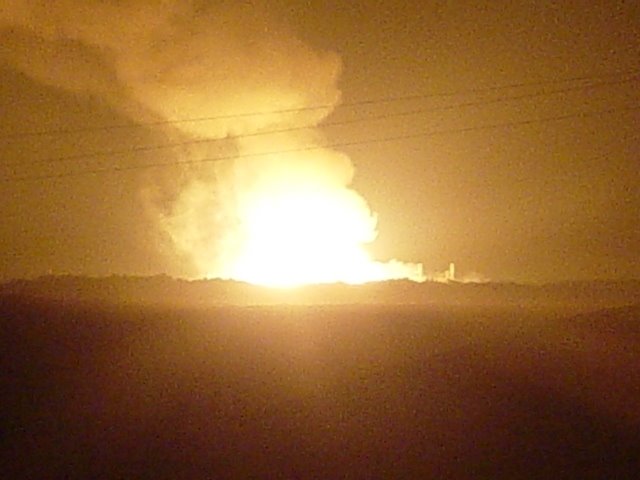
Gas pipeline rupture and fire in Texas. It happened just outside a power plant, on the fuel gas supply pipeline. The stacks can be seen just to the right of the fireball. Click any photo to enlarge


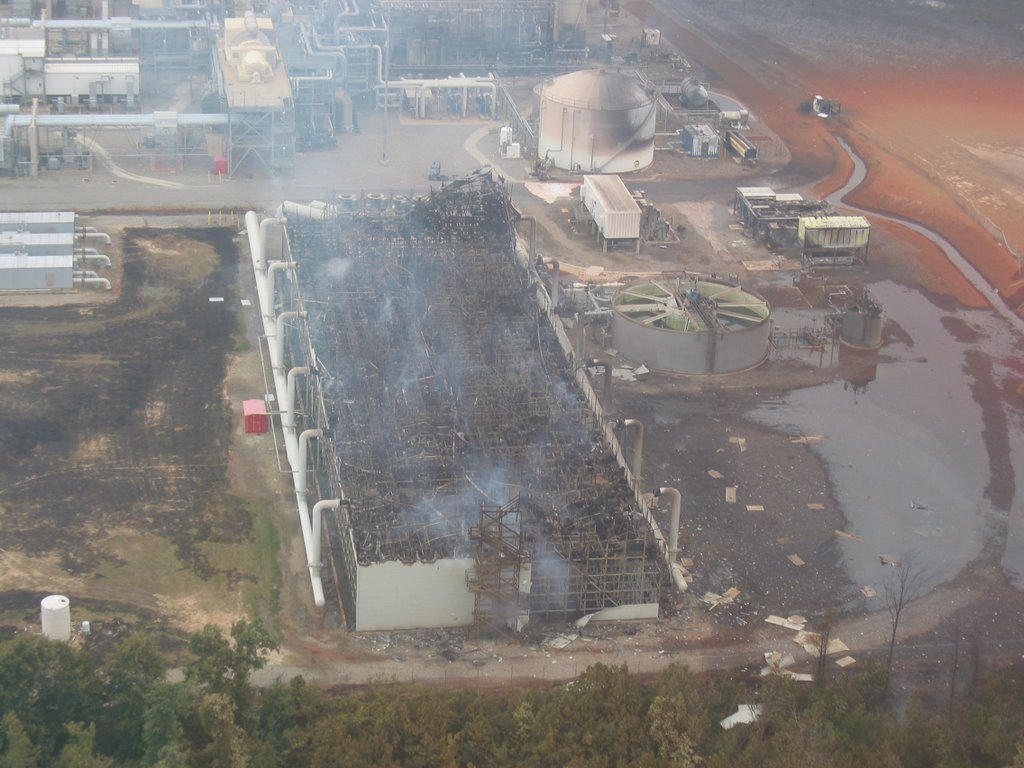
Aftermath. Amazingly no loss of life and only minor injuries occurred.


Cooling tower destroyed. Center of the blaze was apparently just off the frame to the right.

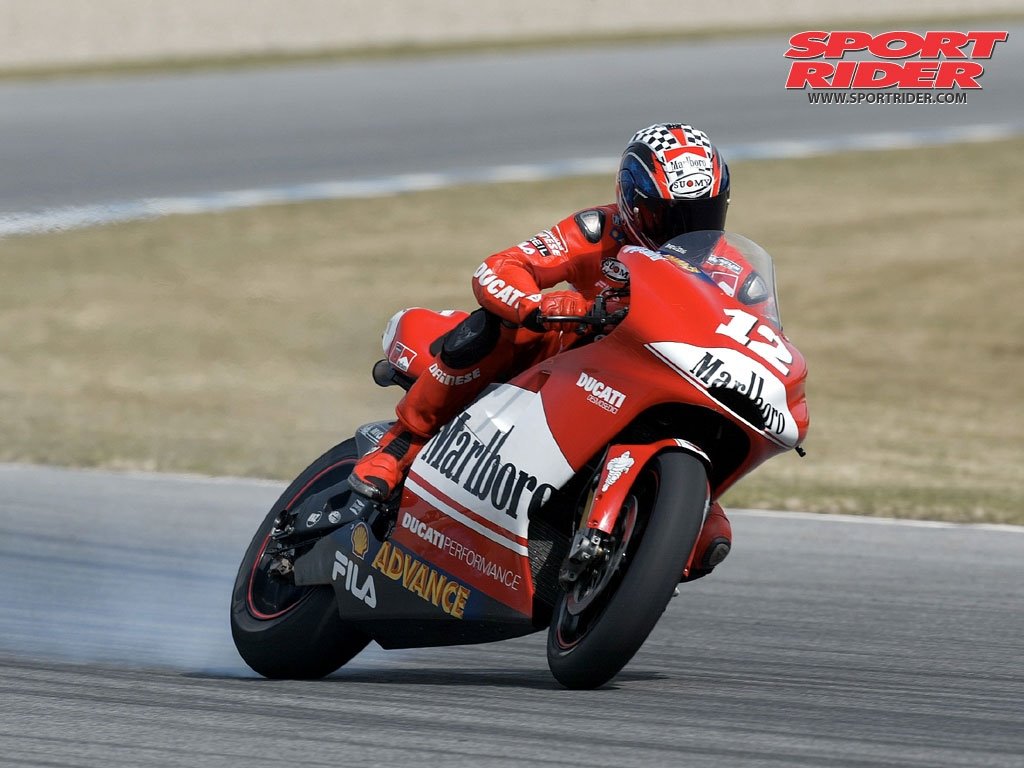
A cool Ducati GP moto shot

Stuff happens...

The previous post was about photos I've gathered of power plant damage due to accidents.  Here are a few more.

Bad day at the power plant

I've had the good fortune to avoid involvement in accidents involving serious injury or fatalities, although I've lost some friends and acquaintances. The energies involved in electrical generation are almost incomprehensible when they are uncontrolled. Here are a few pictures I've acquired over the years.

Wednesday, June 21, 2006

Aircraft engine failure

What happens when a aero unit turbine wheel fails.
1230 PM, Friday, June 2, 2006 at LAX. XXX Airlines Boeing
767 doing a high power engine run had a #1 engine HPT (high pressure turbine) failure.

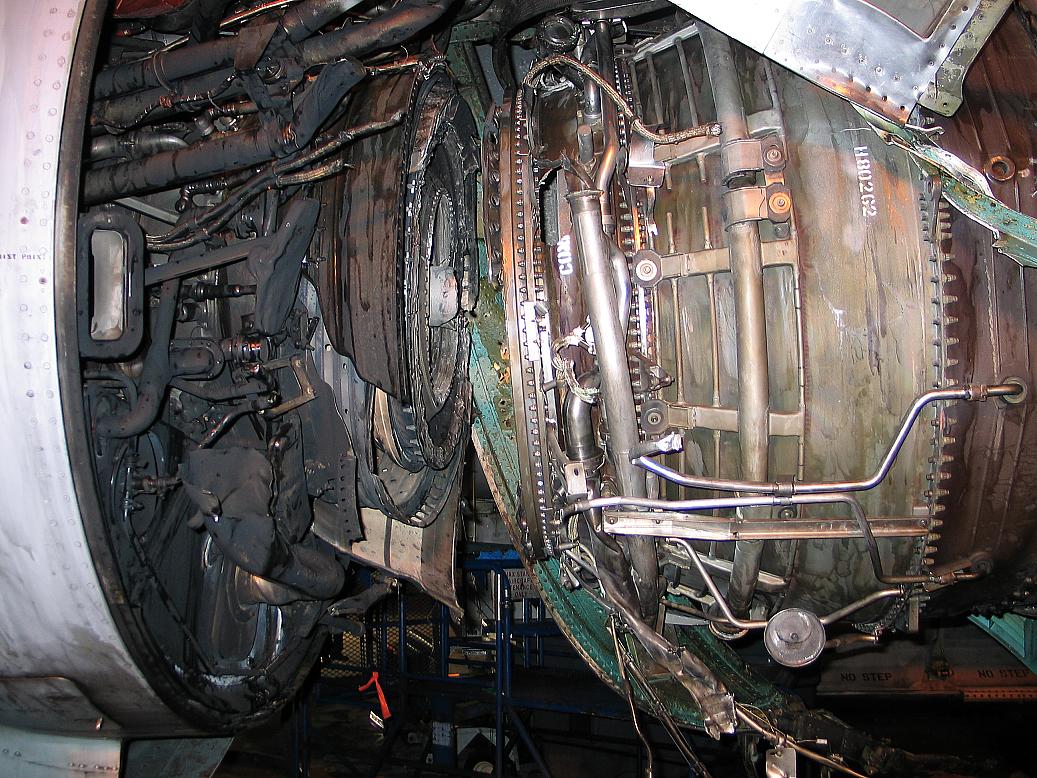
The HPT (High Pressure Turbine) failed catastrophically and punctured left wing, #2 engine, peppered the fuselage, and set fire to the aircraft. The turbine disk exited the engine,
sliced through the aircraft belly, and lodged in the outboard
side of the #2 engine. (on the opposite wing of the aircraft)

Choose your seats accordingly :)

Update:  Apparently the HP Turbine disks, which were forged from titanium alloy, had incorrect percentages of the alloy materials.  This allowed stress cracks to form on the disks, which of course failed under high stress.

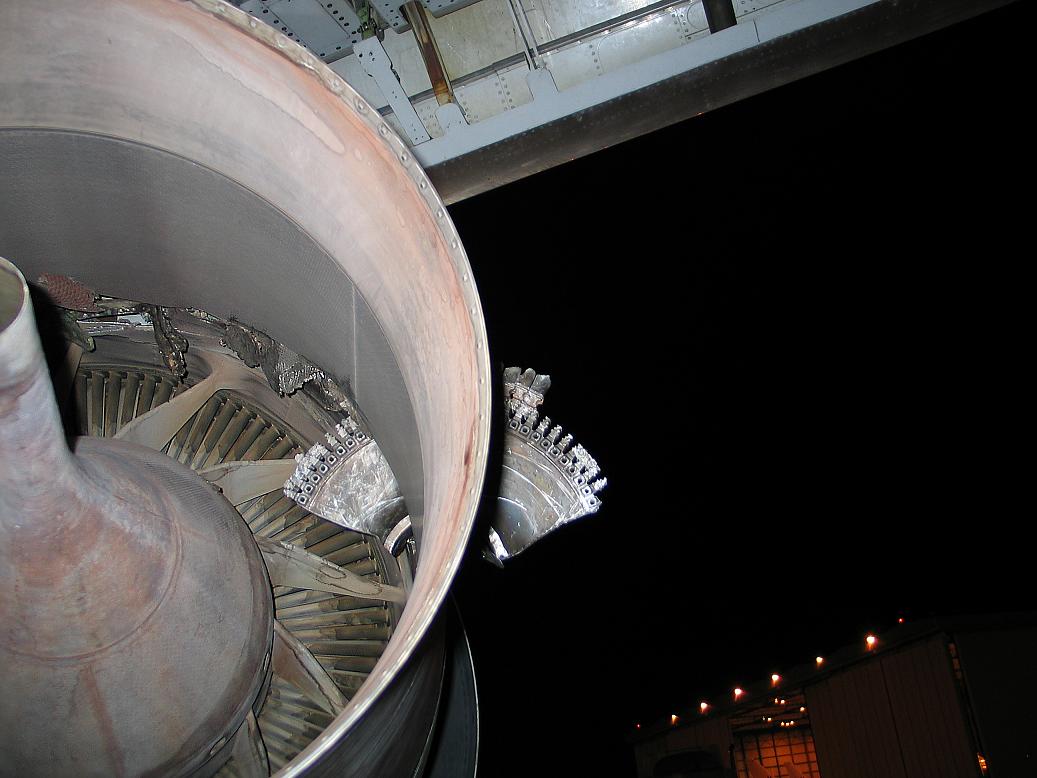
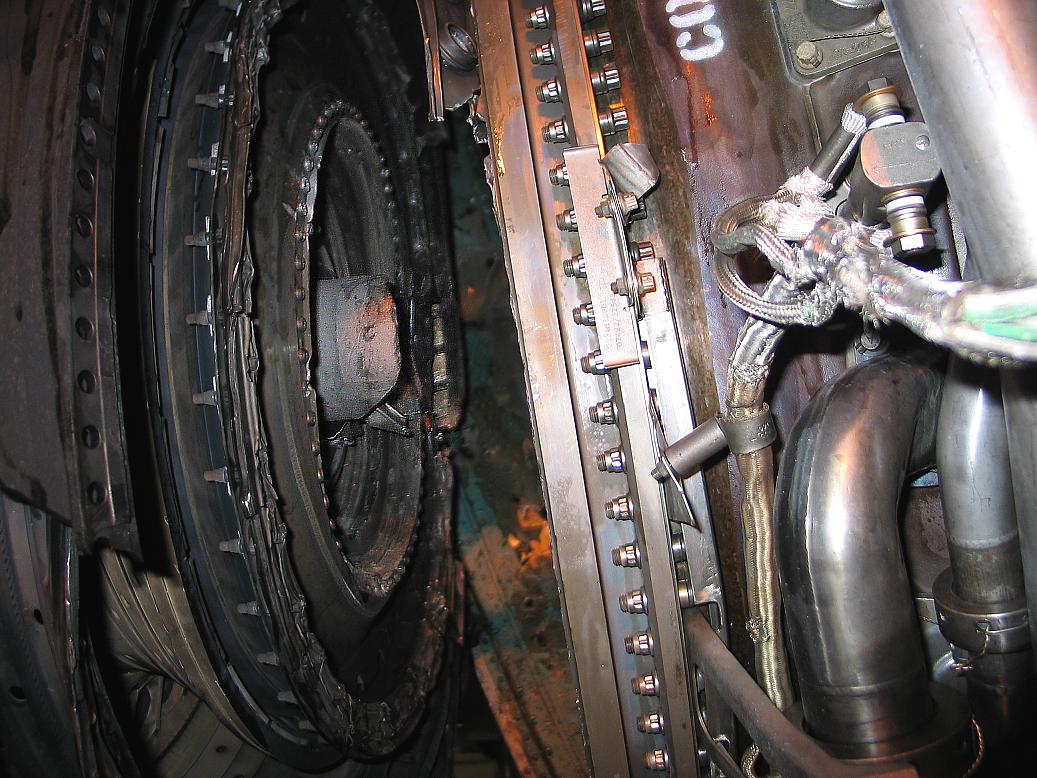
Below, part of the failed HP turbine disk, lodged in the engine on the opposite wing of the aircraft.


Same description, different angle.


Damage to the aircraft skin.  No surprises here - it's basically thick aluminum foil.


Below, the engine that suffered the failure.  The compressor section is to the right.  The failed disk split the compressor and turbine sections, and of course severed oil and fuel systems.  Flame escaped the turbine and the compressor fed the fire with plenty of air.  Not sure if the fire supression system was damaged also.


Close-up of the damaged section.


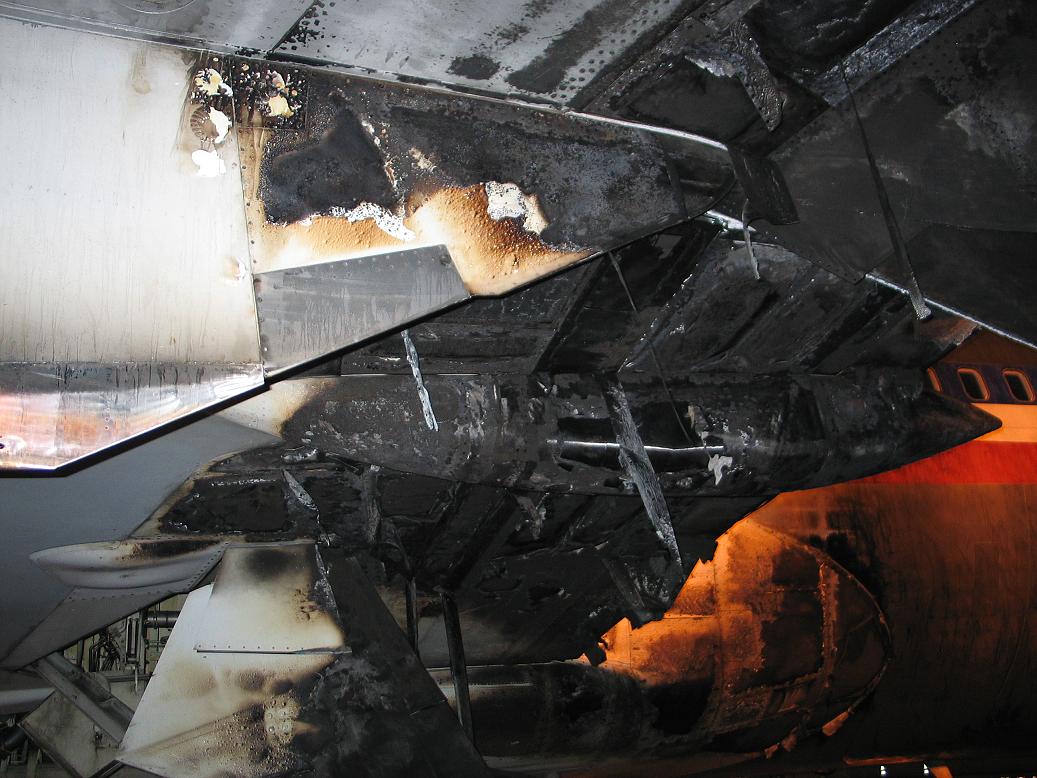
Fire damage aft of the engine.


Scorched paint on the fuselage.


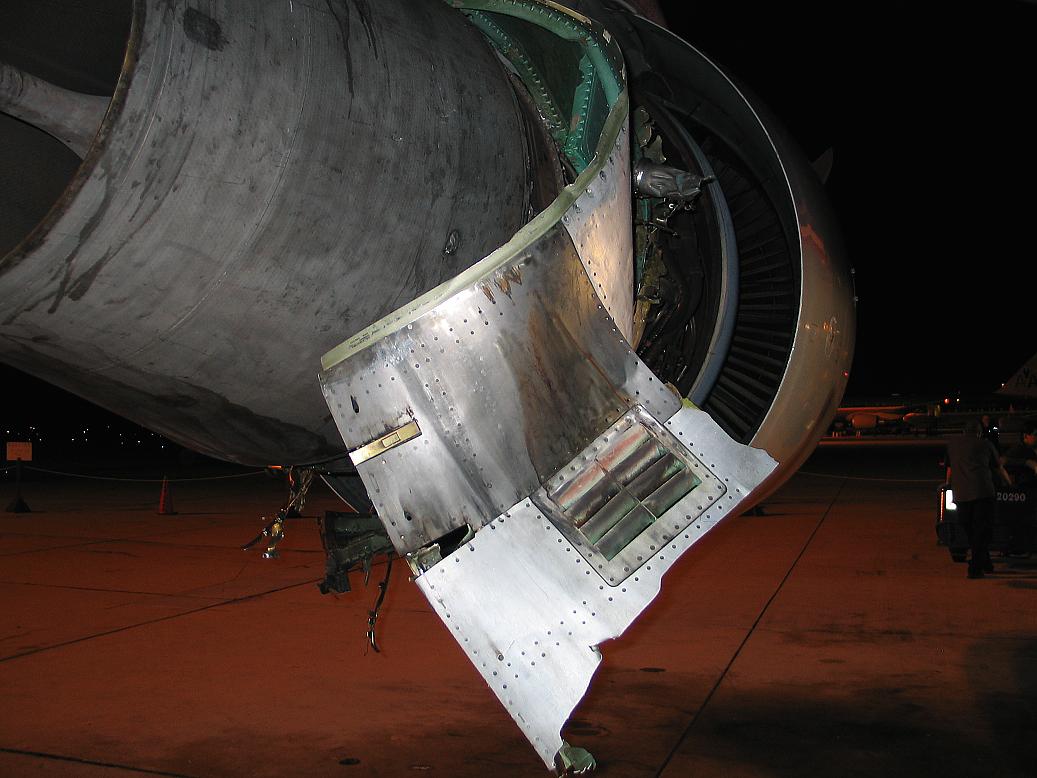
Damaged engine cowling.

Wednesday, June 14, 2006

Weight lifting

The blog description says that I'm interested in weight-lifting. That's true. I've also been on a hiatus from exercising since before I started this blog. Part of the reason is work related, and part of it is personal. Now however, I'm trying to get back on track by eating correctly and exercising consistently. So for the past three days I've been hitting it - and have the sore muscles to prove it!

Anyhow here's my routine, for those with interest:

Day 1
Back, Chest, Abs, Cardio

Day 2
Legs and Butt

Day 3
Delts, Abs, Cardio

Day 4
Arms

Day 5 Rest

Repeat ad infinitum.

The eventual goal is to get big and ripped - although it's unlikely as I have the physique of a Kenyan marathon runner (with none of the stamina). So I'll probably have to settle for muscular and fit. Anyway, I'm eating high quality carbs again and very high protein. Time to go do some stair-climbing!

Monday, June 05, 2006

JT8D turbofan


This is a cutaway of the impressive Pratt-Whitney JT8D turbofan. It's an aeroderivative engine used in peaking power plants, and the main competition to the GE LM2500.


A photo of the inlet end.

These are the engines I alluded to in a previous post that actually produce thrust (actually expanding hot gas) in a power plant environment, rather than shaft output. The engine rests on a stand, with the inlet connected to an air filter by ductwork. The exhaust is directed into a turbo-expander (not unlike a water-wheel arrangement) that converts the expanding gas into rotating energy, with the shaft perpendicular to the direction of thrust. Impressive fact: A single low-bypass aircraft engine can provide about 23 Megawatts of electricity.

Aeroderivative engines are high-maintenance. They are frequently changed out when parts fail on them.

The advantage of this arrangement over the LM2500 is that no alignment is required. The fuel lines, instrumentation and duct work are removed, and the engine can be pulled. Replacement is the reverse. The LM2500 must be carefully aligned with the generator shaft in addition to all of the above items. It lengthens the downtime when failure occurs.

Below:  JT8D installation.  Looking at the exhaust into the turboexpander.

I have not operated these type plants much at all, but according to co-workers, the JT8D can handle a compressor stall better than the GE machines as well.

Here's a photo of a dual JT8D installation:

Fascinating early jet engine


I lifted the photo from Wiki, along with the explanation. I'll turn it over to the original author:

"One problem with these early designs, which are called centrifugal-flow engines, was that the compressor worked by "throwing" (accelerating) air outward from the central intake to the outer periphery of the engine, where the air was then compressed by a divergent duct setup, converting its velocity into pressure. An advantage of this design was that it was already well understood, having been implemented in centrifugal superchargers. However, given the early technological limitations on the shaft speed of the engine, the compressor needed to have a very large diameter to produce the power required. A further disadvantage was that the air flow had to be "bent" to flow rearwards through the combustion section and to the turbine and tailpipe.

Austrian Anselm Franz of Junkers' engine division (Junkers Motoren or Jumo) addressed these problems with the introduction of the axial-flow compressor. Essentially, this is a turbine in reverse. Air coming in the front of the engine is blown towards the rear of the engine by a fan stage (convergent ducts), where it is crushed against a set of non-rotating blades called stators (divergent ducts). The process is nowhere near as powerful as the centrifugal compressor, so a number of these pairs of fans and stators are placed in series to get the needed compression. Even with all the added complexity, the resulting engine is much smaller in diameter."

It's impressive that a single stage centrifugal compressor could accomplish the necessary compression to produce enough thrust to fly an aircraft. Then too I've seen home-made turbocharger conversions to turbine engines. They aren't quite this level of sophistication though! :)

Anyway, it's a cool cutaway and I wanted to share it.

Saturday, June 03, 2006

Gas turbine cut-aways and photos

Here are a few cutaways and photos of gas turbines.

(Click on any image to enlarge)

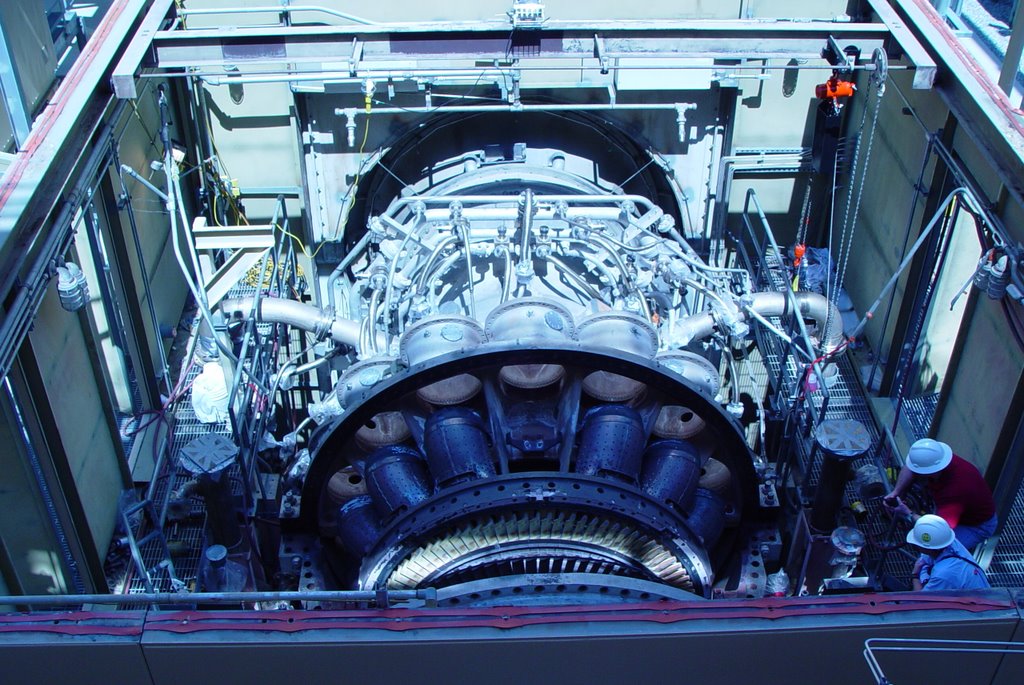
Above is a GE industrial turbine. Note that it is quite large and heavy, and how thick the casing is (bolting for the joints is near the bottom of the photo). Clearly this could never be mounted to an aircraft wing! The air intake is at the far end of the photo, while the exhaust is closest. The mass of smaller pipes is for fuel delivery to the combustors (which have been removed in this photo).

The turbine rotating blades are clearly visible in this picture. The first stage blades are exposed to very corrosive, very high temperature exhaust gas, and are ceramic coated to extend longevity - thus the yellow-ish color. Increasing firing temperatures increases the efficiency of the machines, so there is ongoing research to improve turbine blades. Although it cannot be seen in this photo, the compressor and turbine blades are all mounted on a single shaft that extends throughout the machine.


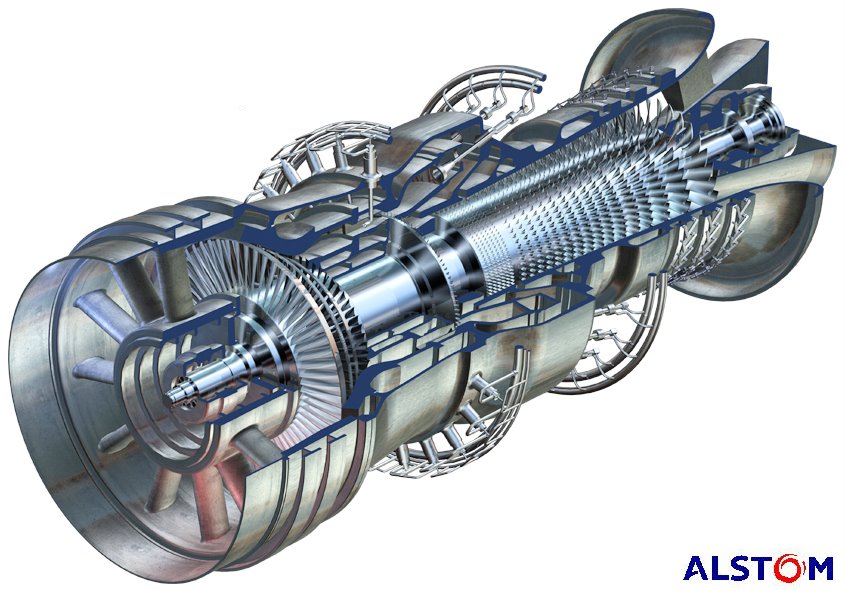
Above is a cut-away drawing of an Alstom industrial turbine. In this rendering, the exhaust is closest to the viewer, and with the cut-away, it is easy to see that the compressor and turbine blades are mounted on a common shaft. Air is drawn in at the far end, compressed, mixed with fuel and burned, and exhausted through the turbine.

This model is unique in that there are two combustion sections. The primary burn section is where the fuel nozzles enter at an angle. The exhaust gases pass through a single stage of turbine blades, then additional fuel is added and burned, and expanded through four more turbine stages. Theoretically in this manner firing temperatures can be reduced.


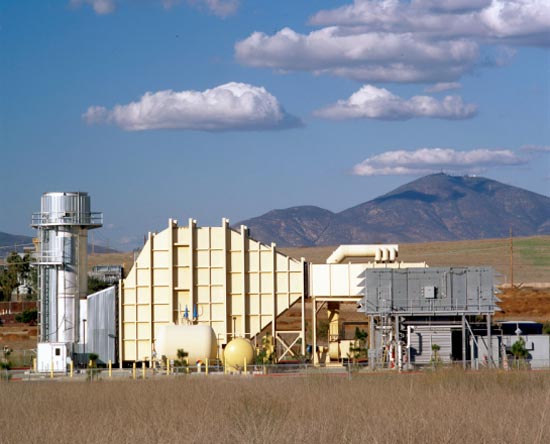
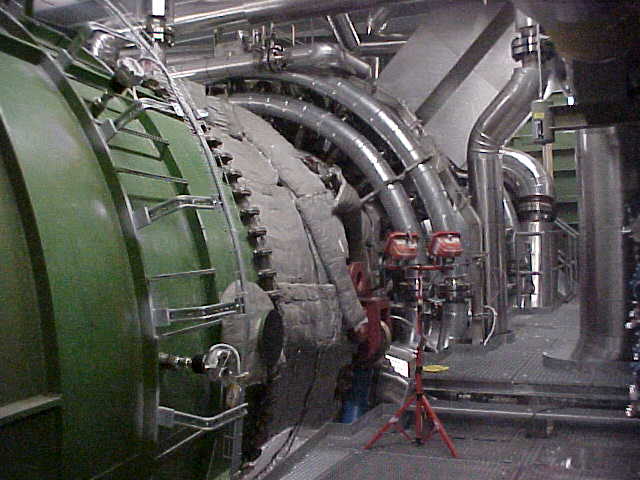
Here is a photo of the above machine.


The same machine, from the other side.


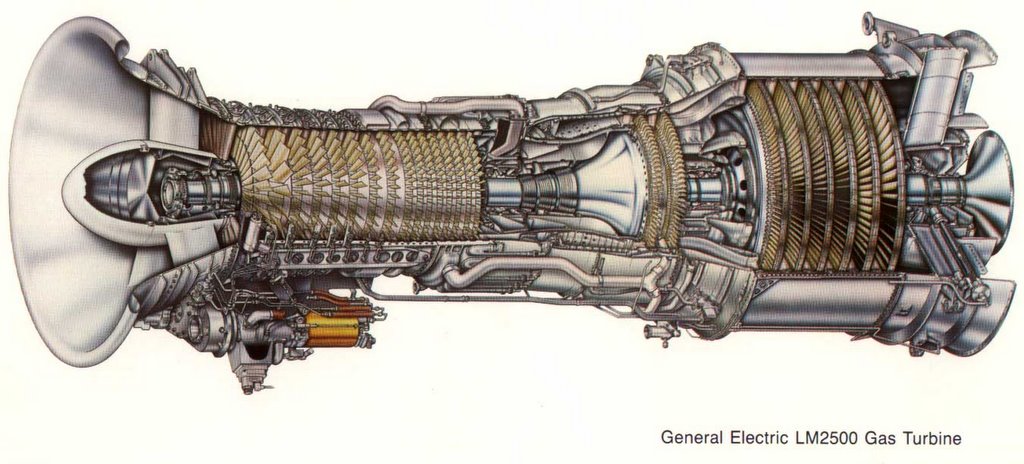
Lastly, here is an example of a commonly used aeroderivative gas turbine,the GE LM2500.
The air inlet is to the left. Air is compressed, fuel added and burned, which turns *two* turbines. This is a two-shaft machine. The first turbine is the high-speed turbine (two stages), which turns the compressor at about 9500 RPM.

The gas is not finished expanding however. It now passes to the second turbine - the power turbine. This second turbine is on a different shaft, rotating at 3600 RPM, which is coupled to an external generator (not shown). The technical term for this is "aerodynamic coupling". Basically the wind exiting the first turbine turns the second turbine.