Once again, it's been quite a while since I did a nerdy nuke post... Time to remedy that.

An advertisement-free blog about motorcycling, Northern life, home improvement, power plants, submarines, nuclear stuff, and a few other off-beat subjects. Comments are welcome. (Image is the Selway Crags in Northern Idaho)
Showing posts with label Fission. Show all posts
Showing posts with label Fission. Show all posts
Monday, August 26, 2019


Saturday, February 01, 2014
K-431 (Project 675)
K-431 was an Echo II class submarine. Construction was started in January 1964, and she was commissioned in September of 1965, in a very rapid construction process. The Echo II class was a twin reactor ship which carried cruise missiles for attacking surface ships. Not very pretty.

Sunday, October 20, 2013
The reactor with a hole in its head...
In 2002 the US came very close to having a massive loss of coolant accident that probably would have led to major core melting (melt-down), and a release of offsite contamination. Everyone knows about the meltdown at Three Mile Island, but not many people know about this...
Background:
In a Pressurized Water Reactor (PWR), the control rods are completely removed from the core after the reactor is up to full power, and dilute Boric Acid (a strong neutron poison) is carefully added to control reactivity.
The purpose of this process is to achieve a flatter neutron flux profile throughout the core.
A flat neutron flux is desirable for a couple of reasons: It helps to even out fuel burnup and it helps to reduce hot and cold coolant channels. When control rods are partially inserted into an operating reactor core, neutron flux is depressed near them, since they absorb neutrons. Therefore fewer fissions occur near the control rods. This localized reduction of fission causes uneven fuel burn and creates cold zones due to reduced fission near the rods. For a given power output, other sections of the reactor core away from the control rods must now run hotter to compensate.
Below, a side-view of a reactor core. The solid line indicates neutron population in this reactor at steady-state power, with a control rod partially inserted to control reactor power. Because there are very few neutrons in the area adjacent to the control rod, for a given power level, other areas of the core have to produce more fissions. The spots on the solid line marked "A" are those places where we might see excessive fissions, overheating, and possible fuel element failures.
The dashed line indicates neutron population with the control rod removed (which is possible if you add Boric Acid as a virtual liquid control rod). As you can see, neutron population is more consistent throughout the reactor, and therefore there won't be any excessive localized fission and heating, as you see at the points marked "A"
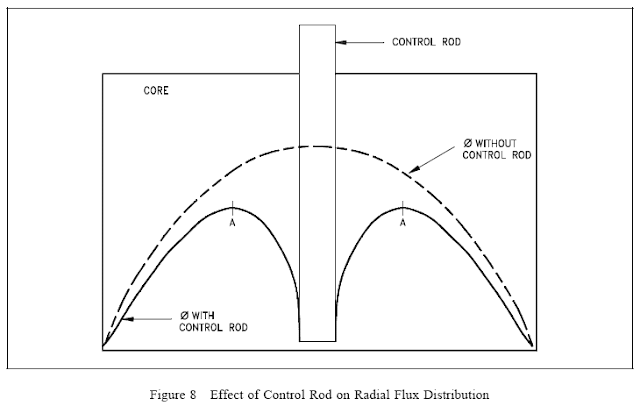
With borated primary coolant, neutrons are depressed equally throughout the core, and so power generation is more evenly distributed, and the reactor can be run closer to its thermal limit, because there is no need to account for hot and cold zones due to tilting of the neutron flux.
However you would hope that there is a better way to keep a flat neutron flux profile throughout a reactor core than using very hot diluted boric acid in the primary coolant loop.
As mentioned above, the primary coolant in these PWR reactors contains Boric Acid, which is a mild acid. For this reason, the piping, pumps, valves, etc are all made of high chrome steel (stainless steel).
The reactor vessel and closure head, however, are not. Due to their size, it is impractical to make the entire thing from stainless steel. Instead, the reactor vessel and head are made from carbon steel, and their interior is clad with a sheet of 3/8" thick stainless steel. In this way, the carbon steel, which is not resistant to acids, is protected from contact with the Boric Acid in the primary coolant.
The Event:
In 2002, Davis-Besse nuclear power plant in Ohio discovered they had a very minor primary coolant leak. The coolant was leaking out along a penetration in the reactor vessel head, where a Control Rod Drive Mechanism (CRDM) was mounted. The CRDM is what pulls the control rods out of the core and allows the reactor to start and shut down. The coolant leak was so minor that it hadn't been noticed - in a million gallon system, a minor leak can go undetected almost forever. Any water leaking from the primary coolant would also be quite hot and would flash to steam immediately, so no water puddling would occur.
Davis-Besse had a tiny coolant leak, however. One which they were unaware of. In 2002 the plant shut down for a refueling outage, and performed an inspection underneath the insulation on the reactor vessel head. This was done after other plants of the same design had uncovered minor leakage. They found a little problem...
At the time it was discovered, the acid had eaten away a hole the size of a football completely through the reactor vessel head in the area of the leaking CRDM penetration. The only thing that was holding the 2500 psig primary coolant in place was 3/8" of stainless steel cladding, which was bulging outwards from the pressure.
Below is a picture of a Babcock & Wilcox design PWR primary coolant loop, with the reactor vessel head highlighted.

Below is a cut-away of a B&W reactor vessel head, with a zoom-in on the point of the leak.

Below are images of the hole in the reactor vessel head.

The photo below gives you an idea how thick engineers designed the reactor vessel head to keep 2500 psig of primary coolant in place. It's astonishing (and wonderful) that thin piece of 3/8" of stainless steel was able to keep the coolant from blasting out.

This would not have been merely a primary coolant leak. This would have been a major accident. Here are some of the potential consequences of such a massive leak, had the cladding ruptured:
Background:
In a Pressurized Water Reactor (PWR), the control rods are completely removed from the core after the reactor is up to full power, and dilute Boric Acid (a strong neutron poison) is carefully added to control reactivity.
The purpose of this process is to achieve a flatter neutron flux profile throughout the core.
A flat neutron flux is desirable for a couple of reasons: It helps to even out fuel burnup and it helps to reduce hot and cold coolant channels. When control rods are partially inserted into an operating reactor core, neutron flux is depressed near them, since they absorb neutrons. Therefore fewer fissions occur near the control rods. This localized reduction of fission causes uneven fuel burn and creates cold zones due to reduced fission near the rods. For a given power output, other sections of the reactor core away from the control rods must now run hotter to compensate.
Below, a side-view of a reactor core. The solid line indicates neutron population in this reactor at steady-state power, with a control rod partially inserted to control reactor power. Because there are very few neutrons in the area adjacent to the control rod, for a given power level, other areas of the core have to produce more fissions. The spots on the solid line marked "A" are those places where we might see excessive fissions, overheating, and possible fuel element failures.
The dashed line indicates neutron population with the control rod removed (which is possible if you add Boric Acid as a virtual liquid control rod). As you can see, neutron population is more consistent throughout the reactor, and therefore there won't be any excessive localized fission and heating, as you see at the points marked "A"

With borated primary coolant, neutrons are depressed equally throughout the core, and so power generation is more evenly distributed, and the reactor can be run closer to its thermal limit, because there is no need to account for hot and cold zones due to tilting of the neutron flux.
However you would hope that there is a better way to keep a flat neutron flux profile throughout a reactor core than using very hot diluted boric acid in the primary coolant loop.
As mentioned above, the primary coolant in these PWR reactors contains Boric Acid, which is a mild acid. For this reason, the piping, pumps, valves, etc are all made of high chrome steel (stainless steel).
The reactor vessel and closure head, however, are not. Due to their size, it is impractical to make the entire thing from stainless steel. Instead, the reactor vessel and head are made from carbon steel, and their interior is clad with a sheet of 3/8" thick stainless steel. In this way, the carbon steel, which is not resistant to acids, is protected from contact with the Boric Acid in the primary coolant.
The Event:
In 2002, Davis-Besse nuclear power plant in Ohio discovered they had a very minor primary coolant leak. The coolant was leaking out along a penetration in the reactor vessel head, where a Control Rod Drive Mechanism (CRDM) was mounted. The CRDM is what pulls the control rods out of the core and allows the reactor to start and shut down. The coolant leak was so minor that it hadn't been noticed - in a million gallon system, a minor leak can go undetected almost forever. Any water leaking from the primary coolant would also be quite hot and would flash to steam immediately, so no water puddling would occur.
Davis-Besse had a tiny coolant leak, however. One which they were unaware of. In 2002 the plant shut down for a refueling outage, and performed an inspection underneath the insulation on the reactor vessel head. This was done after other plants of the same design had uncovered minor leakage. They found a little problem...
At the time it was discovered, the acid had eaten away a hole the size of a football completely through the reactor vessel head in the area of the leaking CRDM penetration. The only thing that was holding the 2500 psig primary coolant in place was 3/8" of stainless steel cladding, which was bulging outwards from the pressure.
Below is a picture of a Babcock & Wilcox design PWR primary coolant loop, with the reactor vessel head highlighted.


Below are images of the hole in the reactor vessel head.

The photo below gives you an idea how thick engineers designed the reactor vessel head to keep 2500 psig of primary coolant in place. It's astonishing (and wonderful) that thin piece of 3/8" of stainless steel was able to keep the coolant from blasting out.

This would not have been merely a primary coolant leak. This would have been a major accident. Here are some of the potential consequences of such a massive leak, had the cladding ruptured:
- A massive steam/water jet would have blasted out of this hole, certainly damaging this control rod, but possibly adjacent ones also. Could the ability of the reactor to shut down been compromised?
- The steam/water blast probably would have ripped tons of insulation loose. This would have fouled the intake of the emergency water re-injection system, which takes suction from the floor of the containment building.
- Major coolant leak accidents are typically modeled for weaker points in the primary coolant system - pumps, steam generators, drain lines, etc. These are equipped with remote-operated valves to isolate these leaks from the reactor core. This leak was was directly above the reactor core, and not isolable from it. Continuous water injection directly into the core would be required for several months to prevent decay heat from melting it.
- It is very likely that with the reactor fill system compromised due to ingesting insulation, and an unisolable leak right above the fuel, that core damage would have occurred.
Saturday, October 19, 2013
Odd Quirks About Nuclear Reactors - Criticality Accidents
One quirky thing about nuclear reactors: If you are not careful - particularly with Plutonium - it is possible to create a reactor unintentionally. That is, you can inadvertently assemble enough fissile material to start a chain reaction, outside of the safe confinement of a shielded reactor vessel.
Monday, October 14, 2013
Odd Quirks About Nuclear Reactors - Xenon and Decay Heat
There are a couple of things that all nuclear reactors do that make them behave quite differently than other, more mundane, heat sources. One is just odd, and the other is a little scary.
Unusual Reactors - Fast Neutron Reactors
In earlier posts I alluded to Fast Neutron Reactors. Here and Here.
In a Fast Neutron Reactor, there is no moderator. Neutron speed is allowed to remain at 49 million miles per hour. Because the neutrons are traveling so fast, the likelihood of them interacting with a Uranium-235 nucleus and causing a fission is very much reduced. To counter this, the enrichment of the fuel must be increased, typically to 20-30% U-235.
In a Fast Neutron Reactor, there is no moderator. Neutron speed is allowed to remain at 49 million miles per hour. Because the neutrons are traveling so fast, the likelihood of them interacting with a Uranium-235 nucleus and causing a fission is very much reduced. To counter this, the enrichment of the fuel must be increased, typically to 20-30% U-235.
Saturday, October 12, 2013
Nuclear Weapons - Plutonium Production
After the CP-1 Reactor successfully proved the concept of a self-sustaining fission reaction, the US accelerated its development of nuclear weapons. The Manhattan Project took a two-pronged approach to generating enough material to build the first bomb: Uranium Enrichment and Plutonium Production. This post is about Plutonium Production.
The post about Uranium Enrichment is linked here.
The post about Uranium Enrichment is linked here.
Friday, October 04, 2013
The CP-1 reactor
The first man-made nuclear reactor was built under the grandstand of Stagg Field, at the University of Chicago.
The first reactor was called a "pile". That may have been wartime jargon to hide its true nature from enemy spies, and it may have been descriptive. In fact, it was a pile of uranium and graphite blocks. It's designation was CP-1, or Chicago Pile #1. CP-1 was part of the Manhattan Project, the US government's secret WW2 program to rush a nuclear weapon into production. Its importance cannot be overstated.
The neutron had been discovered in 1932 by an Englishman named Chadwick. In 1938, Lise Meitner, Otto Hahn, and Fritz Strassman collaborated to recognize and report on the fission of Uranium by neutrons. By 1939 it was understood that excess neutrons from a split atom might be able create a self-sustaining reaction. The next step was inevitable: Make it happen.
Below: The experimental setup that led to the discovery of nuclear fission.

Thus CP-1 was born - an industrial scale-up of what had previously been bench-top experiments in laboratories, with the intent of proving the possibility of a self-sustaining fission chain reaction. The techniques for increasing enrichment of Uranium had not yet been invented. Therefore CP-1 used very pure refined metallic naturally occurring Uranium.
Since CP-1 was fueled by natural uranium, it was not possible to use water as a moderator. Light water absorbs too many neutrons. This would prevent a reactor with such a low percentage of U-235 to begin a chain reaction. Light water is a good moderator, but it is also a mild neutron poison.
For this reason, graphite was chosen for the moderator, as it absorbs neutrons 100x less often than water does Graphite is therefore a superior moderator, because it slows down neutrons while preventing their loss via absorption.
To create CP-1, several other laboratory-level experiments also had to be ramped up to industrial levels. At that point in time, the amount of pure metallic Uranium in the world was measured in grams. Further complicating issues was the fact that nobody had ever bothered segregating trace amounts of Boron (A very powerful neutron poison) from the Carbon that the graphite moderator was made from. After enough Uranium metal had been obtained, construction began. Small cylinders of Uranium were interspersed between large blocks of Boron-free graphite.
Enrico Fermi was in charge of the construction of the reactor. Fermi was a brilliant physicist, and was also probably the only man in the world who could have assembled and controlled a nuclear reactor at that time.
Below, a rendering of the CP-1 reactor. The three cylindrical things dangling from a cable are neutron detectors. The man standing is manipulating a control rod, which when removed, stopped absorbing neutrons and allowed a self-sustaining reaction to occur.

From Wiki:
However all these issues were overcome. On 2 December 1942, CP-1 was ready for a demonstration. Before a group of dignitaries, George Weil worked the final control rod while physicist Enrico Fermi carefully monitored the neutron activity. The pile "went critical" (reached a self-sustaining reaction) at 15:25. Fermi shut it down 28 minutes later.
Unlike most reactors that have been built since, CP-1 had no radiation shielding and no cooling system of any kind. Fermi had convinced Arthur Compton that his calculations were reliable enough to rule out a runaway chain reaction or an explosion. But, as the official historians of theAtomic Energy Commission noted, the "gamble" remained in conducting "a possibly catastrophic experiment in one of the most densely populated areas of the nation!"
With the proof at hand that a nuclear reaction could be made self-sustaining, the Manhattan Project would rapidly move forward toward a nuclear weapon.
The first reactor was called a "pile". That may have been wartime jargon to hide its true nature from enemy spies, and it may have been descriptive. In fact, it was a pile of uranium and graphite blocks. It's designation was CP-1, or Chicago Pile #1. CP-1 was part of the Manhattan Project, the US government's secret WW2 program to rush a nuclear weapon into production. Its importance cannot be overstated.
The neutron had been discovered in 1932 by an Englishman named Chadwick. In 1938, Lise Meitner, Otto Hahn, and Fritz Strassman collaborated to recognize and report on the fission of Uranium by neutrons. By 1939 it was understood that excess neutrons from a split atom might be able create a self-sustaining reaction. The next step was inevitable: Make it happen.
Below: The experimental setup that led to the discovery of nuclear fission.

Thus CP-1 was born - an industrial scale-up of what had previously been bench-top experiments in laboratories, with the intent of proving the possibility of a self-sustaining fission chain reaction. The techniques for increasing enrichment of Uranium had not yet been invented. Therefore CP-1 used very pure refined metallic naturally occurring Uranium.
Since CP-1 was fueled by natural uranium, it was not possible to use water as a moderator. Light water absorbs too many neutrons. This would prevent a reactor with such a low percentage of U-235 to begin a chain reaction. Light water is a good moderator, but it is also a mild neutron poison.
For this reason, graphite was chosen for the moderator, as it absorbs neutrons 100x less often than water does Graphite is therefore a superior moderator, because it slows down neutrons while preventing their loss via absorption.
To create CP-1, several other laboratory-level experiments also had to be ramped up to industrial levels. At that point in time, the amount of pure metallic Uranium in the world was measured in grams. Further complicating issues was the fact that nobody had ever bothered segregating trace amounts of Boron (A very powerful neutron poison) from the Carbon that the graphite moderator was made from. After enough Uranium metal had been obtained, construction began. Small cylinders of Uranium were interspersed between large blocks of Boron-free graphite.
Enrico Fermi was in charge of the construction of the reactor. Fermi was a brilliant physicist, and was also probably the only man in the world who could have assembled and controlled a nuclear reactor at that time.
Below, a rendering of the CP-1 reactor. The three cylindrical things dangling from a cable are neutron detectors. The man standing is manipulating a control rod, which when removed, stopped absorbing neutrons and allowed a self-sustaining reaction to occur.

From Wiki:
However all these issues were overcome. On 2 December 1942, CP-1 was ready for a demonstration. Before a group of dignitaries, George Weil worked the final control rod while physicist Enrico Fermi carefully monitored the neutron activity. The pile "went critical" (reached a self-sustaining reaction) at 15:25. Fermi shut it down 28 minutes later.
Unlike most reactors that have been built since, CP-1 had no radiation shielding and no cooling system of any kind. Fermi had convinced Arthur Compton that his calculations were reliable enough to rule out a runaway chain reaction or an explosion. But, as the official historians of theAtomic Energy Commission noted, the "gamble" remained in conducting "a possibly catastrophic experiment in one of the most densely populated areas of the nation!"
With the proof at hand that a nuclear reaction could be made self-sustaining, the Manhattan Project would rapidly move forward toward a nuclear weapon.
Wednesday, September 25, 2013
Boiling Water Reactors
Boiling Water Reactors (BWRs) are a fairly common design in electrical generation. The advantage a BWR has over a Pressurized Water Reactor (PWR) is mainly the up-front cost.
The primary coolant loop in a PWR is kept at about 2200 psig (155 bar) to prevent boiling in the core. This means the reactor vessel, pressurizer, and steam generators as well as all primary loop components, must be very robust. In addition, they must be made from (or lined with) corrosion resistant materials, due to the addition of boric acid for reactivity control.
With a Boiling Water reactor, the primary coolant loop is also the steam loop. There are no steam generators or pressurizer. The operating pressure is about half that of a PWR, and no boric acid is used. Thus a boiling water reactor can be built with less cost. A BWR also has higher thermal efficiency than a PWR.
Below is a diagram of a BWR vessel. While less expensive to build than a PWR, these are still pretty complex reactors.

Below is a simplified overall diagram of an entire BWR steam/water circuit.

A few things you will notice that are different from a pressurized water reactor:
 .
.
The primary coolant loop in a PWR is kept at about 2200 psig (155 bar) to prevent boiling in the core. This means the reactor vessel, pressurizer, and steam generators as well as all primary loop components, must be very robust. In addition, they must be made from (or lined with) corrosion resistant materials, due to the addition of boric acid for reactivity control.
With a Boiling Water reactor, the primary coolant loop is also the steam loop. There are no steam generators or pressurizer. The operating pressure is about half that of a PWR, and no boric acid is used. Thus a boiling water reactor can be built with less cost. A BWR also has higher thermal efficiency than a PWR.
Below is a diagram of a BWR vessel. While less expensive to build than a PWR, these are still pretty complex reactors.

Below is a simplified overall diagram of an entire BWR steam/water circuit.

A few things you will notice that are different from a pressurized water reactor:
- The top of the reactor vessel is used as a steam drum, to separate water and steam.
- Because the top of the reactor is a steam drum, control rods are moved to the bottom.
- Inside the reactor vessel are circulation pumps (#4). More on these later.
- Steam directly from the reactor core flows through the entire steam system.
- Not shown in the above image are the feedwater and steam shutoff valves. In the event of a steam line rupture, it is important to keep water in the core, and also to prevent the release of radioactive steam outside of the containment structure.
- Note the shielding required around the entire steam system.
- The control rods and circulating pumps penetrate the bottom of the reactor vessel. Should a leak develop there, it can drain all the water from the reactor vessel. Since the fuel must be kept submerged in water (even for several years after use), this is a potential hazard.
- Water circulating in a power plant always contains minor levels of corrosion - flecks of iron from valves and pumps, and magnetite that falls from the inside of piping as temperatures expand and contract the pipe. These corrosion particles can be carried through the reactor core and absorb a neutron. They can become very radioactive, and then settle outside the reactor core. This material is called CRUD, and is only detectable with a radiation detector.
- In a PWR, CRUD is all contained within the primary loop and inside the containment structure. In a BWR, CRUD is everywhere within the steam system - the steam and drain lines, the turbine, the condenser, the condensate pumps, and feedwater pumps.
- There is an important nuclear reaction that occurs that involves the Oxygen in water molecules, H2O. Oxygen-16, when hit with a high energy neutron, can absorb the neutron and eject\ a proton. It then becomes radioactive Nitrogen-16. This is a nasty isotope of nitrogen, mainly because it decays by emitting a gamma of 7.37 MeV. That's a VERY hot gamma ray. Nitrogen-16 has a half-life of 7.1 seconds, so that means it will be emitting these hot gamma rays while it is passing through the steam turbine, condenser, and settling in the hotwell. Therefore massive shielding is required from all steam and feedwater systems during operation.
- Due to the short half-life of Nitrogen-16, it quickly decays away. Shortly after the reactor is shutdown, the only serious radiological hazard in the steam system is due to CRUD, which is composed of metals that have longer half-lives.

BWRs are a little more complex than PWRs from a reactor control standpoint. A BWR, by its very description, has significant in-core boiling - primarily in the upper portion. However a BWR, like the PWR, uses water as a moderator. When water changes to steam, its neutron moderating properties change drastically - 1/1000 drop in density equates to about 1/1000 drop in moderating ability.
With the phase change from water to steam there is an ongoing change in moderation and thermal neutron population, and therefore in the fission process. It is therefore important to monitor neutron levels (flux) at many more points than would be necessary in a BWR, to ensure even power distribution. Fuel burn-up (both axial and radial) is also difficult to calculate for the top end of a BWR, due to the dynamic two-phase activity in the core.
Interestingly, like the PWR, the BWR control rods are out of the core at full power, and reactivity is controlled by using the circulation pumps. When the pumps are run at high speed, boiling occurs higher up in the core, and so more moderator is present, and more neutrons are available to create fissions. Similarly, if reactor power needs to be reduced, the recirculation pumps can be slowed down, and boiling occurs lower in the core. More steam in the core means less neutrons will be thermalized, and so fewer neutrons will be available to cause fission.
Lastly, BWR cores have to be somewhat larger than PWR cores for a given output, and that is mainly due to the fact that the upper part of a BWR core isn't generating much power, because steam is a poor moderator.
Saturday, September 21, 2013
Nuclear Reactors - How they work (part 1)
I've always been fascinated by nuclear reactors. Even as a child, I was mystified by the blue glowing water I would see in the National Geographic Magazine. The whole notion of releasing enormous amounts of energy by gathering certain materials together in a small area is a bit mind-boggling.
So how does a reactor work? First, a little chemistry, then a little physics.
As an example of how nuclear energy is created, we can look at an atom of Helium-4, which contains 2 protons, 2 neutrons, and 2 electrons.
Neutrons (blue) have no electrical charge. Protons (red) have a +1 charge. Electrons (yellow) orbit the atom at a pretty far distance and have a -1 charge. Electrons and protons (and therefore charge) are balanced in typical atoms.
Because protons have a +1 charge, they repel each other. The repulsive electrostatic force is squared every time the distance is cut in half. The closer these protons get to each other, the more they want to fly apart! This is similar to pushing powerful magnets together with both north poles together. However nature provides a way to hold these repelling protons together in spite of themselves :)

Back now to our physics...
The atomic mass of each component:
proton = 1.007766612
neutron = 1.00864160
electron = .000548892490
OK, funky numbers with lots of decimal places. Bear with me here. This is important.
Mass of all these individual components added together in a Helium Atom = 4.03391420898
Yet the actual measured mass of a Helium Atom is only = 4.002602 What the HECK!!!!???
These numbers should be the same!
There is a difference in the atomic mass of 0.03131220898 between the individal components and the assembled atom.
This difference in the calculated mass and the actual mass is called the "mass defect". Holding two positively-charged protons very close together requires a great deal of energy. It also requires an incredibly powerful short-range force, called the nuclear force. The nuclear force is so strong that it can overcome the repulsion of particles with like charges. However, it requires so much energy to bind a nucleus together against the repulsive electrostatic force that there is a noticable change in the mass of the atom and its components.
Here is where we get to Einstein's awesome realization: Mass and energy are equivalent and interchangeble.
The difference in mass of an assembled Helium atom and its components is due to the large amount of energy required to hold that atom's nucleus together against the repulsive force of those positively charge protons that are trying to repel each other. E=mc^2 is the equation that explains how much energy was needed to assemble the Helium atom from its components. It's also how much energy would be released if they were taken apart again. This energy is called Binding Energy.
Binding energy is the same exact thing as the mass defect, only from the viewpoint of energy, rather than mass. E=mc^2 is the mathematical conversion between the two states (matter and energy).
To better understand how much energy, E we are talking about, we need to look on the right side of the equation. The m (or mass) is a very tiny number, 0.03131220898. However c is the speed of light, and that number is squared. So the speed of light times the speed of light is a very, very, large number. The energy that would be released if we break apart one helium nucleus into its components would be 28.3 Million Electron Volts. To put this in perspective, an X-ray has energy at 40-60 thousand Electron volts, while visible light has energy at 2-6 electron volts.
Unfortunately for our energy needs, Helium atoms are notoriously stable, and almost impossible to break apart. However, nature has provided us with certain atoms that will split apart quite readily under the correct conditions.
It turns out that certain high-mass atomic nuclei will split into two smaller fragments after absorbing (or capturing) a neutron. More importantly, when these atoms split, they release many more neutrons, allowing a continuous reaction (or chain reaction) to be sustained. Neutrons are the best subatomic particle to create large numbers of fissions, because they have no charge, and readily interact with the nucleus of an atom. Protons have a positive charge, and therefore are repelled by the positively charged nuclei of atoms.
Below to the left, a neutron is absorbed by a fissionable nucleus. The nucleus splits into two smaller fragments, three additional neutrons, and a gamma ray. This is a pretty typical result of fission.
Atoms that will split (or fission) after capturing a neutron are called "fissionable". There are a large number of atoms that will fission. However not just any fissionable material will work in a reactor.
To assemble a reactor core we need to find fissionable material with some specific properties:
To understand the difference between fissionable and fissile, we need to understand about neutron temperature. When a neutron is ejected from a split atom, it has enormous energy, about 2 Million Electron Volts (or 2 MeV).
Physically, this is the speed of the neutron. A 2 MeV neutron is traveling at about 45 million miles/hr. Neutrons moving this fast don't often linger to induce fission in other atoms. Statistically they are likely to leave the reactor core before an interaction occurs. For this reason it is desirable to slow them down. Neutrons are slowed by allowing them to bounce off lighter atoms and transfer their kinetic energy to the atoms. This process is called "moderation", and slows the neutrons down to what is called "thermal" energy, .025 eV, or about 4900 miles/hr. Depending on the mass of the moderating material, it may take from 10-2500 impacts to reduce the speed of a fast neutron from fission to thermal equillibrium.
Below is a table showing neutron energy (or straight line speed) of a neutron with its description.
It is at thermal energy, speed, or temperature (pick one), that neutrons will more readily be absorbed by a nucleus and lead to another fission.
Now that we understand the process of neutron moderation, we can return to our need for Fissile atoms. Fissile atoms are a small subset of fissionable atoms, that will readily split after absorbing a thermal neutron. The list of candidates of fissile materials is small. Uranium 233 and 235, Plutonium 239, and 241. Only Uranium 235 is naturally occuring, while the others must be produced by excess neutrons from other materials inside a breeder reactor.
In another post I will describe other types of reactors, but for now we will stay with the basic thermal reactor, which is fueled with 5% U-235, both cooled and moderated by normal (light) water.
When an atom splits, it creates two highly radioactive atoms that must be contained, and not allowed to get into the coolant/moderator. Otherwise that water will become very contaminated with radwaste. For this reason, the uranium fuel is surrounded by zircaloy cladding. Below is a photo of people inspecting new fuel assemblies for defects in the cladding.

The energy released by splitting or fission of a single U-235 atom is about 200 MeV, most of which is in the form of kinetic energy of the two new atoms. They are moving at high speed, but due to their mass and charge, they quickly come to rest among other atoms of fuel. The energy these atom fragments lose as they come to rest is converted to heat.
Back to the reactor core. Water surrounds an array of these fuel assemblies, which is called the "core". It takes a certain amount of fissile U-235 packed closely together, and moderated neurtons for a continuous reaction to take place. Below is a top-down view of a generic reactor core.

The reaction is started by withdrawing control rods. Control rods contain strong absorbers of thermal neutrons. These neutron absorbers are also known as "poisons", in that they slow or stop the nuclear fission process. Typically a control rod contains cadmium, boron (or a borated alloy) for neutron control.
"Keff" is the number reactor physicists use to determine whether the reactor core is shutdown, steady-state, or starting up. It's the neutron multiplier. Keff is the likelihood that a single neutron will make it from birth to cause a fission in another Uranium atom. Some of the other possibilities are that a neutron will escape from the reactor core, be absorbed in some material other than Uranium, or be absorbed by a Uranium atom, but not cause a fission.
If Keff is < 1.0 the reactor is "subcritical". If Keff is = 1.0 the reactor is "critical", and if the Keff is >1.0 the reactor is "supercritical". Nothing in any of these terms should be fear-inducing, they just describe a core reactivity condition for sustaining (or changing) the neutron population.
So... what happens when the control rods are removed? I will skip the mathematics this time and give a simple description. Neutrons are always present in U-235, because one of the natural decay modes for U-235 is spontaneous fission. However reactors contain a strong artificial neutron source to ensure there are plenty of neutrons to get things going. Think of the installed neutron source as sort of a pilot light for a gas furnace.
When the control rods are removed partially, neutron population begins to increase for two reasons. The neutrons are no longer being absorbed in the poison, and so they begin splitting U-235 atoms, which generates even more neutrons. The neutron population increases, even if Keff is less than 1, for the above reasons.
Eventually though, if the control rods have been removed far enough, neutrons from new fissions will equal the losses, and Keff will be 1. The reactor will then be critical. However it won't be generating any heat. Reactors typically are critical at an output of about 5 watts. About the power required by a single "night light" bulb. Power must be increased by a factor of 10^8 to get to 500 Megawatts.
After the reactor is critical, the neutron population must increase a great deal before any noticeable heat is generated. So the rods are pulled out a little more, and each generation of neutrons has a few million more than the previous generation. With this small increase in reactivity, there is no further need to withdraw the control rods. Neutron multiplication will increase on its own.
Eventually the reactor reaches a point at which heat is generated, and this is where things get interesting. The moderator (cooling water surrounding the fuel assemblies) heats up, and becomes less dense. It is therefore less effective at slowing down neutrons.
Because the moderator is less effective as temperature increases, more neutrons escape the core, which reduces neutron population, and reactor power stops rising. We therefore have a heat-induced dampening effect on reactor power. Its technical term is "negative temperature coefficient of reactivity". Basically, more heating tends to reduce reactor power. This is a desirable thing, because it prevents a runaway nuclear reaction. Unfortunately not all reactors have this characteristic :(
So far, so good. We have a critical nuclear reactor (Keff = 1.0) which is adding heat to the coolant!
I think that now is a good place to stop and think about the next post. My brain hurts :)
Part 2 is here.
So how does a reactor work? First, a little chemistry, then a little physics.
As an example of how nuclear energy is created, we can look at an atom of Helium-4, which contains 2 protons, 2 neutrons, and 2 electrons.
Neutrons (blue) have no electrical charge. Protons (red) have a +1 charge. Electrons (yellow) orbit the atom at a pretty far distance and have a -1 charge. Electrons and protons (and therefore charge) are balanced in typical atoms.
Because protons have a +1 charge, they repel each other. The repulsive electrostatic force is squared every time the distance is cut in half. The closer these protons get to each other, the more they want to fly apart! This is similar to pushing powerful magnets together with both north poles together. However nature provides a way to hold these repelling protons together in spite of themselves :)

Back now to our physics...
The atomic mass of each component:
proton = 1.007766612
neutron = 1.00864160
electron = .000548892490
OK, funky numbers with lots of decimal places. Bear with me here. This is important.
Mass of all these individual components added together in a Helium Atom = 4.03391420898
Yet the actual measured mass of a Helium Atom is only = 4.002602 What the HECK!!!!???
These numbers should be the same!
There is a difference in the atomic mass of 0.03131220898 between the individal components and the assembled atom.
This difference in the calculated mass and the actual mass is called the "mass defect". Holding two positively-charged protons very close together requires a great deal of energy. It also requires an incredibly powerful short-range force, called the nuclear force. The nuclear force is so strong that it can overcome the repulsion of particles with like charges. However, it requires so much energy to bind a nucleus together against the repulsive electrostatic force that there is a noticable change in the mass of the atom and its components.
Here is where we get to Einstein's awesome realization: Mass and energy are equivalent and interchangeble.
The difference in mass of an assembled Helium atom and its components is due to the large amount of energy required to hold that atom's nucleus together against the repulsive force of those positively charge protons that are trying to repel each other. E=mc^2 is the equation that explains how much energy was needed to assemble the Helium atom from its components. It's also how much energy would be released if they were taken apart again. This energy is called Binding Energy.
Binding energy is the same exact thing as the mass defect, only from the viewpoint of energy, rather than mass. E=mc^2 is the mathematical conversion between the two states (matter and energy).
To better understand how much energy, E we are talking about, we need to look on the right side of the equation. The m (or mass) is a very tiny number, 0.03131220898. However c is the speed of light, and that number is squared. So the speed of light times the speed of light is a very, very, large number. The energy that would be released if we break apart one helium nucleus into its components would be 28.3 Million Electron Volts. To put this in perspective, an X-ray has energy at 40-60 thousand Electron volts, while visible light has energy at 2-6 electron volts.
Unfortunately for our energy needs, Helium atoms are notoriously stable, and almost impossible to break apart. However, nature has provided us with certain atoms that will split apart quite readily under the correct conditions.
It turns out that certain high-mass atomic nuclei will split into two smaller fragments after absorbing (or capturing) a neutron. More importantly, when these atoms split, they release many more neutrons, allowing a continuous reaction (or chain reaction) to be sustained. Neutrons are the best subatomic particle to create large numbers of fissions, because they have no charge, and readily interact with the nucleus of an atom. Protons have a positive charge, and therefore are repelled by the positively charged nuclei of atoms.
Below to the left, a neutron is absorbed by a fissionable nucleus. The nucleus splits into two smaller fragments, three additional neutrons, and a gamma ray. This is a pretty typical result of fission.

Atoms that will split (or fission) after capturing a neutron are called "fissionable". There are a large number of atoms that will fission. However not just any fissionable material will work in a reactor.
To assemble a reactor core we need to find fissionable material with some specific properties:
- Some atoms which are fissionable don't readily absorb neutrons, so they won't work.
- There needs to be a sufficient supply. If the fissionable material is rare, it cannot be used.
- The fissionable atom must produce 2 neutrons when spit, or a reaction cannot be maintained.
- The fissionable atoms must have a long half-life, and not decay to some other element while in the reactor.
To understand the difference between fissionable and fissile, we need to understand about neutron temperature. When a neutron is ejected from a split atom, it has enormous energy, about 2 Million Electron Volts (or 2 MeV).
Physically, this is the speed of the neutron. A 2 MeV neutron is traveling at about 45 million miles/hr. Neutrons moving this fast don't often linger to induce fission in other atoms. Statistically they are likely to leave the reactor core before an interaction occurs. For this reason it is desirable to slow them down. Neutrons are slowed by allowing them to bounce off lighter atoms and transfer their kinetic energy to the atoms. This process is called "moderation", and slows the neutrons down to what is called "thermal" energy, .025 eV, or about 4900 miles/hr. Depending on the mass of the moderating material, it may take from 10-2500 impacts to reduce the speed of a fast neutron from fission to thermal equillibrium.
Below is a table showing neutron energy (or straight line speed) of a neutron with its description.
| Neutron energy | Energy range |
|---|---|
| 0.0 eV-0.025 eV | Cold neutrons |
| 0.025 eV | Thermal neutrons |
| 0.025 eV-0.4 eV | Epithermal neutrons |
| 0.4 eV-0.6 eV | Cadmium neutrons |
| 0.6 eV-1 eV | EpiCadmium neutrons |
| 1 eV-10 eV | Slow neutrons |
| 10 eV-300 eV | Resonance neutrons |
| 300 eV-1 MeV | Intermediate neutrons |
| 1 MeV-20 MeV | Fast neutrons |
| > 20 MeV | Relativistic neutrons |
It is at thermal energy, speed, or temperature (pick one), that neutrons will more readily be absorbed by a nucleus and lead to another fission.
Now that we understand the process of neutron moderation, we can return to our need for Fissile atoms. Fissile atoms are a small subset of fissionable atoms, that will readily split after absorbing a thermal neutron. The list of candidates of fissile materials is small. Uranium 233 and 235, Plutonium 239, and 241. Only Uranium 235 is naturally occuring, while the others must be produced by excess neutrons from other materials inside a breeder reactor.
In another post I will describe other types of reactors, but for now we will stay with the basic thermal reactor, which is fueled with 5% U-235, both cooled and moderated by normal (light) water.
When an atom splits, it creates two highly radioactive atoms that must be contained, and not allowed to get into the coolant/moderator. Otherwise that water will become very contaminated with radwaste. For this reason, the uranium fuel is surrounded by zircaloy cladding. Below is a photo of people inspecting new fuel assemblies for defects in the cladding.

The energy released by splitting or fission of a single U-235 atom is about 200 MeV, most of which is in the form of kinetic energy of the two new atoms. They are moving at high speed, but due to their mass and charge, they quickly come to rest among other atoms of fuel. The energy these atom fragments lose as they come to rest is converted to heat.
Back to the reactor core. Water surrounds an array of these fuel assemblies, which is called the "core". It takes a certain amount of fissile U-235 packed closely together, and moderated neurtons for a continuous reaction to take place. Below is a top-down view of a generic reactor core.

The reaction is started by withdrawing control rods. Control rods contain strong absorbers of thermal neutrons. These neutron absorbers are also known as "poisons", in that they slow or stop the nuclear fission process. Typically a control rod contains cadmium, boron (or a borated alloy) for neutron control.
"Keff" is the number reactor physicists use to determine whether the reactor core is shutdown, steady-state, or starting up. It's the neutron multiplier. Keff is the likelihood that a single neutron will make it from birth to cause a fission in another Uranium atom. Some of the other possibilities are that a neutron will escape from the reactor core, be absorbed in some material other than Uranium, or be absorbed by a Uranium atom, but not cause a fission.
If Keff is < 1.0 the reactor is "subcritical". If Keff is = 1.0 the reactor is "critical", and if the Keff is >1.0 the reactor is "supercritical". Nothing in any of these terms should be fear-inducing, they just describe a core reactivity condition for sustaining (or changing) the neutron population.
So... what happens when the control rods are removed? I will skip the mathematics this time and give a simple description. Neutrons are always present in U-235, because one of the natural decay modes for U-235 is spontaneous fission. However reactors contain a strong artificial neutron source to ensure there are plenty of neutrons to get things going. Think of the installed neutron source as sort of a pilot light for a gas furnace.
When the control rods are removed partially, neutron population begins to increase for two reasons. The neutrons are no longer being absorbed in the poison, and so they begin splitting U-235 atoms, which generates even more neutrons. The neutron population increases, even if Keff is less than 1, for the above reasons.
Eventually though, if the control rods have been removed far enough, neutrons from new fissions will equal the losses, and Keff will be 1. The reactor will then be critical. However it won't be generating any heat. Reactors typically are critical at an output of about 5 watts. About the power required by a single "night light" bulb. Power must be increased by a factor of 10^8 to get to 500 Megawatts.
After the reactor is critical, the neutron population must increase a great deal before any noticeable heat is generated. So the rods are pulled out a little more, and each generation of neutrons has a few million more than the previous generation. With this small increase in reactivity, there is no further need to withdraw the control rods. Neutron multiplication will increase on its own.
Eventually the reactor reaches a point at which heat is generated, and this is where things get interesting. The moderator (cooling water surrounding the fuel assemblies) heats up, and becomes less dense. It is therefore less effective at slowing down neutrons.
Because the moderator is less effective as temperature increases, more neutrons escape the core, which reduces neutron population, and reactor power stops rising. We therefore have a heat-induced dampening effect on reactor power. Its technical term is "negative temperature coefficient of reactivity". Basically, more heating tends to reduce reactor power. This is a desirable thing, because it prevents a runaway nuclear reaction. Unfortunately not all reactors have this characteristic :(
So far, so good. We have a critical nuclear reactor (Keff = 1.0) which is adding heat to the coolant!
I think that now is a good place to stop and think about the next post. My brain hurts :)
Part 2 is here.
Subscribe to:
Posts (Atom)