"Difficulty shows what men are. Therefore when a difficulty falls upon you, remember that God, like a trainer of wrestlers, has matched you with a rough young man. Why? So that you may become an Olympic conqueror; but it is not accomplished without sweat." - Epictetus

An advertisement-free blog about motorcycling, Northern life, home improvement, power plants, submarines, nuclear stuff, and a few other off-beat subjects. Comments are welcome. (Image is the Selway Crags in Northern Idaho)
Showing posts with label Control Rod. Show all posts
Showing posts with label Control Rod. Show all posts
Sunday, August 29, 2021
Enrichment, burnable poison, and self-poisoning


Saturday, February 01, 2014
K-431 (Project 675)
K-431 was an Echo II class submarine. Construction was started in January 1964, and she was commissioned in September of 1965, in a very rapid construction process. The Echo II class was a twin reactor ship which carried cruise missiles for attacking surface ships. Not very pretty.

Wednesday, January 29, 2014
K-27, Project 645 (645 Кит-ЖМТ)
The Soviet and US Navies operated a large number of submarines, each generation improving in quality. A silent covert game of cloak and dagger took place beneath the waves that most people were completely unaware of.
The Soviets at one time had the largest fleet of submarines in the world. In many respects, advanced Soviet submarines were superior to their US cold war counterparts. Several Soviet submarine designs could dive to a greater depth than a standard US MK 48 torpedo!
US submarines (from the arrival of Thresher) had held the advantage of stealth, and superior sonar equipment. Soviet submarines, in contrast, held the advantage of survivability (due to double-hull construction and huge amounts of reserve bouyancy), weapon-carrying capacity, greater depth and top speed.
The US experimented with a variety of reactor/propulsion designs, but only one used a liquid-metal cooled reactor:
USS Seawolf (SSN-575) was the second US submarine (after USS Nautilus), and the only US submarine to have a liquid metal cooled reactor. The reactor was cooled using liquid sodium, which of course would be problematic for the crew if it ever leaked. Seawolf also had steam superheaters, for added efficiency. These were also problematic, and thus were seldom in service. Because liquid metal is much more efficient than water at removing core heat, the propulsion plant was only 40% the size of Nautilus'. Seawolf was eventually converted to a more typical S2W pressurized water reactor (PWR) with a saturated steam plant. PWR and saturated steam plants in US submarine design continues to this day.
The Soviets' emphasis on submarine speed, depth and power of course led to more propulsion designs that used liquid metal cooled reactors. Soviet reactors of this type used a Lead-Bismuth coolant that was far less hazardous than liquid sodium, at least from a fire hazard standpoint. From a power-weight (and size) standpoint, the liquid metal cooled reactor is far superior to a light water cooled reactor. From a safety standpoint, not so great.
Recall that liquid metal cooled reactors are Fast neutron reactors, or sometimes intermediate speed reactors. All liquid metal cooled reactors have a positive void coefficient of reactivity. That means that if the coolant inadvertantly boils in the core, reactor power will increase. Which will boil more metal, and increase power even more. This happens rapidly, and core damage (meltdown!) is fairly common with this type of reactor.
So with that background, lets talk about the Soviet submarine K-27, or Projekt 645.
The Soviet's first class of nuclear attack submarines was called the November class. They used dual 70 Megawatt PWR reactors for propulsion. 13 of these were built before technology allowed creation of superior designs. Even so, they were superior to the USS Nautilus, in speed, depth, and stealth. One could also argue that Nautilus was really an experiment to prove that nuclear propulsion could work on a submarine, rather than a true nuclear attack submarine, however, and not be wrong.
Profile of a November-Class Submarine:

Back to K-27. This was a unique single-ship design by the Soviets, just as Seawolf was for the US Navy. K-27 was a November-Class submarine with a unique power plant. Rather than two 70 Megawatt PWRs, the Soviets used two VT-1 liquid metal cooled reactors, with an output of 73 MW. The advantage of smaller footprint and weight of the metal-cooled reactors allowed more weapons to be carried.
She was laid down on June 1958 and launched in April 1962. She was commissioned October 1963 after full-scale builders sea trials and official tests. She performed well (although with heavy maintenance for the new metal-cooled reactors) until a reactor accident in the port (left) reactor happened in May 1968.
The ship was making a full speed submerged run, when a reactor automatic control rod withdrew itself. Boiling occured, and reactor power plummeted from 83% to 7% in about 90 seconds, as the core melted. Unfortunately for the crew, poor decisions made after the initial accident would cost many of them their lives.
The main purpose of cladding U-235 in a reactor with Zircaloy or Stainless steel is to keep the highly radioactive freshly split atoms from getting into the coolant and spreading. When the fuel assemblies melt down, these radioactive atoms mix in the coolant, and get outside the heavily shielded reactor vessel.
Unknown to the crew, the captain had the radiation alarms disabled. Radioactive gases were released from the fuel, which the crew were exposed to. Another captain might have surfaced the ship and ventilated it with the massive air blowers all submarines are equipped with. The ship limped home on the starboard reactor and was laid up for several years. Five sailors who worked in the propulsion plant died within a week of the accident, while 30 more died between 1968 and 2003. Quite a high death rate for a crew of young, healthy men.
K-27 was brought into shipyard, and the starboard reactor coolant was kept liquid by steam piped in at the shipyard while the radioactivity in the port side reactor died down. In 1973 the decision was made that repairing or replacing the reactor in the aging ship was not worthwhile, and the ship was decomissioned in February 1979.
Her disposal was... interesting. Rather than remove the melted down mess that remained of the port side reactor, the Soviets decided to fill her reactor compartment with a solidifying agent. Next they towed her, not out to sea, but very close to land. In 1982 they sunk her in just 100 ft of water, just offshore of Novaya Zemlya. Google Earth Coordinates Here
She didn't want to sink, however, so they ended up having to ram her.

There is now a great deal of urgency in re-floating K-27 and removing her radioactive coolant system and fuel. This is an environmental hazard that will eventually become a serious problem, and quite close to shore. Where it was disposed of is the Island of Novaya Zemlya, a harsh glacier-scoured island that has been a nuclear testing and dumping ground for generations.

Interestingly there is equipment available to de-fuel this unique ship that was used on many other liquid-metal cooled ships at the end of the cold war. However, this now-unused de-fueling equipment will not remain in optimum condition forever, so the race is on. Hopefully someone is interested in recovering this ship before it becomes a big environmental mess.
The Soviets at one time had the largest fleet of submarines in the world. In many respects, advanced Soviet submarines were superior to their US cold war counterparts. Several Soviet submarine designs could dive to a greater depth than a standard US MK 48 torpedo!
US submarines (from the arrival of Thresher) had held the advantage of stealth, and superior sonar equipment. Soviet submarines, in contrast, held the advantage of survivability (due to double-hull construction and huge amounts of reserve bouyancy), weapon-carrying capacity, greater depth and top speed.
The US experimented with a variety of reactor/propulsion designs, but only one used a liquid-metal cooled reactor:
USS Seawolf (SSN-575) was the second US submarine (after USS Nautilus), and the only US submarine to have a liquid metal cooled reactor. The reactor was cooled using liquid sodium, which of course would be problematic for the crew if it ever leaked. Seawolf also had steam superheaters, for added efficiency. These were also problematic, and thus were seldom in service. Because liquid metal is much more efficient than water at removing core heat, the propulsion plant was only 40% the size of Nautilus'. Seawolf was eventually converted to a more typical S2W pressurized water reactor (PWR) with a saturated steam plant. PWR and saturated steam plants in US submarine design continues to this day.
The Soviets' emphasis on submarine speed, depth and power of course led to more propulsion designs that used liquid metal cooled reactors. Soviet reactors of this type used a Lead-Bismuth coolant that was far less hazardous than liquid sodium, at least from a fire hazard standpoint. From a power-weight (and size) standpoint, the liquid metal cooled reactor is far superior to a light water cooled reactor. From a safety standpoint, not so great.
Recall that liquid metal cooled reactors are Fast neutron reactors, or sometimes intermediate speed reactors. All liquid metal cooled reactors have a positive void coefficient of reactivity. That means that if the coolant inadvertantly boils in the core, reactor power will increase. Which will boil more metal, and increase power even more. This happens rapidly, and core damage (meltdown!) is fairly common with this type of reactor.
So with that background, lets talk about the Soviet submarine K-27, or Projekt 645.
The Soviet's first class of nuclear attack submarines was called the November class. They used dual 70 Megawatt PWR reactors for propulsion. 13 of these were built before technology allowed creation of superior designs. Even so, they were superior to the USS Nautilus, in speed, depth, and stealth. One could also argue that Nautilus was really an experiment to prove that nuclear propulsion could work on a submarine, rather than a true nuclear attack submarine, however, and not be wrong.
Profile of a November-Class Submarine:
Back to K-27. This was a unique single-ship design by the Soviets, just as Seawolf was for the US Navy. K-27 was a November-Class submarine with a unique power plant. Rather than two 70 Megawatt PWRs, the Soviets used two VT-1 liquid metal cooled reactors, with an output of 73 MW. The advantage of smaller footprint and weight of the metal-cooled reactors allowed more weapons to be carried.
She was laid down on June 1958 and launched in April 1962. She was commissioned October 1963 after full-scale builders sea trials and official tests. She performed well (although with heavy maintenance for the new metal-cooled reactors) until a reactor accident in the port (left) reactor happened in May 1968.
The ship was making a full speed submerged run, when a reactor automatic control rod withdrew itself. Boiling occured, and reactor power plummeted from 83% to 7% in about 90 seconds, as the core melted. Unfortunately for the crew, poor decisions made after the initial accident would cost many of them their lives.
The main purpose of cladding U-235 in a reactor with Zircaloy or Stainless steel is to keep the highly radioactive freshly split atoms from getting into the coolant and spreading. When the fuel assemblies melt down, these radioactive atoms mix in the coolant, and get outside the heavily shielded reactor vessel.
Unknown to the crew, the captain had the radiation alarms disabled. Radioactive gases were released from the fuel, which the crew were exposed to. Another captain might have surfaced the ship and ventilated it with the massive air blowers all submarines are equipped with. The ship limped home on the starboard reactor and was laid up for several years. Five sailors who worked in the propulsion plant died within a week of the accident, while 30 more died between 1968 and 2003. Quite a high death rate for a crew of young, healthy men.
K-27 was brought into shipyard, and the starboard reactor coolant was kept liquid by steam piped in at the shipyard while the radioactivity in the port side reactor died down. In 1973 the decision was made that repairing or replacing the reactor in the aging ship was not worthwhile, and the ship was decomissioned in February 1979.
Her disposal was... interesting. Rather than remove the melted down mess that remained of the port side reactor, the Soviets decided to fill her reactor compartment with a solidifying agent. Next they towed her, not out to sea, but very close to land. In 1982 they sunk her in just 100 ft of water, just offshore of Novaya Zemlya. Google Earth Coordinates Here
She didn't want to sink, however, so they ended up having to ram her.
K-27 refusing to be scuttled:
There is now a great deal of urgency in re-floating K-27 and removing her radioactive coolant system and fuel. This is an environmental hazard that will eventually become a serious problem, and quite close to shore. Where it was disposed of is the Island of Novaya Zemlya, a harsh glacier-scoured island that has been a nuclear testing and dumping ground for generations.

Interestingly there is equipment available to de-fuel this unique ship that was used on many other liquid-metal cooled ships at the end of the cold war. However, this now-unused de-fueling equipment will not remain in optimum condition forever, so the race is on. Hopefully someone is interested in recovering this ship before it becomes a big environmental mess.
Sunday, October 20, 2013
TRIGA - an amazingly safe nuclear research reactor
So far we have talked about natural reactors, fast neutron reactors, plutonium production reactors, and thermal power plant reactors.
There is one cool reactor that I would be remiss in discussing, and that is the TRIGA reactor. I worked at a facility where two of these were located, and was licensed to operate them both. One was the very first TRIGA reactor ever built, rated at 250 KW (thermal), and the other was a MK IV model, rated at 1.5 MW (thermal). These reactors are swimming-pool reactors, and so they don't generate steam or electrical power using steam turbines.
In fact TRIGA stands for (T)raining, (R)esearch, (I)sotope production, (GA) General Atomic, the manufacturer.
In the late 1950's there was a desire to promote "Atoms for Peace". This was Eisenhower's attempt to invoke the power of the atom for peaceful purposes. The world was understandably horrified by the images of Hiroshima and Nagasaki, as well as the possibility that the budding cold war might turn into a hot war at some point.
The invention of TRIGA reactors went a long way toward fulfilling that vision. Unlike other reactors, TRIGA reactors have a solid moderator that is cast into the fuel itself. Therefore there is a homogenous blend of solid moderator and fuel. The moderator is Zirconium Hydride, and as you would expect, the hydrogen atoms do the moderating.
Because about 60% of the moderator is solid and homogenous with the fuel, this reactor has what is known as a "prompt negative temperature coefficient of reactivity". In other words, the very instant a runaway nuclear reaction begins and starts causing fuel temperature to increase, the solid moderator temperature also instantly increases, which in turn reduces the available thermal neutrons. This provides a VERY rapid damping of the runaway nuclear reaction.
If you recall in an earlier post, it is important (in all reactors except TRIGA) to never allow the reactor to be critical on prompt neutrons alone, because each generation of neutrons only last 10^-14 seconds. There is no way to control a reaction that proceeds so quickly, so the small fraction of delayed neutrons are what allow us to control reactors. Chernobyl, SL-1, and the Borax Experiment were each prompt criticality events that ended badly.
TRIGA reactors though, can easily tolerate a prompt critical event. Doing this is called "Pulsing" the reactor. Any reactor can be pulsed, but only a TRIGA can do it more than once ;) In fact, the record reactivity insertion into any reactor was TRIGA, at 5.22 times the value needed to be prompt critical. Because the moderator heats up as rapidly as the fuel, it shuts the reactor down just as soon as heat is generated, in a few thousandths of a second, without operator intervention.
TRIGA reactors ended up being sold around the world. Being low-power, they weren't practical for making weapons, and the solid UZrH moderator was incredibly difficult to extract from the fissionable fuel, so using the fuel for making weapons was not possible. Even so, currently manufactured TRIGA fuel has been reduced from 20% U-235 down to 7% to prevent proliferation.
Here is a video of a TRIGA reactor being pulsed to 2.5 x prompt criticality. Any other reactor would vaporize the fuel and create a steam explosion, blowing water upwards out of the tank!
Below is an image of a TRIGA reactor at the bottom of the pool, while not in operation. As you can see, it's quite simple. The fuel elements rest on a bottom grid plate, and are kept vertical by the upper grid plate. The fuel can be grabbed by a long-handled pole with a ball-type coupler at the end, similar to how modern hydraulic couplings work.
The rods sticking down into the core are just aluminum shafts that connect the drive motors to the control rods (which are partially out of the core).
The inner ring around the core is a lazy susan. Samples can be dropped into a number of holders in this dry ring. When the reactor is in operation, the ring rotates to ensure each sample is exposed to equal amounts of neutron flux. This is useful for performing neutron activation analysis on several samples at once.
The outer ring is a graphite reflector/moderator, which reduces the amount of fuel needed. The cans outside the reflector are neutron detectors, for determining what power level the reactor is at. The little lanyard at the bottom is attached to a neutron source (usually Americium/Beryllium). This makes sure there are enough neutrons available to start the reactor up. Also its a daily test to pull it and stick it next to each neutron detector and make sure they work OK before you start the reactor up.

There is one cool reactor that I would be remiss in discussing, and that is the TRIGA reactor. I worked at a facility where two of these were located, and was licensed to operate them both. One was the very first TRIGA reactor ever built, rated at 250 KW (thermal), and the other was a MK IV model, rated at 1.5 MW (thermal). These reactors are swimming-pool reactors, and so they don't generate steam or electrical power using steam turbines.
In fact TRIGA stands for (T)raining, (R)esearch, (I)sotope production, (GA) General Atomic, the manufacturer.
In the late 1950's there was a desire to promote "Atoms for Peace". This was Eisenhower's attempt to invoke the power of the atom for peaceful purposes. The world was understandably horrified by the images of Hiroshima and Nagasaki, as well as the possibility that the budding cold war might turn into a hot war at some point.
The invention of TRIGA reactors went a long way toward fulfilling that vision. Unlike other reactors, TRIGA reactors have a solid moderator that is cast into the fuel itself. Therefore there is a homogenous blend of solid moderator and fuel. The moderator is Zirconium Hydride, and as you would expect, the hydrogen atoms do the moderating.
Because about 60% of the moderator is solid and homogenous with the fuel, this reactor has what is known as a "prompt negative temperature coefficient of reactivity". In other words, the very instant a runaway nuclear reaction begins and starts causing fuel temperature to increase, the solid moderator temperature also instantly increases, which in turn reduces the available thermal neutrons. This provides a VERY rapid damping of the runaway nuclear reaction.
If you recall in an earlier post, it is important (in all reactors except TRIGA) to never allow the reactor to be critical on prompt neutrons alone, because each generation of neutrons only last 10^-14 seconds. There is no way to control a reaction that proceeds so quickly, so the small fraction of delayed neutrons are what allow us to control reactors. Chernobyl, SL-1, and the Borax Experiment were each prompt criticality events that ended badly.
TRIGA reactors though, can easily tolerate a prompt critical event. Doing this is called "Pulsing" the reactor. Any reactor can be pulsed, but only a TRIGA can do it more than once ;) In fact, the record reactivity insertion into any reactor was TRIGA, at 5.22 times the value needed to be prompt critical. Because the moderator heats up as rapidly as the fuel, it shuts the reactor down just as soon as heat is generated, in a few thousandths of a second, without operator intervention.
TRIGA reactors ended up being sold around the world. Being low-power, they weren't practical for making weapons, and the solid UZrH moderator was incredibly difficult to extract from the fissionable fuel, so using the fuel for making weapons was not possible. Even so, currently manufactured TRIGA fuel has been reduced from 20% U-235 down to 7% to prevent proliferation.
Here is a video of a TRIGA reactor being pulsed to 2.5 x prompt criticality. Any other reactor would vaporize the fuel and create a steam explosion, blowing water upwards out of the tank!
Below is an image of a TRIGA reactor at the bottom of the pool, while not in operation. As you can see, it's quite simple. The fuel elements rest on a bottom grid plate, and are kept vertical by the upper grid plate. The fuel can be grabbed by a long-handled pole with a ball-type coupler at the end, similar to how modern hydraulic couplings work.
The rods sticking down into the core are just aluminum shafts that connect the drive motors to the control rods (which are partially out of the core).
The inner ring around the core is a lazy susan. Samples can be dropped into a number of holders in this dry ring. When the reactor is in operation, the ring rotates to ensure each sample is exposed to equal amounts of neutron flux. This is useful for performing neutron activation analysis on several samples at once.
The outer ring is a graphite reflector/moderator, which reduces the amount of fuel needed. The cans outside the reflector are neutron detectors, for determining what power level the reactor is at. The little lanyard at the bottom is attached to a neutron source (usually Americium/Beryllium). This makes sure there are enough neutrons available to start the reactor up. Also its a daily test to pull it and stick it next to each neutron detector and make sure they work OK before you start the reactor up.

The reactor with a hole in its head...
In 2002 the US came very close to having a massive loss of coolant accident that probably would have led to major core melting (melt-down), and a release of offsite contamination. Everyone knows about the meltdown at Three Mile Island, but not many people know about this...
Background:
In a Pressurized Water Reactor (PWR), the control rods are completely removed from the core after the reactor is up to full power, and dilute Boric Acid (a strong neutron poison) is carefully added to control reactivity.
The purpose of this process is to achieve a flatter neutron flux profile throughout the core.
A flat neutron flux is desirable for a couple of reasons: It helps to even out fuel burnup and it helps to reduce hot and cold coolant channels. When control rods are partially inserted into an operating reactor core, neutron flux is depressed near them, since they absorb neutrons. Therefore fewer fissions occur near the control rods. This localized reduction of fission causes uneven fuel burn and creates cold zones due to reduced fission near the rods. For a given power output, other sections of the reactor core away from the control rods must now run hotter to compensate.
Below, a side-view of a reactor core. The solid line indicates neutron population in this reactor at steady-state power, with a control rod partially inserted to control reactor power. Because there are very few neutrons in the area adjacent to the control rod, for a given power level, other areas of the core have to produce more fissions. The spots on the solid line marked "A" are those places where we might see excessive fissions, overheating, and possible fuel element failures.
The dashed line indicates neutron population with the control rod removed (which is possible if you add Boric Acid as a virtual liquid control rod). As you can see, neutron population is more consistent throughout the reactor, and therefore there won't be any excessive localized fission and heating, as you see at the points marked "A"
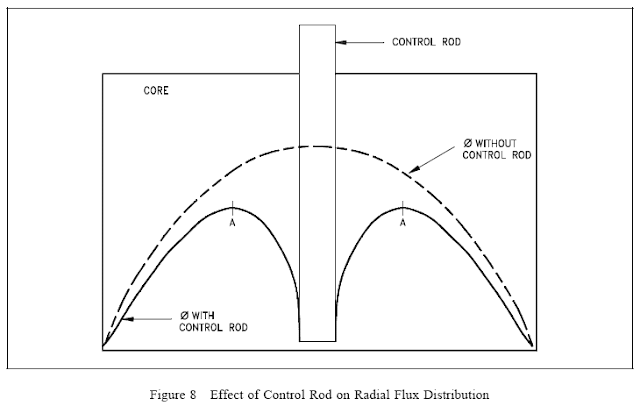
With borated primary coolant, neutrons are depressed equally throughout the core, and so power generation is more evenly distributed, and the reactor can be run closer to its thermal limit, because there is no need to account for hot and cold zones due to tilting of the neutron flux.
However you would hope that there is a better way to keep a flat neutron flux profile throughout a reactor core than using very hot diluted boric acid in the primary coolant loop.
As mentioned above, the primary coolant in these PWR reactors contains Boric Acid, which is a mild acid. For this reason, the piping, pumps, valves, etc are all made of high chrome steel (stainless steel).
The reactor vessel and closure head, however, are not. Due to their size, it is impractical to make the entire thing from stainless steel. Instead, the reactor vessel and head are made from carbon steel, and their interior is clad with a sheet of 3/8" thick stainless steel. In this way, the carbon steel, which is not resistant to acids, is protected from contact with the Boric Acid in the primary coolant.
The Event:
In 2002, Davis-Besse nuclear power plant in Ohio discovered they had a very minor primary coolant leak. The coolant was leaking out along a penetration in the reactor vessel head, where a Control Rod Drive Mechanism (CRDM) was mounted. The CRDM is what pulls the control rods out of the core and allows the reactor to start and shut down. The coolant leak was so minor that it hadn't been noticed - in a million gallon system, a minor leak can go undetected almost forever. Any water leaking from the primary coolant would also be quite hot and would flash to steam immediately, so no water puddling would occur.
Davis-Besse had a tiny coolant leak, however. One which they were unaware of. In 2002 the plant shut down for a refueling outage, and performed an inspection underneath the insulation on the reactor vessel head. This was done after other plants of the same design had uncovered minor leakage. They found a little problem...
At the time it was discovered, the acid had eaten away a hole the size of a football completely through the reactor vessel head in the area of the leaking CRDM penetration. The only thing that was holding the 2500 psig primary coolant in place was 3/8" of stainless steel cladding, which was bulging outwards from the pressure.
Below is a picture of a Babcock & Wilcox design PWR primary coolant loop, with the reactor vessel head highlighted.

Below is a cut-away of a B&W reactor vessel head, with a zoom-in on the point of the leak.

Below are images of the hole in the reactor vessel head.

The photo below gives you an idea how thick engineers designed the reactor vessel head to keep 2500 psig of primary coolant in place. It's astonishing (and wonderful) that thin piece of 3/8" of stainless steel was able to keep the coolant from blasting out.

This would not have been merely a primary coolant leak. This would have been a major accident. Here are some of the potential consequences of such a massive leak, had the cladding ruptured:
Background:
In a Pressurized Water Reactor (PWR), the control rods are completely removed from the core after the reactor is up to full power, and dilute Boric Acid (a strong neutron poison) is carefully added to control reactivity.
The purpose of this process is to achieve a flatter neutron flux profile throughout the core.
A flat neutron flux is desirable for a couple of reasons: It helps to even out fuel burnup and it helps to reduce hot and cold coolant channels. When control rods are partially inserted into an operating reactor core, neutron flux is depressed near them, since they absorb neutrons. Therefore fewer fissions occur near the control rods. This localized reduction of fission causes uneven fuel burn and creates cold zones due to reduced fission near the rods. For a given power output, other sections of the reactor core away from the control rods must now run hotter to compensate.
Below, a side-view of a reactor core. The solid line indicates neutron population in this reactor at steady-state power, with a control rod partially inserted to control reactor power. Because there are very few neutrons in the area adjacent to the control rod, for a given power level, other areas of the core have to produce more fissions. The spots on the solid line marked "A" are those places where we might see excessive fissions, overheating, and possible fuel element failures.
The dashed line indicates neutron population with the control rod removed (which is possible if you add Boric Acid as a virtual liquid control rod). As you can see, neutron population is more consistent throughout the reactor, and therefore there won't be any excessive localized fission and heating, as you see at the points marked "A"

With borated primary coolant, neutrons are depressed equally throughout the core, and so power generation is more evenly distributed, and the reactor can be run closer to its thermal limit, because there is no need to account for hot and cold zones due to tilting of the neutron flux.
However you would hope that there is a better way to keep a flat neutron flux profile throughout a reactor core than using very hot diluted boric acid in the primary coolant loop.
As mentioned above, the primary coolant in these PWR reactors contains Boric Acid, which is a mild acid. For this reason, the piping, pumps, valves, etc are all made of high chrome steel (stainless steel).
The reactor vessel and closure head, however, are not. Due to their size, it is impractical to make the entire thing from stainless steel. Instead, the reactor vessel and head are made from carbon steel, and their interior is clad with a sheet of 3/8" thick stainless steel. In this way, the carbon steel, which is not resistant to acids, is protected from contact with the Boric Acid in the primary coolant.
The Event:
In 2002, Davis-Besse nuclear power plant in Ohio discovered they had a very minor primary coolant leak. The coolant was leaking out along a penetration in the reactor vessel head, where a Control Rod Drive Mechanism (CRDM) was mounted. The CRDM is what pulls the control rods out of the core and allows the reactor to start and shut down. The coolant leak was so minor that it hadn't been noticed - in a million gallon system, a minor leak can go undetected almost forever. Any water leaking from the primary coolant would also be quite hot and would flash to steam immediately, so no water puddling would occur.
Davis-Besse had a tiny coolant leak, however. One which they were unaware of. In 2002 the plant shut down for a refueling outage, and performed an inspection underneath the insulation on the reactor vessel head. This was done after other plants of the same design had uncovered minor leakage. They found a little problem...
At the time it was discovered, the acid had eaten away a hole the size of a football completely through the reactor vessel head in the area of the leaking CRDM penetration. The only thing that was holding the 2500 psig primary coolant in place was 3/8" of stainless steel cladding, which was bulging outwards from the pressure.
Below is a picture of a Babcock & Wilcox design PWR primary coolant loop, with the reactor vessel head highlighted.


Below are images of the hole in the reactor vessel head.

The photo below gives you an idea how thick engineers designed the reactor vessel head to keep 2500 psig of primary coolant in place. It's astonishing (and wonderful) that thin piece of 3/8" of stainless steel was able to keep the coolant from blasting out.

This would not have been merely a primary coolant leak. This would have been a major accident. Here are some of the potential consequences of such a massive leak, had the cladding ruptured:
- A massive steam/water jet would have blasted out of this hole, certainly damaging this control rod, but possibly adjacent ones also. Could the ability of the reactor to shut down been compromised?
- The steam/water blast probably would have ripped tons of insulation loose. This would have fouled the intake of the emergency water re-injection system, which takes suction from the floor of the containment building.
- Major coolant leak accidents are typically modeled for weaker points in the primary coolant system - pumps, steam generators, drain lines, etc. These are equipped with remote-operated valves to isolate these leaks from the reactor core. This leak was was directly above the reactor core, and not isolable from it. Continuous water injection directly into the core would be required for several months to prevent decay heat from melting it.
- It is very likely that with the reactor fill system compromised due to ingesting insulation, and an unisolable leak right above the fuel, that core damage would have occurred.
Wednesday, September 25, 2013
Boiling Water Reactors
Boiling Water Reactors (BWRs) are a fairly common design in electrical generation. The advantage a BWR has over a Pressurized Water Reactor (PWR) is mainly the up-front cost.
The primary coolant loop in a PWR is kept at about 2200 psig (155 bar) to prevent boiling in the core. This means the reactor vessel, pressurizer, and steam generators as well as all primary loop components, must be very robust. In addition, they must be made from (or lined with) corrosion resistant materials, due to the addition of boric acid for reactivity control.
With a Boiling Water reactor, the primary coolant loop is also the steam loop. There are no steam generators or pressurizer. The operating pressure is about half that of a PWR, and no boric acid is used. Thus a boiling water reactor can be built with less cost. A BWR also has higher thermal efficiency than a PWR.
Below is a diagram of a BWR vessel. While less expensive to build than a PWR, these are still pretty complex reactors.

Below is a simplified overall diagram of an entire BWR steam/water circuit.

A few things you will notice that are different from a pressurized water reactor:
 .
.
The primary coolant loop in a PWR is kept at about 2200 psig (155 bar) to prevent boiling in the core. This means the reactor vessel, pressurizer, and steam generators as well as all primary loop components, must be very robust. In addition, they must be made from (or lined with) corrosion resistant materials, due to the addition of boric acid for reactivity control.
With a Boiling Water reactor, the primary coolant loop is also the steam loop. There are no steam generators or pressurizer. The operating pressure is about half that of a PWR, and no boric acid is used. Thus a boiling water reactor can be built with less cost. A BWR also has higher thermal efficiency than a PWR.
Below is a diagram of a BWR vessel. While less expensive to build than a PWR, these are still pretty complex reactors.

Below is a simplified overall diagram of an entire BWR steam/water circuit.

A few things you will notice that are different from a pressurized water reactor:
- The top of the reactor vessel is used as a steam drum, to separate water and steam.
- Because the top of the reactor is a steam drum, control rods are moved to the bottom.
- Inside the reactor vessel are circulation pumps (#4). More on these later.
- Steam directly from the reactor core flows through the entire steam system.
- Not shown in the above image are the feedwater and steam shutoff valves. In the event of a steam line rupture, it is important to keep water in the core, and also to prevent the release of radioactive steam outside of the containment structure.
- Note the shielding required around the entire steam system.
- The control rods and circulating pumps penetrate the bottom of the reactor vessel. Should a leak develop there, it can drain all the water from the reactor vessel. Since the fuel must be kept submerged in water (even for several years after use), this is a potential hazard.
- Water circulating in a power plant always contains minor levels of corrosion - flecks of iron from valves and pumps, and magnetite that falls from the inside of piping as temperatures expand and contract the pipe. These corrosion particles can be carried through the reactor core and absorb a neutron. They can become very radioactive, and then settle outside the reactor core. This material is called CRUD, and is only detectable with a radiation detector.
- In a PWR, CRUD is all contained within the primary loop and inside the containment structure. In a BWR, CRUD is everywhere within the steam system - the steam and drain lines, the turbine, the condenser, the condensate pumps, and feedwater pumps.
- There is an important nuclear reaction that occurs that involves the Oxygen in water molecules, H2O. Oxygen-16, when hit with a high energy neutron, can absorb the neutron and eject\ a proton. It then becomes radioactive Nitrogen-16. This is a nasty isotope of nitrogen, mainly because it decays by emitting a gamma of 7.37 MeV. That's a VERY hot gamma ray. Nitrogen-16 has a half-life of 7.1 seconds, so that means it will be emitting these hot gamma rays while it is passing through the steam turbine, condenser, and settling in the hotwell. Therefore massive shielding is required from all steam and feedwater systems during operation.
- Due to the short half-life of Nitrogen-16, it quickly decays away. Shortly after the reactor is shutdown, the only serious radiological hazard in the steam system is due to CRUD, which is composed of metals that have longer half-lives.

BWRs are a little more complex than PWRs from a reactor control standpoint. A BWR, by its very description, has significant in-core boiling - primarily in the upper portion. However a BWR, like the PWR, uses water as a moderator. When water changes to steam, its neutron moderating properties change drastically - 1/1000 drop in density equates to about 1/1000 drop in moderating ability.
With the phase change from water to steam there is an ongoing change in moderation and thermal neutron population, and therefore in the fission process. It is therefore important to monitor neutron levels (flux) at many more points than would be necessary in a BWR, to ensure even power distribution. Fuel burn-up (both axial and radial) is also difficult to calculate for the top end of a BWR, due to the dynamic two-phase activity in the core.
Interestingly, like the PWR, the BWR control rods are out of the core at full power, and reactivity is controlled by using the circulation pumps. When the pumps are run at high speed, boiling occurs higher up in the core, and so more moderator is present, and more neutrons are available to create fissions. Similarly, if reactor power needs to be reduced, the recirculation pumps can be slowed down, and boiling occurs lower in the core. More steam in the core means less neutrons will be thermalized, and so fewer neutrons will be available to cause fission.
Lastly, BWR cores have to be somewhat larger than PWR cores for a given output, and that is mainly due to the fact that the upper part of a BWR core isn't generating much power, because steam is a poor moderator.
Sunday, September 22, 2013
Nuclear Reactors - How they work (part 2)
Previously (part 1) we had a Pressurized Water Reactor (PWR) which was critical and adding heat to the coolant/moderator. After the reactor reaches the point where it is generating heat, and the moderator becomes less effective, it becomes neccessary to withdraw the control rods again to increase power output.
Since this is a PWR, we are not supposed to have large-scale boiling in the core. Steam doesn't transfer heat as readily as water does, and in a PWR, in-core boiling is a bad, bad thing. For this reason the pressure in the primary coolant loop must be kept well above the boiling point of water for the temperature found in the core. How do we do that? We have a pressurizer!
The pressurizer does three things: First, it acts as a surge volume for the primary coolant system by maintaining a compressible steam-filled void space. Secondly, it keeps the system pressure high enough that boiling cannot occur in the core. This is accomplished by keeping the pressurizer vessel half full of water, and adding enough electrical heaters that the temperature in the pressurizer is kept higher than that of the core. All boiling will occur in the pressurizer, not in the core.
Lastly, the pressurizer controls the primary coolant system pressure. As more electric heaters are energized in the pressurizer vessel, saturation conditions increase, causing pressure to rise. To reduce primary pressure, a shower spray head at the top of the vessel can spray slightly cooler water into the steam, condensing a portion of the steam and reducing pressure. It's quite a simple and elegant process.
Below is a simplified diagram of the primary and secondary systems of a PWR. The radioactive primary coolant (Red) is contained in a closed loop. The reactor core is the heat source, the control rod drive mechanism positions the control rods to increase/decrease reactor power, the primary pump circulates the primary coolant, and pressurizer serves as a static surge volume.
The steam generator segregates the radioactive primary coolant from the steam/water system, but allows heat to be transferred out of the primary coolant loop and generate steam for the turbine.

Pressure in the primary system is increased by energizing submerged electrical heaters in the pressurizer, and reduced by spraying a small slip-stream of primary coolant from the reactor coolant pump through a spray head at the top of the pressurizer. This cools and condenses some of the steam in the pressurizer, reducing system pressure.
Temperature is gradually increased by withdrawing the control rods. Remember in the previous post that the neutron population would increase with no control rod movement if the reactor were slightly supercritical? That is no longer the case when power level is high enough for the reactor to generate heat. After the core begins heating and the "negative temperature coefficient of reactivity" kicks in, withdrawing the control rods increases power, followed by a smaller drop in power as the primary coolant heats up. So control rods are withdrawn in a series bumps, and the coolant temperature is slowly increased.
The primary coolant pump circulates primary coolant (very pure water) between the reactor core and the steam generator. The reactor core adds heat created by fission. The steam generator removes heat by boiling secondary water in a heat exchanger. Thus, primary coolant is radioactive, but does not boil. Secondary water is non-radioactive, and does boil.
In a PWR, excess fuel is loaded, more than what is required to bring the reactor up to power. This is done so that the reactor can continue to run as the U-235 is expended, and fission products build up. Many of the atoms that are created by fission are strong neutron absorbers (poisons), and eventually result in the inability of the reactor to maintain full power. This is in spite of excess U-235 added at during refueling. Only about 3% of the U-235 is used up before the accumulation of poison halts reactor operation. This is why fuel recycling is so desirable from an industry standpoint.
Commercial PWRs are unique in that they add boric acid to the primary coolant. Boron is a neutron absorber. With the addition of boron to the coolant, the control rods may be entirely withdrawn from the core, using only boron to control neutron population. This is desirable because in the vicinity of control rods, neutron population, and fissions will be depressed. This forces other regions of the core to run hotter for a given power level. With control rods out of the core, neutron distribution is more consistent and hot spots due to uneven neutron flux are less likely to develop.
At a certain point, on the secondary side of the steam generator, steam is at an adequate pressure to begin warming up the steam turbine. This also has an interesting impact on reactor power. As we create steam on the secondary side of the steam generator, we are also removing heat from the primary coolant. This slightly cooler primary coolant returns to the reactor. Since it is now more dense, it is a better moderator, and more neutrons stay in the core to cause fissions. Reactor power now increases along with steam demand. This is a very desirable feedback loop, because now there is little need to adjust the control rods. We allow the steam turbine load to determine what power level the reactor will operate at.
The remainder of the steam plant operates in a very similar manner to a fossil-fueled plant. One difference: Since it is not possible to superheat the steam with this process, steam dryers are added between different stages on the steam turbine, to prevent mist from damaging the lower pressure sections.
Since this is a PWR, we are not supposed to have large-scale boiling in the core. Steam doesn't transfer heat as readily as water does, and in a PWR, in-core boiling is a bad, bad thing. For this reason the pressure in the primary coolant loop must be kept well above the boiling point of water for the temperature found in the core. How do we do that? We have a pressurizer!
The pressurizer does three things: First, it acts as a surge volume for the primary coolant system by maintaining a compressible steam-filled void space. Secondly, it keeps the system pressure high enough that boiling cannot occur in the core. This is accomplished by keeping the pressurizer vessel half full of water, and adding enough electrical heaters that the temperature in the pressurizer is kept higher than that of the core. All boiling will occur in the pressurizer, not in the core.
Lastly, the pressurizer controls the primary coolant system pressure. As more electric heaters are energized in the pressurizer vessel, saturation conditions increase, causing pressure to rise. To reduce primary pressure, a shower spray head at the top of the vessel can spray slightly cooler water into the steam, condensing a portion of the steam and reducing pressure. It's quite a simple and elegant process.
Below is a simplified diagram of the primary and secondary systems of a PWR. The radioactive primary coolant (Red) is contained in a closed loop. The reactor core is the heat source, the control rod drive mechanism positions the control rods to increase/decrease reactor power, the primary pump circulates the primary coolant, and pressurizer serves as a static surge volume.
The steam generator segregates the radioactive primary coolant from the steam/water system, but allows heat to be transferred out of the primary coolant loop and generate steam for the turbine.

Pressure in the primary system is increased by energizing submerged electrical heaters in the pressurizer, and reduced by spraying a small slip-stream of primary coolant from the reactor coolant pump through a spray head at the top of the pressurizer. This cools and condenses some of the steam in the pressurizer, reducing system pressure.
Temperature is gradually increased by withdrawing the control rods. Remember in the previous post that the neutron population would increase with no control rod movement if the reactor were slightly supercritical? That is no longer the case when power level is high enough for the reactor to generate heat. After the core begins heating and the "negative temperature coefficient of reactivity" kicks in, withdrawing the control rods increases power, followed by a smaller drop in power as the primary coolant heats up. So control rods are withdrawn in a series bumps, and the coolant temperature is slowly increased.
The primary coolant pump circulates primary coolant (very pure water) between the reactor core and the steam generator. The reactor core adds heat created by fission. The steam generator removes heat by boiling secondary water in a heat exchanger. Thus, primary coolant is radioactive, but does not boil. Secondary water is non-radioactive, and does boil.
In a PWR, excess fuel is loaded, more than what is required to bring the reactor up to power. This is done so that the reactor can continue to run as the U-235 is expended, and fission products build up. Many of the atoms that are created by fission are strong neutron absorbers (poisons), and eventually result in the inability of the reactor to maintain full power. This is in spite of excess U-235 added at during refueling. Only about 3% of the U-235 is used up before the accumulation of poison halts reactor operation. This is why fuel recycling is so desirable from an industry standpoint.
Commercial PWRs are unique in that they add boric acid to the primary coolant. Boron is a neutron absorber. With the addition of boron to the coolant, the control rods may be entirely withdrawn from the core, using only boron to control neutron population. This is desirable because in the vicinity of control rods, neutron population, and fissions will be depressed. This forces other regions of the core to run hotter for a given power level. With control rods out of the core, neutron distribution is more consistent and hot spots due to uneven neutron flux are less likely to develop.
At a certain point, on the secondary side of the steam generator, steam is at an adequate pressure to begin warming up the steam turbine. This also has an interesting impact on reactor power. As we create steam on the secondary side of the steam generator, we are also removing heat from the primary coolant. This slightly cooler primary coolant returns to the reactor. Since it is now more dense, it is a better moderator, and more neutrons stay in the core to cause fissions. Reactor power now increases along with steam demand. This is a very desirable feedback loop, because now there is little need to adjust the control rods. We allow the steam turbine load to determine what power level the reactor will operate at.
The remainder of the steam plant operates in a very similar manner to a fossil-fueled plant. One difference: Since it is not possible to superheat the steam with this process, steam dryers are added between different stages on the steam turbine, to prevent mist from damaging the lower pressure sections.
Subscribe to:
Posts (Atom)