

An advertisement-free blog about motorcycling, Northern life, home improvement, power plants, submarines, nuclear stuff, and a few other off-beat subjects. Comments are welcome. (Image is the Selway Crags in Northern Idaho)
Sunday, March 06, 2016
Hydroelectric failure #2 -Teton Dam
Here's a nice picture taken from a helicopter on June 5, 1976. This is Teton Dam in Eastern Idaho, in the process of collapsing and killing 11 people and 35,000 head of cattle.
 Image courtesy of wikipedia, Photographer/Maker: Roberts ID-L-0010, WaterArchives.org


Car alternator problem at high RPM
On the new little car, I had noticed an issue while driving, but it didn't give me much concern... until Friday morning.
What I had noticed was that the lights would noticeably dim as the engine revved higher, typically just before the car up-shifted. It was not affecting the electrical system or my ability to start the car however, so I ignored it.
What I had noticed was that the lights would noticeably dim as the engine revved higher, typically just before the car up-shifted. It was not affecting the electrical system or my ability to start the car however, so I ignored it.
Friday, March 04, 2016
Snow Plowing
The first summer after we moved to Idaho, I bought a little tractor. It's a 13 Horsepower, 2 cylinder diesel tractor with 4x4, a PTO and a hydraulic bucket loader. It came with a 4ft rotary tiller and a back blade.


Thursday, February 18, 2016
Hydroelectric failure #1 -Taum Sauk
I think we will start small and work our way up on these dam failures...
Taum Sauk was/is a hydroelectric pumped storage facility located in Missouri. Pumped storage facilities are used by electrical system operators to store power (in the form of water at increased elevation) when demand is low, and to generate power when it is needed most.
Pumped storage units will use their generators as motors, and their turbines as pumps, to pump water to an upper reservoir. This is typically done at night or during weekends, which are periods of low electrical demand. When peak electrical load is needed, the water is released from the upper reservoir to a lower one, through the turbine, which spins the generator for additional power. The process repeats as needed.
Taum Sauk was/is a hydroelectric pumped storage facility located in Missouri. Pumped storage facilities are used by electrical system operators to store power (in the form of water at increased elevation) when demand is low, and to generate power when it is needed most.
Pumped storage units will use their generators as motors, and their turbines as pumps, to pump water to an upper reservoir. This is typically done at night or during weekends, which are periods of low electrical demand. When peak electrical load is needed, the water is released from the upper reservoir to a lower one, through the turbine, which spins the generator for additional power. The process repeats as needed.
Tuesday, February 16, 2016
20th Vehicle: Subaru Legacy SUS 30th Anniversary Model
I had been checking Craigslist ads for about a year, looking for a decently priced All Wheel Drive car, preferably a tiny Subaru wagon. I was shocked how much money people wanted for a worn-out high-mileage AWD car. I mentioned this fact to a co-worker, who said that he was about to put his daughter's car up for sale.
Hydroelectric power
I've never done a post on hydro power before. I find thermal power (regardless of the heat source) a bit more complex, and therefore more interesting. On the other hand, hydro power and dams generate a LOT of power. While most dams and powerhouses go along uneventfully, each is unique, and some have had *very* interesting events (by that I mean failures). Some of the events are obscure and forgotten, and I think it will be fun to look at those. But first, a little hydro history...
Hydropower is the energy that can be harvested from falling water. Because water is so dense, even a modest drop in elevation can perform significant work. Hydropower has been around since ancient times, most commonly by harnessing the rotary motion provided by water wheels. The water wheel would then be geared to a grain mill, lumber mill, or textile mill.
Waterwheels could be arranged with water flowing over the top - "overshot", or dipped into a fast running current, "undershot".


With the advent electrical power, the waterwheel was eventually abandoned in favor of more efficient and controllable means of capturing the power from running water.
The mechanism that replaced the waterwheel was the turbine. The first turbine entering widespread use was called the "Francis Turbine". It was invented in 1848 for a textile factory in Massachussets. This design is a reaction turbine with quite high efficiency, and it is still widely used today.
Water turbines develop greater power when there is more flow and pressure. The flow of a river varies over time according to the whims of nature, but of course the water can be held in a reservoir and released as needed. The other advantage of a reservoir is that a dam increases the height of the water behind it, increasing the pressure. As the water level rises behind the dam, so does the pressure at the turbine inlet. (In hydropower speak, this pressure is called "head") To maximize the head - the distance between the surface of the water behind the dam and the turbine inlet - turbines are located at the bottom of the dam, with a generators installed just above them in a large machinery hall.
Cutaway of the action: (Image courtesy of the US Army Corps of Engineers)

Below, the installation of a Francis Turbine at Grand Coulee Dam in Washington State, late 1930's. This turbine drives a 125 Megawatt generator.

One of the larger turbines added to Grand Coulee in the 1970's. This drives a 600 MW generator. Grand Coulee can generate up to 6800 MW, making it the largest power station in the U.S.

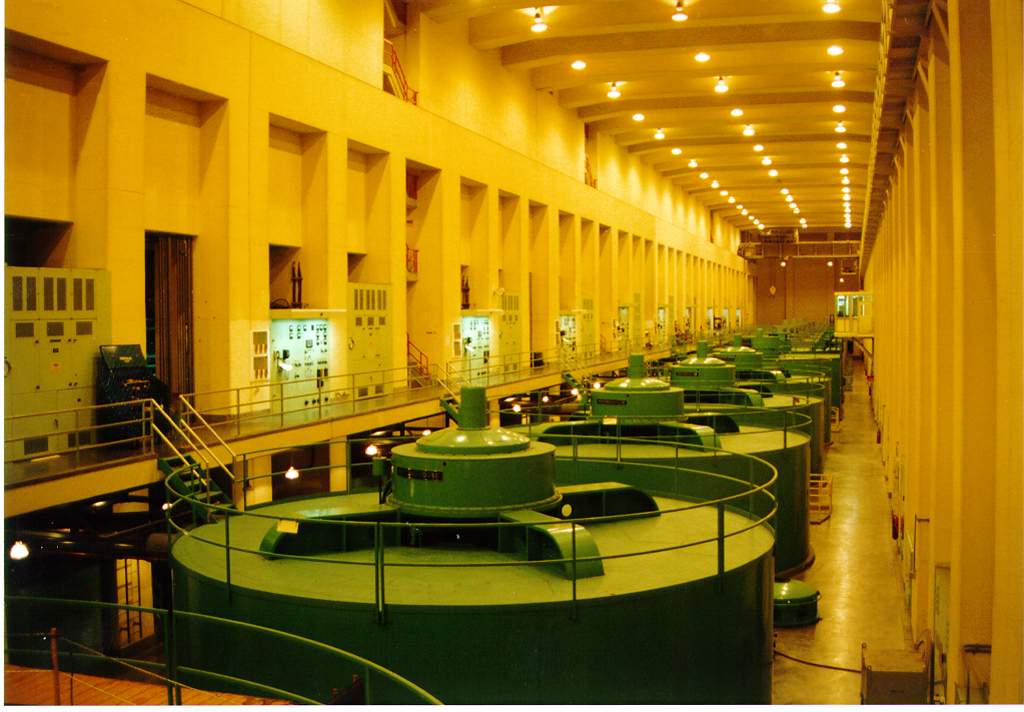
Below, some of the generators at Grand Coulee Dam.


There are other, less massive hydroelectric power plants, of course. Many Hydro power plants are called "run-of-the-river" plants. They will have a dam, to provide a bit of elevation and increase water pressure, but they will not have a reservoir. The output of these hydroelectric power plants is completely at the mercy of the flow of the river. Here is an example of a run-of-the-river dam:

Notice that this dam does not impound a vast amount of water behind it, so when the river runs low, so does the power output. This is not the case with a powerhouse with a reservoir of water.
This is just a brief overview of how hydroelectric power works. If you are more interested, here are a couple of quick links:
History of the LADWP power projects
Everything you need to know about Hydroelectric Energy
I'm not that interested. Hydro is pretty dam (pun intended) boring - except when it fails. That's what I am interested in! You often read about a fire, a meltdown or explosion at a thermal plant. I bet you didn't know that hydro plant failures have killed more people than any other type of power plant. We will look into that more in the next few posts...
Hydropower is the energy that can be harvested from falling water. Because water is so dense, even a modest drop in elevation can perform significant work. Hydropower has been around since ancient times, most commonly by harnessing the rotary motion provided by water wheels. The water wheel would then be geared to a grain mill, lumber mill, or textile mill.
Waterwheels could be arranged with water flowing over the top - "overshot", or dipped into a fast running current, "undershot".
With the advent electrical power, the waterwheel was eventually abandoned in favor of more efficient and controllable means of capturing the power from running water.
The mechanism that replaced the waterwheel was the turbine. The first turbine entering widespread use was called the "Francis Turbine". It was invented in 1848 for a textile factory in Massachussets. This design is a reaction turbine with quite high efficiency, and it is still widely used today.
Water turbines develop greater power when there is more flow and pressure. The flow of a river varies over time according to the whims of nature, but of course the water can be held in a reservoir and released as needed. The other advantage of a reservoir is that a dam increases the height of the water behind it, increasing the pressure. As the water level rises behind the dam, so does the pressure at the turbine inlet. (In hydropower speak, this pressure is called "head") To maximize the head - the distance between the surface of the water behind the dam and the turbine inlet - turbines are located at the bottom of the dam, with a generators installed just above them in a large machinery hall.
Cutaway of the action: (Image courtesy of the US Army Corps of Engineers)

Below, the installation of a Francis Turbine at Grand Coulee Dam in Washington State, late 1930's. This turbine drives a 125 Megawatt generator.

One of the larger turbines added to Grand Coulee in the 1970's. This drives a 600 MW generator. Grand Coulee can generate up to 6800 MW, making it the largest power station in the U.S.

Below, some of the generators at Grand Coulee Dam.
Below, a panoramic picture of Grand Coulee Dam. The new powerhouse is at the left.

There are other, less massive hydroelectric power plants, of course. Many Hydro power plants are called "run-of-the-river" plants. They will have a dam, to provide a bit of elevation and increase water pressure, but they will not have a reservoir. The output of these hydroelectric power plants is completely at the mercy of the flow of the river. Here is an example of a run-of-the-river dam:

Notice that this dam does not impound a vast amount of water behind it, so when the river runs low, so does the power output. This is not the case with a powerhouse with a reservoir of water.
This is just a brief overview of how hydroelectric power works. If you are more interested, here are a couple of quick links:
History of the LADWP power projects
Everything you need to know about Hydroelectric Energy
I'm not that interested. Hydro is pretty dam (pun intended) boring - except when it fails. That's what I am interested in! You often read about a fire, a meltdown or explosion at a thermal plant. I bet you didn't know that hydro plant failures have killed more people than any other type of power plant. We will look into that more in the next few posts...
Wednesday, January 13, 2016
Summer and Winter Tires
On the post about my recent crappy day, I mentioned exchanging summer and winter tires on my truck. For those who seldom deal with winter weather, it might not be apparent what I am talking about.
Sunday, January 10, 2016
A really crappy day
OK, this day is far enough in the past that I am now willing to write about it and laugh a little.
We had a little snow storm...
It wasn't all that long ago that we experienced an epic wind-storm that knocked out power at our house for three days. A few families went an entire week without electrical power, and a handful of people were without power clear through Thanksgiving. If that were me, I wouldn't be feeling very thankful at all :)
Friday, December 25, 2015
Plutonium 238
Good news! Oak Ridge National Laboratory has begun manufacturing a new supply of Plutonium 238.
Below, a pellet of Pu-238 glowing orange from internal heating due to alpha decay.
"Plutonium pellet" by Department of Energy (via Wikipedia)

Below, a pellet of Pu-238 glowing orange from internal heating due to alpha decay.
"Plutonium pellet" by Department of Energy (via Wikipedia)

Subscribe to:
Posts (Atom)