

An advertisement-free blog about motorcycling, Northern life, home improvement, power plants, submarines, nuclear stuff, and a few other off-beat subjects. Comments are welcome. (Image is the Selway Crags in Northern Idaho)
Showing posts with label dam. Show all posts
Showing posts with label dam. Show all posts
Monday, February 20, 2017
Dam Failure: The St. Francis Dam
Below is a satellite view of the previous location of the St. Francis dam, a ways north of Los Angeles, CA. (Click image to enlarge)


Saturday, February 18, 2017
Hydroelectric near-miss: Oroville Dam ***Update #2***
Sunday, January 29, 2017
Hydroelectric Near-Miss - The Glen Canyon Dam
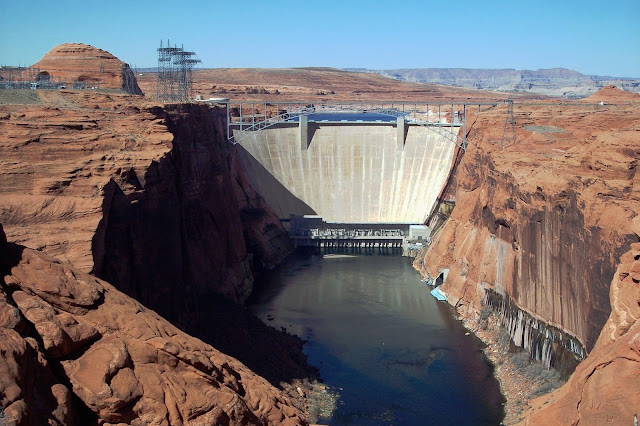
The Glen Canyon dam is a very large dam on the upper Colorado River, on the northern border of Arizona. The Glen Canyon dam impounds the Colorado River in a man made reservoir named Lake Powell.
Below: The vast reservoir of Lake Powell. The Glen Canyon dam is at the bottom left. Click any image to enlarge.

Below, a closer view of the Glen Canyon dam from above.

The Glen Canyon Dam is a gravity arch dam, very similar in design to the more famous Hoover Dam. Although it's 30 years newer, it's still quite similar in appearance. Glen Canyon Dam is upstream of Hoover Dam, and impounds water for states in the Upper Colorado River Basin (Western Colorado, Utah, and New Mexico)
In 1983, Glen Canyon dam was nearly overtopped. The photo below shows a small dam with a tiny reservoir being overtopped. Even this image of a very small dam being overtopped is unnerving. This is the San Clemente dam on the Carmel River in California. The dam has since been removed.

Overtopping is very dangerous, because the overtopping water can erode bedrock adjacent to and/or underneath the dam, leading to tunneling, which of course leads to complete failure...
...and failure brings us back to Glen Canyon Dam, because it nearly did fail in 1983.
I will now quote Wikipedia (while Bolding the most interesting parts)
(Brief aside from the Wikipedia article - below is a profile of the Glen Canyon dam spillway. There was concern that ongoing cavitation would erode the plugs in the diversion tunnels at the bottom left. At that point the lake would uncontrollably drain Lake Powell from underneath the dam, destroying the dam in the process)

Back to the Wikipedia article:
Below is an image of the cavitation damage inside the left spillway after the 1983 event.

Point of interest: The reason that the small San Clemente dam shown earlier in this post was over-topped was due to silt build-up in the reservoir. This caused a massive loss of reservoir capacity, from the initial 1425 acre feet capacity to just 70 acre feet, in its 87 year life-span. Due to the very high silt levels in the Colorado River, about 100 million US tons of silt settle in the reservoir annually. That's about 30,000 dump trucks per day that settle into the reservoir, so capacity is being lost. More importantly, without dredging, the silt will eventually block the dam's outlets, reducing its ability to store and release water.
Below is a 3 part government video of this event. What these videos never say is how close to failure the dam was, nor how much danger people downstream of Glen Canyon dam were in. It's great video though, because it examines in detail how much damage occurred when the dam's spillways had to deal with a 25 year flood. You would think that a dam should be able to release *a lot* of excess runoff without running the risk complete failure.
I'm beginning to suspect that one of hydro-engineering's dirty secrets is that many dams lack the ability to safely and adequately bypass large quantities of runoff.
On the bright side, nobody lost their life. We will look into a bit of that in future posts. Some dam failures have caused appalling loss of life.
If you live downstream from a dam, keep a raft handy!
Below: The vast reservoir of Lake Powell. The Glen Canyon dam is at the bottom left. Click any image to enlarge.

Below, a closer view of the Glen Canyon dam from above.

The Glen Canyon Dam is a gravity arch dam, very similar in design to the more famous Hoover Dam. Although it's 30 years newer, it's still quite similar in appearance. Glen Canyon Dam is upstream of Hoover Dam, and impounds water for states in the Upper Colorado River Basin (Western Colorado, Utah, and New Mexico)

In 1983, Glen Canyon dam was nearly overtopped. The photo below shows a small dam with a tiny reservoir being overtopped. Even this image of a very small dam being overtopped is unnerving. This is the San Clemente dam on the Carmel River in California. The dam has since been removed.

Overtopping is very dangerous, because the overtopping water can erode bedrock adjacent to and/or underneath the dam, leading to tunneling, which of course leads to complete failure...
...and failure brings us back to Glen Canyon Dam, because it nearly did fail in 1983.
I will now quote Wikipedia (while Bolding the most interesting parts)
During the El Niño winter of 1982–1983, the Bureau of Reclamation predicted an average runoff for the Colorado River basin based on snowpack measurements in the Rocky Mountains. However, snowfall during April and May was exceptionally heavy; this combined with a sudden rise in temperatures and unusual rainstorms in June to produce major flooding across the western United States.[83]
With Lake Powell nearly full, the USBR did not have enough time to draw down the reservoir to accommodate extra runoff. By mid-June, water was pouring into Lake Powell at over 120,000 cubic feet per second (3,400 m3/s). Even with the power plant and river outlet works running at full capacity, Lake Powell continued to rise to the point where the spillways had to be opened. Other than a brief test in 1980, this was the only time the spillways had ever been used.[84]At the beginning of June, dam operators opened the gates on the left spillway, sending 10,000 cubic feet per second (280 m3/s), less than one-tenth of capacity, down the tunnel into the river below. After a few days, the entire dam suddenly began to shake violently. The rumblings were so notable that a worker in the employee dining room, located near the power plant, was reported to say that it "sounded like the barrages that he had experienced in Vietnam". [16][17]
The spillway was closed down for inspections and workers discovered that the flow of water was causing cavitation – the explosive collapse of vacuum pockets in water moving at high speed – which was damaging the concrete lining and eroding the rock spillway tunnels from the upper ends of the diversion tunnels, which connect to the bottom of the reservoir.[85] This was rapidly being destroyed by the cavitation and it was feared that a connection would be made to the bottom of Lake Powell, compromising the dam's foundation and causing the dam to burst.[85]
(Brief aside from the Wikipedia article - below is a profile of the Glen Canyon dam spillway. There was concern that ongoing cavitation would erode the plugs in the diversion tunnels at the bottom left. At that point the lake would uncontrollably drain Lake Powell from underneath the dam, destroying the dam in the process)

Back to the Wikipedia article:
Meanwhile, snow continued melting in the Rockies and Lake Powell continued to rise rapidly. To delay having to use the spillways, the USBR installed plywood flashboards (later replaced by steel) atop the gates to increase the lake level.[86] Even this additional capacity was exhausted; discharges through the left spillway reached 32,000 cubic feet per second (910 m3/s), and the right spillway was opened to 15,000 cubic feet per second (420 m3/s). At Lee's Ferry, the Colorado River peaked at 97,300 cubic feet per second (2,760 m3/s), which was and still is the highest water flow recorded there since the dam was built.[87] On July 14, Lake Powell reached 3,708.34 feet (1,130.30 m) elevation, a level that has not been exceeded since.[88]Just as it seemed inevitable that the dam would fail, inflows fell and the dam was saved. Upon inspection, it was found that cavitation had caused massive gouging damage to both spillways, carrying away thousands of tons of concrete, steel rebar and huge chunks of rock.[89]
After the flood, it was suggested that the flashboards atop the spillway gates should be replaced with stronger boards and kept permanently; this would allow an "insurance" against a 1983-reminiscent flood.[15] An air slot was constructed in each spillway tunnel afterwards to prevent catastrophic cavitation events like those of 1983. Most surprising, however, is that the flood of 1983, although it nearly caused catastrophic disaster, it was a "relatively small flood".[19] It was, in fact, only a 25-year flood, or a flood that has a four percent chance of occurring in any given year.[11][17]

Point of interest: The reason that the small San Clemente dam shown earlier in this post was over-topped was due to silt build-up in the reservoir. This caused a massive loss of reservoir capacity, from the initial 1425 acre feet capacity to just 70 acre feet, in its 87 year life-span. Due to the very high silt levels in the Colorado River, about 100 million US tons of silt settle in the reservoir annually. That's about 30,000 dump trucks per day that settle into the reservoir, so capacity is being lost. More importantly, without dredging, the silt will eventually block the dam's outlets, reducing its ability to store and release water.
Below is a 3 part government video of this event. What these videos never say is how close to failure the dam was, nor how much danger people downstream of Glen Canyon dam were in. It's great video though, because it examines in detail how much damage occurred when the dam's spillways had to deal with a 25 year flood. You would think that a dam should be able to release *a lot* of excess runoff without running the risk complete failure.
I'm beginning to suspect that one of hydro-engineering's dirty secrets is that many dams lack the ability to safely and adequately bypass large quantities of runoff.
On the bright side, nobody lost their life. We will look into a bit of that in future posts. Some dam failures have caused appalling loss of life.
Part 1
Part 2
Part 3
If you live downstream from a dam, keep a raft handy!
Thursday, February 18, 2016
Hydroelectric failure #1 -Taum Sauk
I think we will start small and work our way up on these dam failures...
Taum Sauk was/is a hydroelectric pumped storage facility located in Missouri. Pumped storage facilities are used by electrical system operators to store power (in the form of water at increased elevation) when demand is low, and to generate power when it is needed most.
Pumped storage units will use their generators as motors, and their turbines as pumps, to pump water to an upper reservoir. This is typically done at night or during weekends, which are periods of low electrical demand. When peak electrical load is needed, the water is released from the upper reservoir to a lower one, through the turbine, which spins the generator for additional power. The process repeats as needed.
Taum Sauk was/is a hydroelectric pumped storage facility located in Missouri. Pumped storage facilities are used by electrical system operators to store power (in the form of water at increased elevation) when demand is low, and to generate power when it is needed most.
Pumped storage units will use their generators as motors, and their turbines as pumps, to pump water to an upper reservoir. This is typically done at night or during weekends, which are periods of low electrical demand. When peak electrical load is needed, the water is released from the upper reservoir to a lower one, through the turbine, which spins the generator for additional power. The process repeats as needed.
Tuesday, February 16, 2016
Hydroelectric power
I've never done a post on hydro power before. I find thermal power (regardless of the heat source) a bit more complex, and therefore more interesting. On the other hand, hydro power and dams generate a LOT of power. While most dams and powerhouses go along uneventfully, each is unique, and some have had *very* interesting events (by that I mean failures). Some of the events are obscure and forgotten, and I think it will be fun to look at those. But first, a little hydro history...
Hydropower is the energy that can be harvested from falling water. Because water is so dense, even a modest drop in elevation can perform significant work. Hydropower has been around since ancient times, most commonly by harnessing the rotary motion provided by water wheels. The water wheel would then be geared to a grain mill, lumber mill, or textile mill.
Waterwheels could be arranged with water flowing over the top - "overshot", or dipped into a fast running current, "undershot".


With the advent electrical power, the waterwheel was eventually abandoned in favor of more efficient and controllable means of capturing the power from running water.
The mechanism that replaced the waterwheel was the turbine. The first turbine entering widespread use was called the "Francis Turbine". It was invented in 1848 for a textile factory in Massachussets. This design is a reaction turbine with quite high efficiency, and it is still widely used today.
Water turbines develop greater power when there is more flow and pressure. The flow of a river varies over time according to the whims of nature, but of course the water can be held in a reservoir and released as needed. The other advantage of a reservoir is that a dam increases the height of the water behind it, increasing the pressure. As the water level rises behind the dam, so does the pressure at the turbine inlet. (In hydropower speak, this pressure is called "head") To maximize the head - the distance between the surface of the water behind the dam and the turbine inlet - turbines are located at the bottom of the dam, with a generators installed just above them in a large machinery hall.
Cutaway of the action: (Image courtesy of the US Army Corps of Engineers)

Below, the installation of a Francis Turbine at Grand Coulee Dam in Washington State, late 1930's. This turbine drives a 125 Megawatt generator.

One of the larger turbines added to Grand Coulee in the 1970's. This drives a 600 MW generator. Grand Coulee can generate up to 6800 MW, making it the largest power station in the U.S.

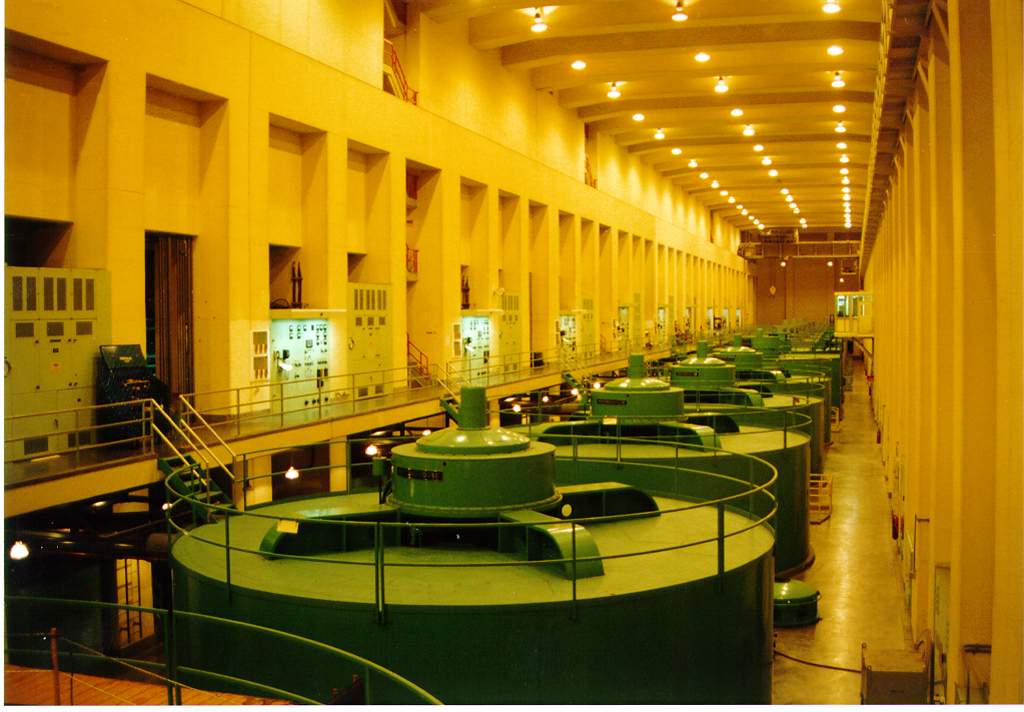
Below, some of the generators at Grand Coulee Dam.


There are other, less massive hydroelectric power plants, of course. Many Hydro power plants are called "run-of-the-river" plants. They will have a dam, to provide a bit of elevation and increase water pressure, but they will not have a reservoir. The output of these hydroelectric power plants is completely at the mercy of the flow of the river. Here is an example of a run-of-the-river dam:

Notice that this dam does not impound a vast amount of water behind it, so when the river runs low, so does the power output. This is not the case with a powerhouse with a reservoir of water.
This is just a brief overview of how hydroelectric power works. If you are more interested, here are a couple of quick links:
History of the LADWP power projects
Everything you need to know about Hydroelectric Energy
I'm not that interested. Hydro is pretty dam (pun intended) boring - except when it fails. That's what I am interested in! You often read about a fire, a meltdown or explosion at a thermal plant. I bet you didn't know that hydro plant failures have killed more people than any other type of power plant. We will look into that more in the next few posts...
Hydropower is the energy that can be harvested from falling water. Because water is so dense, even a modest drop in elevation can perform significant work. Hydropower has been around since ancient times, most commonly by harnessing the rotary motion provided by water wheels. The water wheel would then be geared to a grain mill, lumber mill, or textile mill.
Waterwheels could be arranged with water flowing over the top - "overshot", or dipped into a fast running current, "undershot".
With the advent electrical power, the waterwheel was eventually abandoned in favor of more efficient and controllable means of capturing the power from running water.
The mechanism that replaced the waterwheel was the turbine. The first turbine entering widespread use was called the "Francis Turbine". It was invented in 1848 for a textile factory in Massachussets. This design is a reaction turbine with quite high efficiency, and it is still widely used today.
Water turbines develop greater power when there is more flow and pressure. The flow of a river varies over time according to the whims of nature, but of course the water can be held in a reservoir and released as needed. The other advantage of a reservoir is that a dam increases the height of the water behind it, increasing the pressure. As the water level rises behind the dam, so does the pressure at the turbine inlet. (In hydropower speak, this pressure is called "head") To maximize the head - the distance between the surface of the water behind the dam and the turbine inlet - turbines are located at the bottom of the dam, with a generators installed just above them in a large machinery hall.
Cutaway of the action: (Image courtesy of the US Army Corps of Engineers)

Below, the installation of a Francis Turbine at Grand Coulee Dam in Washington State, late 1930's. This turbine drives a 125 Megawatt generator.

One of the larger turbines added to Grand Coulee in the 1970's. This drives a 600 MW generator. Grand Coulee can generate up to 6800 MW, making it the largest power station in the U.S.

Below, some of the generators at Grand Coulee Dam.
Below, a panoramic picture of Grand Coulee Dam. The new powerhouse is at the left.

There are other, less massive hydroelectric power plants, of course. Many Hydro power plants are called "run-of-the-river" plants. They will have a dam, to provide a bit of elevation and increase water pressure, but they will not have a reservoir. The output of these hydroelectric power plants is completely at the mercy of the flow of the river. Here is an example of a run-of-the-river dam:

Notice that this dam does not impound a vast amount of water behind it, so when the river runs low, so does the power output. This is not the case with a powerhouse with a reservoir of water.
This is just a brief overview of how hydroelectric power works. If you are more interested, here are a couple of quick links:
History of the LADWP power projects
Everything you need to know about Hydroelectric Energy
I'm not that interested. Hydro is pretty dam (pun intended) boring - except when it fails. That's what I am interested in! You often read about a fire, a meltdown or explosion at a thermal plant. I bet you didn't know that hydro plant failures have killed more people than any other type of power plant. We will look into that more in the next few posts...
Subscribe to:
Posts (Atom)