It shouldn't be too long, I'm just taking a summer breather. Been a lot going on in the real world!
Back soon!

An advertisement-free blog about motorcycling, Northern life, home improvement, power plants, submarines, nuclear stuff, and a few other off-beat subjects. Comments are welcome. (Image is the Selway Crags in Northern Idaho)
Friday, July 21, 2017


Sunday, May 21, 2017
Nearby Radiological Emergency
This past week there was a radiological emergency at the Hanford Reservation. The event caused a site-wide alert to shelter-in-place. Very exciting.


Wednesday, April 26, 2017
Evaporative vs Refrigeration cooling
Once upon a time I lived in the Mojave desert. It's the most arid place that I've ever been to, although from what I've seen, it's nowhere near as dry as the Sahara desert. In the summer months, the sun is intense and the heat is brutal. Any time you live in a desert, it's a great idea to try to keep the inside of your house from getting as hot as the rest of the desert!
Sunday, April 16, 2017
Garage door alarm
I'm taking a brief break from Hydro failures and the depressing loss of life that goes along with it. I have a post on the Johnstown flood in draft, and will get to that shortly.
Meanwhile, I thought I'd put up a post about a practical home improvement. I thought of the idea after reading this article.
Monday, February 20, 2017
Dam Failure: The St. Francis Dam
Below is a satellite view of the previous location of the St. Francis dam, a ways north of Los Angeles, CA. (Click image to enlarge)


Saturday, February 18, 2017
Hydroelectric near-miss: Oroville Dam ***Update #2***
Sunday, January 29, 2017
Hydroelectric Near-Miss - The Glen Canyon Dam
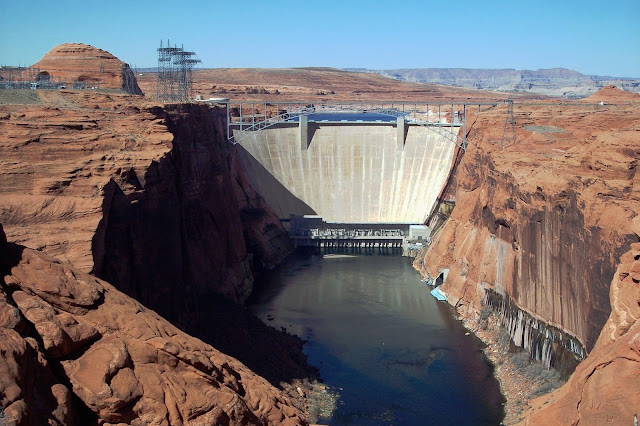
The Glen Canyon dam is a very large dam on the upper Colorado River, on the northern border of Arizona. The Glen Canyon dam impounds the Colorado River in a man made reservoir named Lake Powell.
Below: The vast reservoir of Lake Powell. The Glen Canyon dam is at the bottom left. Click any image to enlarge.

Below, a closer view of the Glen Canyon dam from above.

The Glen Canyon Dam is a gravity arch dam, very similar in design to the more famous Hoover Dam. Although it's 30 years newer, it's still quite similar in appearance. Glen Canyon Dam is upstream of Hoover Dam, and impounds water for states in the Upper Colorado River Basin (Western Colorado, Utah, and New Mexico)
In 1983, Glen Canyon dam was nearly overtopped. The photo below shows a small dam with a tiny reservoir being overtopped. Even this image of a very small dam being overtopped is unnerving. This is the San Clemente dam on the Carmel River in California. The dam has since been removed.

Overtopping is very dangerous, because the overtopping water can erode bedrock adjacent to and/or underneath the dam, leading to tunneling, which of course leads to complete failure...
...and failure brings us back to Glen Canyon Dam, because it nearly did fail in 1983.
I will now quote Wikipedia (while Bolding the most interesting parts)
(Brief aside from the Wikipedia article - below is a profile of the Glen Canyon dam spillway. There was concern that ongoing cavitation would erode the plugs in the diversion tunnels at the bottom left. At that point the lake would uncontrollably drain Lake Powell from underneath the dam, destroying the dam in the process)

Back to the Wikipedia article:
Below is an image of the cavitation damage inside the left spillway after the 1983 event.

Point of interest: The reason that the small San Clemente dam shown earlier in this post was over-topped was due to silt build-up in the reservoir. This caused a massive loss of reservoir capacity, from the initial 1425 acre feet capacity to just 70 acre feet, in its 87 year life-span. Due to the very high silt levels in the Colorado River, about 100 million US tons of silt settle in the reservoir annually. That's about 30,000 dump trucks per day that settle into the reservoir, so capacity is being lost. More importantly, without dredging, the silt will eventually block the dam's outlets, reducing its ability to store and release water.
Below is a 3 part government video of this event. What these videos never say is how close to failure the dam was, nor how much danger people downstream of Glen Canyon dam were in. It's great video though, because it examines in detail how much damage occurred when the dam's spillways had to deal with a 25 year flood. You would think that a dam should be able to release *a lot* of excess runoff without running the risk complete failure.
I'm beginning to suspect that one of hydro-engineering's dirty secrets is that many dams lack the ability to safely and adequately bypass large quantities of runoff.
On the bright side, nobody lost their life. We will look into a bit of that in future posts. Some dam failures have caused appalling loss of life.
If you live downstream from a dam, keep a raft handy!
Below: The vast reservoir of Lake Powell. The Glen Canyon dam is at the bottom left. Click any image to enlarge.

Below, a closer view of the Glen Canyon dam from above.

The Glen Canyon Dam is a gravity arch dam, very similar in design to the more famous Hoover Dam. Although it's 30 years newer, it's still quite similar in appearance. Glen Canyon Dam is upstream of Hoover Dam, and impounds water for states in the Upper Colorado River Basin (Western Colorado, Utah, and New Mexico)

In 1983, Glen Canyon dam was nearly overtopped. The photo below shows a small dam with a tiny reservoir being overtopped. Even this image of a very small dam being overtopped is unnerving. This is the San Clemente dam on the Carmel River in California. The dam has since been removed.

Overtopping is very dangerous, because the overtopping water can erode bedrock adjacent to and/or underneath the dam, leading to tunneling, which of course leads to complete failure...
...and failure brings us back to Glen Canyon Dam, because it nearly did fail in 1983.
I will now quote Wikipedia (while Bolding the most interesting parts)
During the El Niño winter of 1982–1983, the Bureau of Reclamation predicted an average runoff for the Colorado River basin based on snowpack measurements in the Rocky Mountains. However, snowfall during April and May was exceptionally heavy; this combined with a sudden rise in temperatures and unusual rainstorms in June to produce major flooding across the western United States.[83]
With Lake Powell nearly full, the USBR did not have enough time to draw down the reservoir to accommodate extra runoff. By mid-June, water was pouring into Lake Powell at over 120,000 cubic feet per second (3,400 m3/s). Even with the power plant and river outlet works running at full capacity, Lake Powell continued to rise to the point where the spillways had to be opened. Other than a brief test in 1980, this was the only time the spillways had ever been used.[84]At the beginning of June, dam operators opened the gates on the left spillway, sending 10,000 cubic feet per second (280 m3/s), less than one-tenth of capacity, down the tunnel into the river below. After a few days, the entire dam suddenly began to shake violently. The rumblings were so notable that a worker in the employee dining room, located near the power plant, was reported to say that it "sounded like the barrages that he had experienced in Vietnam". [16][17]
The spillway was closed down for inspections and workers discovered that the flow of water was causing cavitation – the explosive collapse of vacuum pockets in water moving at high speed – which was damaging the concrete lining and eroding the rock spillway tunnels from the upper ends of the diversion tunnels, which connect to the bottom of the reservoir.[85] This was rapidly being destroyed by the cavitation and it was feared that a connection would be made to the bottom of Lake Powell, compromising the dam's foundation and causing the dam to burst.[85]
(Brief aside from the Wikipedia article - below is a profile of the Glen Canyon dam spillway. There was concern that ongoing cavitation would erode the plugs in the diversion tunnels at the bottom left. At that point the lake would uncontrollably drain Lake Powell from underneath the dam, destroying the dam in the process)

Back to the Wikipedia article:
Meanwhile, snow continued melting in the Rockies and Lake Powell continued to rise rapidly. To delay having to use the spillways, the USBR installed plywood flashboards (later replaced by steel) atop the gates to increase the lake level.[86] Even this additional capacity was exhausted; discharges through the left spillway reached 32,000 cubic feet per second (910 m3/s), and the right spillway was opened to 15,000 cubic feet per second (420 m3/s). At Lee's Ferry, the Colorado River peaked at 97,300 cubic feet per second (2,760 m3/s), which was and still is the highest water flow recorded there since the dam was built.[87] On July 14, Lake Powell reached 3,708.34 feet (1,130.30 m) elevation, a level that has not been exceeded since.[88]Just as it seemed inevitable that the dam would fail, inflows fell and the dam was saved. Upon inspection, it was found that cavitation had caused massive gouging damage to both spillways, carrying away thousands of tons of concrete, steel rebar and huge chunks of rock.[89]
After the flood, it was suggested that the flashboards atop the spillway gates should be replaced with stronger boards and kept permanently; this would allow an "insurance" against a 1983-reminiscent flood.[15] An air slot was constructed in each spillway tunnel afterwards to prevent catastrophic cavitation events like those of 1983. Most surprising, however, is that the flood of 1983, although it nearly caused catastrophic disaster, it was a "relatively small flood".[19] It was, in fact, only a 25-year flood, or a flood that has a four percent chance of occurring in any given year.[11][17]

Point of interest: The reason that the small San Clemente dam shown earlier in this post was over-topped was due to silt build-up in the reservoir. This caused a massive loss of reservoir capacity, from the initial 1425 acre feet capacity to just 70 acre feet, in its 87 year life-span. Due to the very high silt levels in the Colorado River, about 100 million US tons of silt settle in the reservoir annually. That's about 30,000 dump trucks per day that settle into the reservoir, so capacity is being lost. More importantly, without dredging, the silt will eventually block the dam's outlets, reducing its ability to store and release water.
Below is a 3 part government video of this event. What these videos never say is how close to failure the dam was, nor how much danger people downstream of Glen Canyon dam were in. It's great video though, because it examines in detail how much damage occurred when the dam's spillways had to deal with a 25 year flood. You would think that a dam should be able to release *a lot* of excess runoff without running the risk complete failure.
I'm beginning to suspect that one of hydro-engineering's dirty secrets is that many dams lack the ability to safely and adequately bypass large quantities of runoff.
On the bright side, nobody lost their life. We will look into a bit of that in future posts. Some dam failures have caused appalling loss of life.
Part 1
Part 2
Part 3
If you live downstream from a dam, keep a raft handy!
Tuesday, December 06, 2016
Nuclear War
During the recent presidential election, there was a great deal of Cold War-era rhetoric, and it un-nerved me a bit. I wasn't worried about myself - I've had a reasonably long and healthy life. I was un-nerved for our daughter.
I was hopeful that the belligerent words would calm down, and for the moment, they have. But I suppose those that set them in motion might do so again. Even so, there are often world events that are of concern.
Here's the thing: The nuclear genie is out of the bottle. I never dreamed a civilian nuclear reactor would melt down after the wake-up call of Three Mile Island. Nevertheless we've now had Chernobyl and three of the Fukushima reactors contaminate large areas. In fact, there is ongoing groundwater contamination at the Fukushima nuclear site... That's plenty of contamination, even without intentionally detonating nuclear weapons.
I was hopeful that the belligerent words would calm down, and for the moment, they have. But I suppose those that set them in motion might do so again. Even so, there are often world events that are of concern.
Here's the thing: The nuclear genie is out of the bottle. I never dreamed a civilian nuclear reactor would melt down after the wake-up call of Three Mile Island. Nevertheless we've now had Chernobyl and three of the Fukushima reactors contaminate large areas. In fact, there is ongoing groundwater contamination at the Fukushima nuclear site... That's plenty of contamination, even without intentionally detonating nuclear weapons.
Thursday, November 24, 2016
Happy Thanksgiving
I realize that many, if not most visitors to this blog are from outside the US. I'm pretty happy about that, because it means that the topics I post about appeal to a wide range of people. Welcome here, everyone :)
Today is a uniquely US holiday, Thanksgiving. I don't pay particular homage to this holiday, nor to its traditions. I frequently have to work on Thanksgiving, and worked this one as well. Our family will pretend that tomorrow is Thanksgiving instead.
Below is the famous Norman Rockwell painting of a family having a traditional Thanksgiving dinner. The name of the painting is "Freedom From Want", and sadly that's not how a lot of families in the world today live. This is also NOT how our family serves a Thanksgiving dinner.

There are only three in our family, so the traditions that we follow are watching the Macy's Parade and eating a pretty big afternoon meal. I am crazy about the stuffing, and it's the only chance I get to have any. Sometimes we watch (US) football. More often we retreat alone to carry on with our individual interests. There is nothing wrong with that either, although it's not quite as much family bonding as what you interpret from the picture :)
Today is a uniquely US holiday, Thanksgiving. I don't pay particular homage to this holiday, nor to its traditions. I frequently have to work on Thanksgiving, and worked this one as well. Our family will pretend that tomorrow is Thanksgiving instead.
Below is the famous Norman Rockwell painting of a family having a traditional Thanksgiving dinner. The name of the painting is "Freedom From Want", and sadly that's not how a lot of families in the world today live. This is also NOT how our family serves a Thanksgiving dinner.

There are only three in our family, so the traditions that we follow are watching the Macy's Parade and eating a pretty big afternoon meal. I am crazy about the stuffing, and it's the only chance I get to have any. Sometimes we watch (US) football. More often we retreat alone to carry on with our individual interests. There is nothing wrong with that either, although it's not quite as much family bonding as what you interpret from the picture :)
Tuesday, November 08, 2016
Still here!
This is not a dead blog! Just busy with mundane stuff and having a bit of writer's block :) Hang tight!
Subscribe to:
Posts (Atom)